

450 Higher Engineering Mathematics
When x = 0, y = 1 thus
1
2 ln 1 = ln 1 +c, from which,
c = 0.
Hence the particular solution is
1
2 ln(1 + x 2 ) = ln y
i.e. ln(1 + x 2 )
1
2 = ln y, from which, (1 + x 2 )
1
2 = y
Hence the equation of the curve is y =
(1 +x 2 ).
Problem 12. The current i in an electric circuit
containing resistance R and inductance L in series
with a constant voltage source E is given by the
differential equation E − L
di
dt
= Ri. Solve the
equation and find i in terms of time t given that
when t = 0, i = 0.
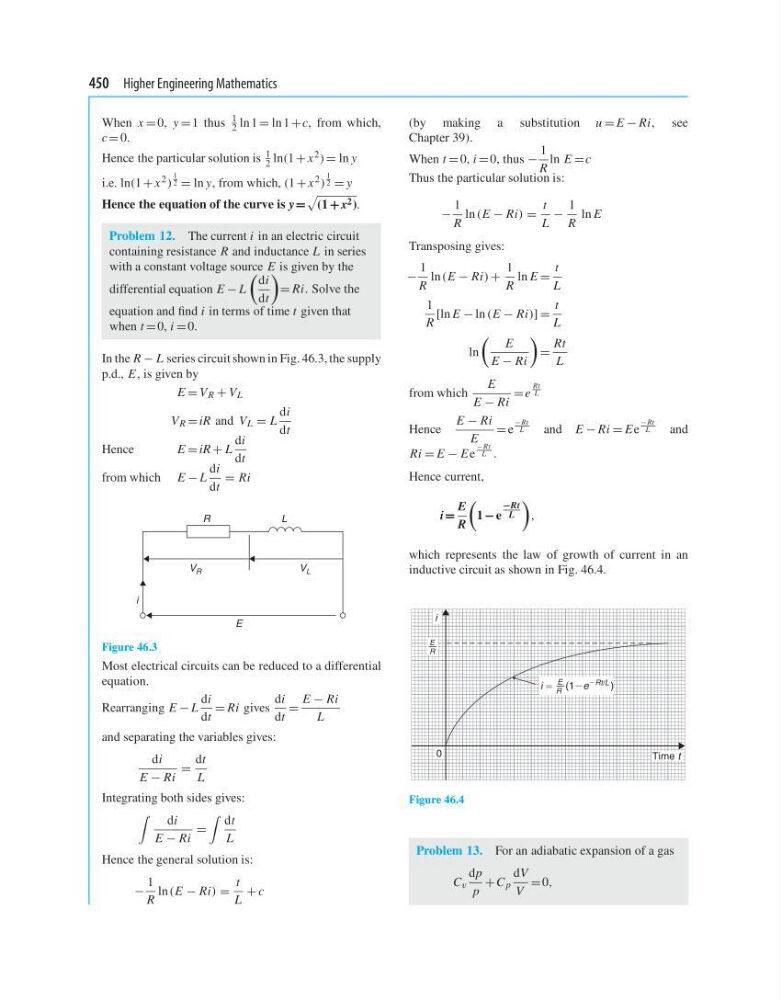
In the R − L series circuit shown in Fig. 46.3, the supply
p.d., E, is given by
E = V R + V L
V R = iR and V L = L
di
dt
Hence
E = iR + L
di
dt
from which E − L
di
dt
= Ri
V R
V L
R
E
i
L
Figure 46.3
Most electrical circuits can be reduced to a differential
equation.
Rearranging E − L
di
dt
= Ri gives
di
dt
=
E − Ri
L
and separating the variables gives:
di
E − Ri
=
dt
L
Integrating both sides gives:
di
E − Ri
=
dt
L
Hence the general solution is:
−
1
R
ln (E − Ri) =
t
L
+ c
(by making a substitution u = E − Ri, see
Chapter 39).
When t = 0, i = 0, thus −
1
R
ln E =c
Thus the particular solution is:
−
1
R
ln (E − Ri) =
t
L
−
1
R
ln E
Transposing gives:
−
1
R
ln (E − Ri) +
1
R
ln E =
t
L
1
R
[ln E − ln (E − Ri)] =
t
L
ln
E
E − Ri
=
Rt
L
from which
E
E − Ri
= e
Rt
L
Hence
E − Ri
E
= e
−Rt
L
and E − Ri = Ee
−Rt
L
and
Ri = E − Ee
−Rt
L .
Hence current,
i =
E
R
1 − e
−Rt
L
,
which represents the law of growth of current in an
inductive circuit as shown in Fig. 46.4.
i
i
(1Ϫe ϪRt/L )
Time t
0
E
R
E
R
ϭ
Figure 46.4
Problem 13. For an adiabatic expansion of a gas
C v
dp
p
+ C p
dV
V
= 0,
When x = 0, y = 1 thus
1
2 ln 1 = ln 1 +c, from which,
c = 0.
Hence the particular solution is
1
2 ln(1 + x 2 ) = ln y
i.e. ln(1 + x 2 )
1
2 = ln y, from which, (1 + x 2 )
1
2 = y
Hence the equation of the curve is y =
(1 +x 2 ).
Problem 12. The current i in an electric circuit
containing resistance R and inductance L in series
with a constant voltage source E is given by the
differential equation E − L
di
dt
= Ri. Solve the
equation and find i in terms of time t given that
when t = 0, i = 0.
In the R − L series circuit shown in Fig. 46.3, the supply
p.d., E, is given by
E = V R + V L
V R = iR and V L = L
di
dt
Hence
E = iR + L
di
dt
from which E − L
di
dt
= Ri
V R
V L
R
E
i
L
Figure 46.3
Most electrical circuits can be reduced to a differential
equation.
Rearranging E − L
di
dt
= Ri gives
di
dt
=
E − Ri
L
and separating the variables gives:
di
E − Ri
=
dt
L
Integrating both sides gives:
di
E − Ri
=
dt
L
Hence the general solution is:
−
1
R
ln (E − Ri) =
t
L
+ c
(by making a substitution u = E − Ri, see
Chapter 39).
When t = 0, i = 0, thus −
1
R
ln E =c
Thus the particular solution is:
−
1
R
ln (E − Ri) =
t
L
−
1
R
ln E
Transposing gives:
−
1
R
ln (E − Ri) +
1
R
ln E =
t
L
1
R
[ln E − ln (E − Ri)] =
t
L
ln
E
E − Ri
=
Rt
L
from which
E
E − Ri
= e
Rt
L
Hence
E − Ri
E
= e
−Rt
L
and E − Ri = Ee
−Rt
L
and
Ri = E − Ee
−Rt
L .
Hence current,
i =
E
R
1 − e
−Rt
L
,
which represents the law of growth of current in an
inductive circuit as shown in Fig. 46.4.
i
i
(1Ϫe ϪRt/L )
Time t
0
E
R
E
R
ϭ
Figure 46.4
Problem 13. For an adiabatic expansion of a gas
C v
dp
p
+ C p
dV
V
= 0,