

438 Higher Engineering Mathematics
Problem 4. Use the mid-ordinate rule with (a) 4
intervals, (b) 8 intervals, to evaluate
3
1
2
√
x
dx,
correct to 3 decimal places.
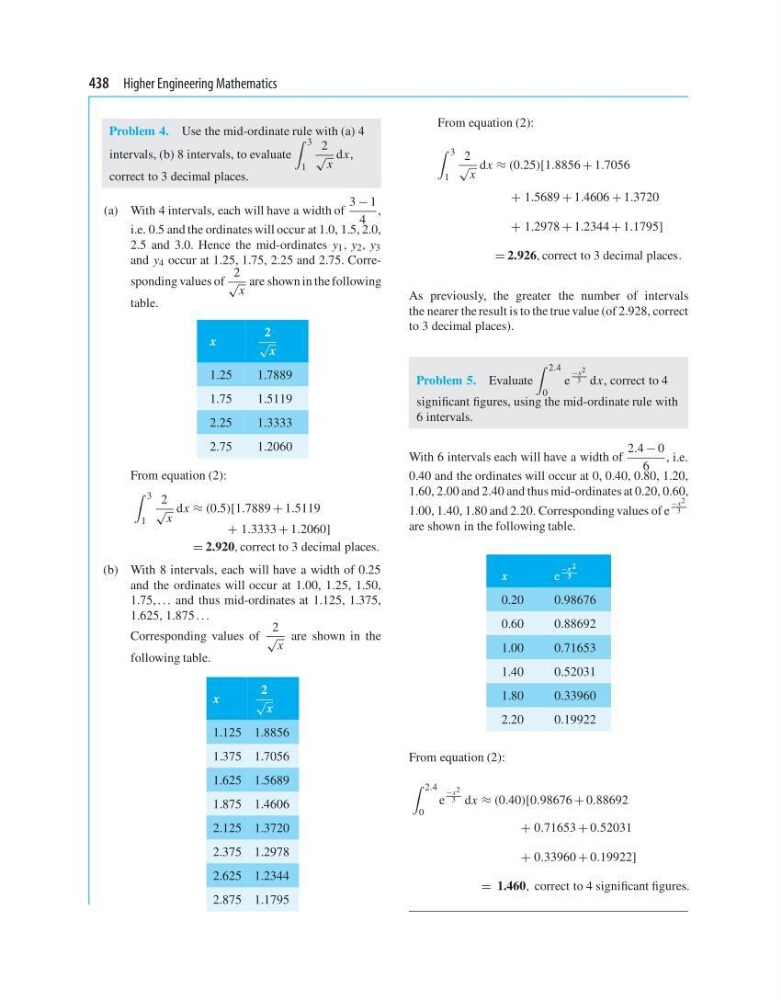
(a) With 4 intervals, each will have a width of
3 − 1
4
,
i.e. 0.5 and the ordinates will occur at 1.0, 1.5, 2.0,
2.5 and 3.0. Hence the mid-ordinates y 1 , y 2 , y 3
and y 4 occur at 1.25, 1.75, 2.25 and 2.75. Corresponding values of
2
√
x
are shown in the following
table.
x
2
√
x
1.25
1.7889
1.75
1.5119
2.25
1.3333
2.75
1.2060
From equation (2):
3
1
2
√
x
dx ≈ (0.5)[1.7889 + 1.5119
+ 1.3333 + 1.2060]
= 2.920, correct to 3 decimal places.
(b) With 8 intervals, each will have a width of 0.25
and the ordinates will occur at 1.00, 1.25, 1.50,
1.75, ... and thus mid-ordinates at 1.125, 1.375,
1.625, 1.875 ...
Corresponding values of
2
√
x
are shown in the
following table.
x
2
√
x
1.125 1.8856
1.375 1.7056
1.625 1.5689
1.875 1.4606
2.125 1.3720
2.375 1.2978
2.625 1.2344
2.875 1.1795
From equation (2):
3
1
2
√
x
dx ≈ (0.25)[1.8856 + 1.7056
+ 1.5689 + 1.4606 + 1.3720
+ 1.2978 + 1.2344 + 1.1795]
= 2.926, correct to 3 decimal places.
As previously, the greater the number of intervals
the nearer the result is to the true value (of 2.928, correct
to 3 decimal places).
Problem 5. Evaluate
2.4
0
e
−x 2
3 dx, correct to 4
significant figures, using the mid-ordinate rule with
6 intervals.
With 6 intervals each will have a width of
2.4 − 0
6
, i.e.
0.40 and the ordinates will occur at 0, 0.40, 0.80, 1.20,
1.60, 2.00 and 2.40 and thus mid-ordinates at 0.20, 0.60,
1.00, 1.40, 1.80 and 2.20. Corresponding values of e
−x 2
3
are shown in the following table.
x
e
−x 2
3
0.20
0.98676
0.60
0.88692
1.00
0.71653
1.40
0.52031
1.80
0.33960
2.20
0.19922
From equation (2):
2.4
0
e
−x 2
3 dx ≈ (0.40)[0.98676 + 0.88692
+ 0.71653 + 0.52031
+ 0.33960 + 0.19922]
= 1.460, correct to 4 significant figures.
Problem 4. Use the mid-ordinate rule with (a) 4
intervals, (b) 8 intervals, to evaluate
3
1
2
√
x
dx,
correct to 3 decimal places.
(a) With 4 intervals, each will have a width of
3 − 1
4
,
i.e. 0.5 and the ordinates will occur at 1.0, 1.5, 2.0,
2.5 and 3.0. Hence the mid-ordinates y 1 , y 2 , y 3
and y 4 occur at 1.25, 1.75, 2.25 and 2.75. Corresponding values of
2
√
x
are shown in the following
table.
x
2
√
x
1.25
1.7889
1.75
1.5119
2.25
1.3333
2.75
1.2060
From equation (2):
3
1
2
√
x
dx ≈ (0.5)[1.7889 + 1.5119
+ 1.3333 + 1.2060]
= 2.920, correct to 3 decimal places.
(b) With 8 intervals, each will have a width of 0.25
and the ordinates will occur at 1.00, 1.25, 1.50,
1.75, ... and thus mid-ordinates at 1.125, 1.375,
1.625, 1.875 ...
Corresponding values of
2
√
x
are shown in the
following table.
x
2
√
x
1.125 1.8856
1.375 1.7056
1.625 1.5689
1.875 1.4606
2.125 1.3720
2.375 1.2978
2.625 1.2344
2.875 1.1795
From equation (2):
3
1
2
√
x
dx ≈ (0.25)[1.8856 + 1.7056
+ 1.5689 + 1.4606 + 1.3720
+ 1.2978 + 1.2344 + 1.1795]
= 2.926, correct to 3 decimal places.
As previously, the greater the number of intervals
the nearer the result is to the true value (of 2.928, correct
to 3 decimal places).
Problem 5. Evaluate
2.4
0
e
−x 2
3 dx, correct to 4
significant figures, using the mid-ordinate rule with
6 intervals.
With 6 intervals each will have a width of
2.4 − 0
6
, i.e.
0.40 and the ordinates will occur at 0, 0.40, 0.80, 1.20,
1.60, 2.00 and 2.40 and thus mid-ordinates at 0.20, 0.60,
1.00, 1.40, 1.80 and 2.20. Corresponding values of e
−x 2
3
are shown in the following table.
x
e
−x 2
3
0.20
0.98676
0.60
0.88692
1.00
0.71653
1.40
0.52031
1.80
0.33960
2.20
0.19922
From equation (2):
2.4
0
e
−x 2
3 dx ≈ (0.40)[0.98676 + 0.88692
+ 0.71653 + 0.52031
+ 0.33960 + 0.19922]
= 1.460, correct to 4 significant figures.