

Reduction formulae 431
= 4[(−0.054178 − 0.1020196
− 0.2881612) − (−0.533333)]
= 4(0.0889745) = 0.356
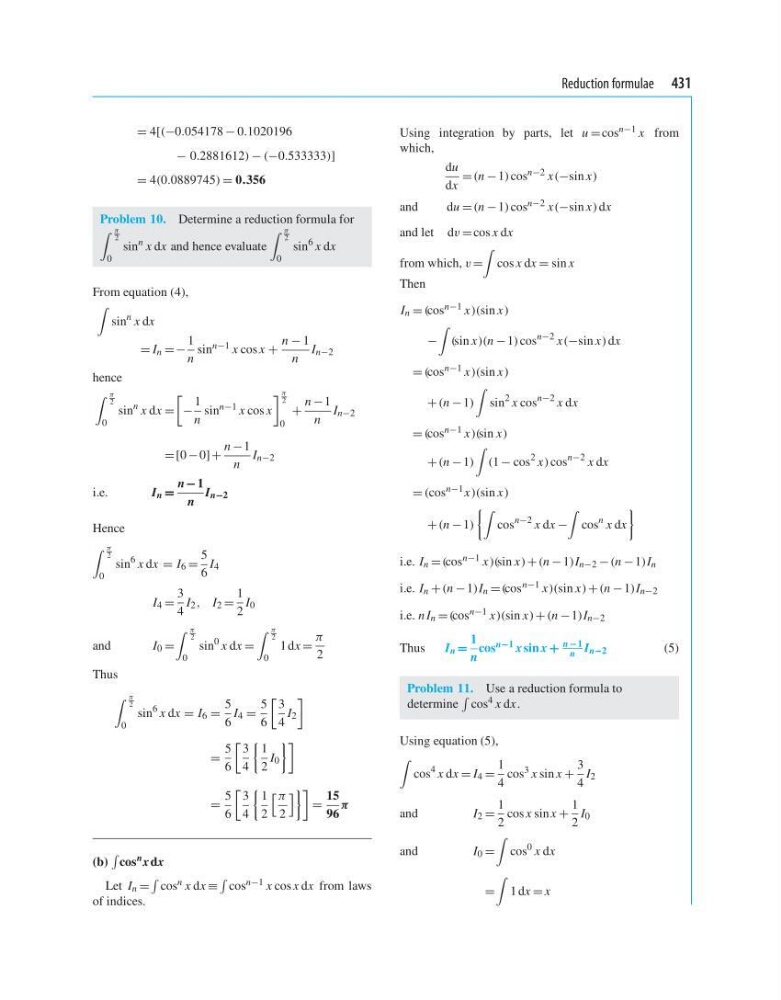
Problem 10. Determine a reduction formula for
π
2
0
sin
n x dx and hence evaluate
π
2
0
sin
6 x dx
From equation (4),
sin
n x dx
= I n =−
1
n
sin n−1 x cos x +
n − 1
n
I n−2
hence
π
2
0
sin
n x dx =
−
1
n
sin n−1 x cos x
π
2
0
+
n −1
n
I n−2
= [0 − 0] +
n −1
n
I n−2
i.e.
I n =
n − 1
n
I n−2
Hence
π
2
0
sin
6 x dx = I 6 =
5
6
I 4
I 4 =
3
4
I 2 , I 2 =
1
2
I 0
and
I 0 =
π
2
0
sin
0 x dx =
π
2
0
1 dx =
π
2
Thus
π
2
0
sin
6 x dx = I 6 =
5
6
I 4 =
5
6
3
4
I 2
=
5
6
3
4
1
2
I 0
=
5
6
3
4
1
2
π
2
=
15
96
π
(b)
cos
n x dx
Let I n =
cos n x dx ≡
cos n−1 x cos x dx from laws
of indices.
Using integration by parts, let u = cos n−1 x from
which,
du
dx
= (n − 1) cos n−2 x(−sin x)
and
du = (n − 1) cos n−2 x(−sin x) dx
and let dv = cos x dx
from which, v =
cos x dx = sin x
Then
I n = (cos n−1 x)(sin x)
−
(sin x)(n − 1) cos
n−2 x(−sin x) dx
= (cos n−1 x)(sin x)
+ (n − 1)
sin
2 x cos
n−2 x dx
= (cos n−1 x)(sin x)
+ (n − 1)
(1 − cos
2 x) cos
n−2 x dx
= (cos n−1 x)(sin x)
+ (n − 1)
cos
n−2 x dx −
cos
n x dx
i.e. I n = (cos n−1 x)(sin x) + (n − 1)I n−2 − (n − 1)I n
i.e. I n + (n − 1)I n = (cos n−1 x)(sin x) + (n − 1)I n−2
i.e. n I n = (cos n−1 x)(sin x) + (n −1)I n−2
Thus
I n =
1
n
cos n−1 x sin x +
n −1
n I n−2
(5)
Problem 11. Use a reduction formula to
determine
cos 4 x dx.
Using equation (5),
cos
4 x dx = I 4 =
1
4
cos 3 x sin x +
3
4
I 2
and
I 2 =
1
2
cos x sin x +
1
2
I 0
and
I 0 =
cos
0 x dx
=
1 dx = x
= 4[(−0.054178 − 0.1020196
− 0.2881612) − (−0.533333)]
= 4(0.0889745) = 0.356
Problem 10. Determine a reduction formula for
π
2
0
sin
n x dx and hence evaluate
π
2
0
sin
6 x dx
From equation (4),
sin
n x dx
= I n =−
1
n
sin n−1 x cos x +
n − 1
n
I n−2
hence
π
2
0
sin
n x dx =
−
1
n
sin n−1 x cos x
π
2
0
+
n −1
n
I n−2
= [0 − 0] +
n −1
n
I n−2
i.e.
I n =
n − 1
n
I n−2
Hence
π
2
0
sin
6 x dx = I 6 =
5
6
I 4
I 4 =
3
4
I 2 , I 2 =
1
2
I 0
and
I 0 =
π
2
0
sin
0 x dx =
π
2
0
1 dx =
π
2
Thus
π
2
0
sin
6 x dx = I 6 =
5
6
I 4 =
5
6
3
4
I 2
=
5
6
3
4
1
2
I 0
=
5
6
3
4
1
2
π
2
=
15
96
π
(b)
cos
n x dx
Let I n =
cos n x dx ≡
cos n−1 x cos x dx from laws
of indices.
Using integration by parts, let u = cos n−1 x from
which,
du
dx
= (n − 1) cos n−2 x(−sin x)
and
du = (n − 1) cos n−2 x(−sin x) dx
and let dv = cos x dx
from which, v =
cos x dx = sin x
Then
I n = (cos n−1 x)(sin x)
−
(sin x)(n − 1) cos
n−2 x(−sin x) dx
= (cos n−1 x)(sin x)
+ (n − 1)
sin
2 x cos
n−2 x dx
= (cos n−1 x)(sin x)
+ (n − 1)
(1 − cos
2 x) cos
n−2 x dx
= (cos n−1 x)(sin x)
+ (n − 1)
cos
n−2 x dx −
cos
n x dx
i.e. I n = (cos n−1 x)(sin x) + (n − 1)I n−2 − (n − 1)I n
i.e. I n + (n − 1)I n = (cos n−1 x)(sin x) + (n − 1)I n−2
i.e. n I n = (cos n−1 x)(sin x) + (n −1)I n−2
Thus
I n =
1
n
cos n−1 x sin x +
n −1
n I n−2
(5)
Problem 11. Use a reduction formula to
determine
cos 4 x dx.
Using equation (5),
cos
4 x dx = I 4 =
1
4
cos 3 x sin x +
3
4
I 2
and
I 2 =
1
2
cos x sin x +
1
2
I 0
and
I 0 =
cos
0 x dx
=
1 dx = x