

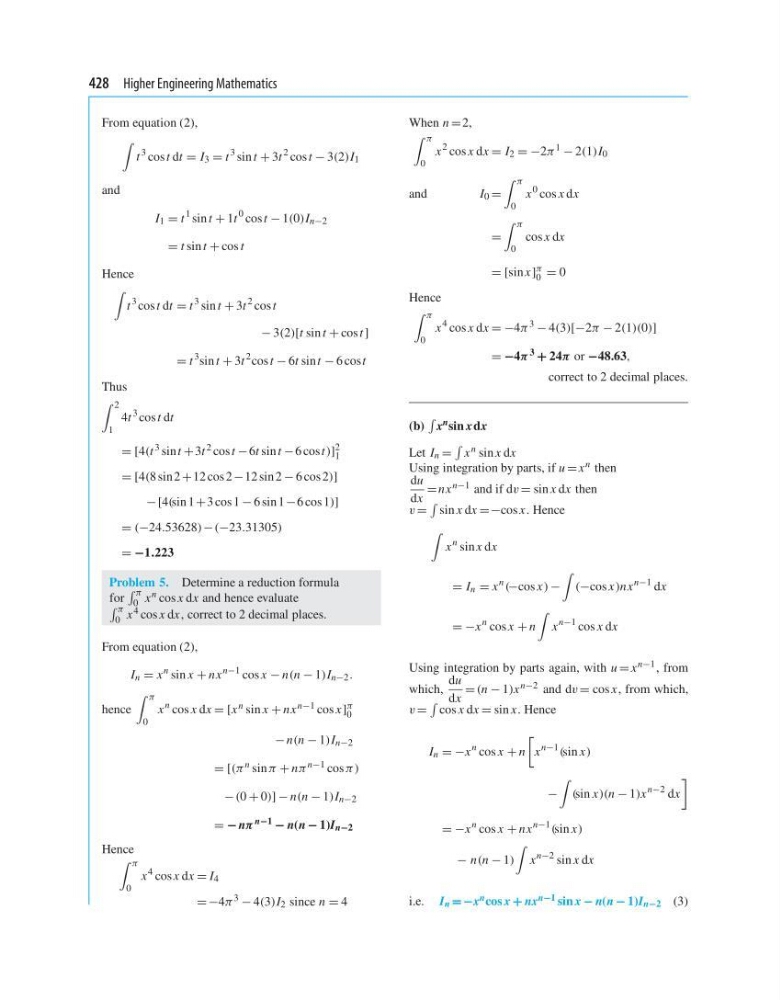
428 Higher Engineering Mathematics
From equation (2),
t
3 cos t dt = I 3 = t
3 sin t + 3t
2 cos t − 3(2)I 1
and
I 1 = t
1 sin t + 1t
0 cos t − 1(0)I n−2
= t sin t + cos t
Hence
t
3 cos t dt = t
3 sin t + 3t
2 cos t
− 3(2)[t sin t + cos t ]
= t
3 sin t + 3t
2 cos t − 6t sin t − 6 cost
Thus
2
1
4t
3 cos t dt
= [4(t 3 sin t + 3t 2 cos t − 6t sin t − 6 cost )]
2
1
= [4(8 sin2 +12 cos 2 −12 sin 2 − 6 cos 2)]
− [4(sin 1 +3 cos 1 − 6 sin1 −6 cos 1)]
= (−24.53628) −(−23.31305)
= −1.223
Problem 5. Determine a reduction formula
for
π
0 x n cos x dx and hence evaluate
π
0 x 4 cos x dx, correct to 2 decimal places.
From equation (2),
I n = x
n sin x + nx
n−1 cos x − n(n − 1)I n−2 .
hence
π
0
x
n cos x dx = [x n sin x + nx n−1 cos x] π
0
− n(n − 1)I n−2
= [(π n sin π + nπ n−1 cos π)
− (0 + 0)] − n(n − 1)I n−2
= − nπ n−1 − n(n − 1)I n−2
Hence
π
0
x
4 cos x dx = I 4
= −4π 3 − 4(3)I 2 since n = 4
When n =2,
π
0
x
2 cos x dx = I 2 = −2π 1 − 2(1)I 0
and
I 0 =
π
0
x
0 cos x dx
=
π
0
cos x dx
= [sin x] π
0 = 0
Hence
π
0
x
4 cos x dx = −4π 3 − 4(3)[−2π − 2(1)(0)]
= −4π 3 + 24π or −48.63,
correct to 2 decimal places.
(b)
x n sin x dx
Let I n =
x n sin x dx
Using integration by parts, if u = x n then
du
dx
= nx n−1 and if dv = sin x dx then
v =
sin x dx =−cos x. Hence
x
n sin x dx
= I n = x
n
(−cos x) −
(−cos x)nx
n−1 dx
= −x
n cos x + n
x
n−1 cos x dx
Using integration by parts again, with u = x n−1 , from
which,
du
dx
= (n − 1)x n−2 and dv = cos x, from which,
v =
cos x dx = sin x. Hence
I n = −x
n cos x + n
x
n−1
(sin x)
−
(sin x)(n − 1)x
n−2 dx
= −x
n cos x + nx
n−1
(sin x)
− n(n − 1)
x
n−2 sin x dx
i.e. I n =−x n cos x + nx n−1 sin x − n(n − 1)I n−2 (3)
From equation (2),
t
3 cos t dt = I 3 = t
3 sin t + 3t
2 cos t − 3(2)I 1
and
I 1 = t
1 sin t + 1t
0 cos t − 1(0)I n−2
= t sin t + cos t
Hence
t
3 cos t dt = t
3 sin t + 3t
2 cos t
− 3(2)[t sin t + cos t ]
= t
3 sin t + 3t
2 cos t − 6t sin t − 6 cost
Thus
2
1
4t
3 cos t dt
= [4(t 3 sin t + 3t 2 cos t − 6t sin t − 6 cost )]
2
1
= [4(8 sin2 +12 cos 2 −12 sin 2 − 6 cos 2)]
− [4(sin 1 +3 cos 1 − 6 sin1 −6 cos 1)]
= (−24.53628) −(−23.31305)
= −1.223
Problem 5. Determine a reduction formula
for
π
0 x n cos x dx and hence evaluate
π
0 x 4 cos x dx, correct to 2 decimal places.
From equation (2),
I n = x
n sin x + nx
n−1 cos x − n(n − 1)I n−2 .
hence
π
0
x
n cos x dx = [x n sin x + nx n−1 cos x] π
0
− n(n − 1)I n−2
= [(π n sin π + nπ n−1 cos π)
− (0 + 0)] − n(n − 1)I n−2
= − nπ n−1 − n(n − 1)I n−2
Hence
π
0
x
4 cos x dx = I 4
= −4π 3 − 4(3)I 2 since n = 4
When n =2,
π
0
x
2 cos x dx = I 2 = −2π 1 − 2(1)I 0
and
I 0 =
π
0
x
0 cos x dx
=
π
0
cos x dx
= [sin x] π
0 = 0
Hence
π
0
x
4 cos x dx = −4π 3 − 4(3)[−2π − 2(1)(0)]
= −4π 3 + 24π or −48.63,
correct to 2 decimal places.
(b)
x n sin x dx
Let I n =
x n sin x dx
Using integration by parts, if u = x n then
du
dx
= nx n−1 and if dv = sin x dx then
v =
sin x dx =−cos x. Hence
x
n sin x dx
= I n = x
n
(−cos x) −
(−cos x)nx
n−1 dx
= −x
n cos x + n
x
n−1 cos x dx
Using integration by parts again, with u = x n−1 , from
which,
du
dx
= (n − 1)x n−2 and dv = cos x, from which,
v =
cos x dx = sin x. Hence
I n = −x
n cos x + n
x
n−1
(sin x)
−
(sin x)(n − 1)x
n−2 dx
= −x
n cos x + nx
n−1
(sin x)
− n(n − 1)
x
n−2 sin x dx
i.e. I n =−x n cos x + nx n−1 sin x − n(n − 1)I n−2 (3)