

Integration by parts 423
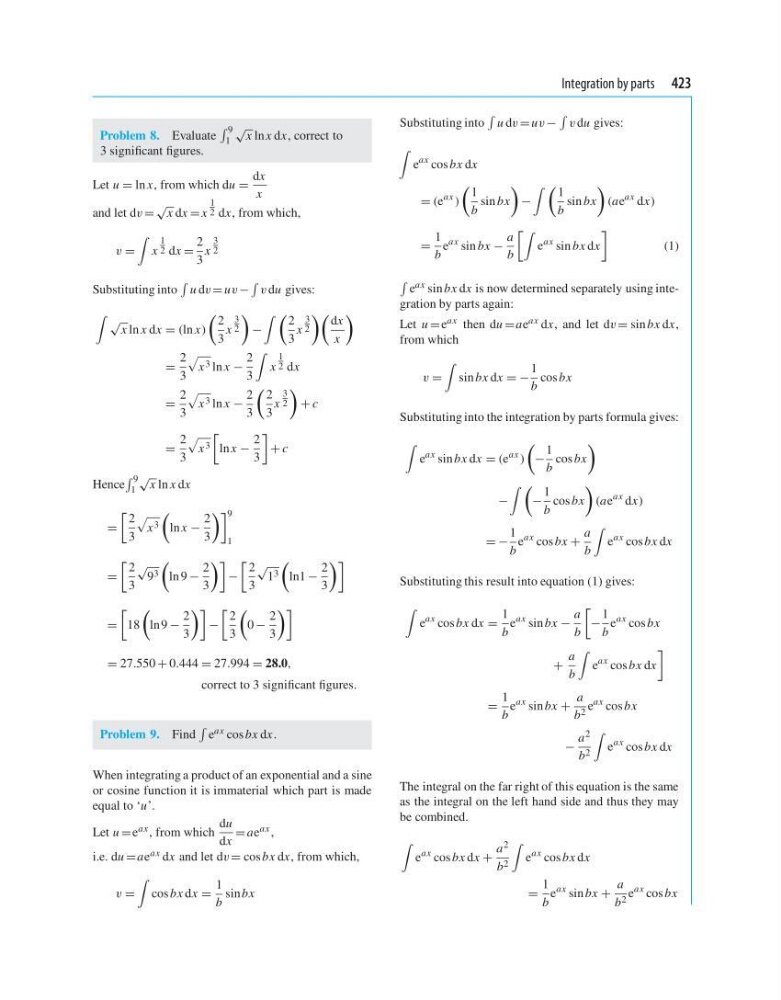
Problem 8. Evaluate
9
1
√
x ln x dx, correct to
3 significant figures.
Let u = ln x, from which du =
dx
x
and let dv =
√
x dx = x
1
2 dx, from which,
v =
x
1
2 dx =
2
3
x
3
2
Substituting into
u dv = uv −
v du gives:
√
x ln x dx = (ln x)
2
3
x
3
2
−
2
3
x
3
2
dx
x
=
2
3
x 3 ln x −
2
3
x
1
2 dx
=
2
3
x 3 ln x −
2
3
2
3
x
3
2
+ c
=
2
3
x 3
ln x −
2
3
+ c
Hence
9
1
√
x ln x dx
=
2
3
x 3
ln x −
2
3
9
1
=
2
3
√
9 3
ln 9 −
2
3
−
2
3
√
1 3
ln1 −
2
3
=
18
ln 9 −
2
3
−
2
3
0 −
2
3
= 27.550 + 0.444 = 27.994 = 28.0,
correct to 3 significant figures.
Problem 9. Find
e ax cos bx dx.
When integrating a product of an exponential and a sine
or cosine function it is immaterial which part is made
equal to ‘u’.
Let u =e ax , from which
du
dx
= ae ax ,
i.e. du =ae ax dx and let dv = cos bx dx, from which,
v =
cos bx dx =
1
b
sin bx
Substituting into
u dv = uv −
v du gives:
e
ax cos bx dx
= (e
ax
)
1
b
sin bx
−
1
b
sin bx
(ae
ax dx)
=
1
b
e
ax sin bx −
a
b
e
ax sin bx dx
(1)
e ax sin bx dx is now determined separately using integration by parts again:
Let u = e ax then du =ae ax dx, and let dv = sin bx dx,
from which
v =
sin bx dx = −
1
b
cos bx
Substituting into the integration by parts formula gives:
e
ax sin bx dx = (e
ax
)
−
1
b
cos bx
−
−
1
b
cos bx
(ae
ax dx)
= −
1
b
e
ax cos bx +
a
b
e
ax cos bx dx
Substituting this result into equation (1) gives:
e
ax cos bx dx =
1
b
e
ax sin bx −
a
b
−
1
b
e
ax cos bx
+
a
b
e
ax cos bx dx
=
1
b
e
ax sin bx +
a
b 2 e
ax cos bx
−
a 2
b 2
e
ax cos bx dx
The integral on the far right of this equation is the same
as the integral on the left hand side and thus they may
be combined.
e
ax cos bx dx +
a 2
b 2
e
ax cos bx dx
=
1
b
e
ax sin bx +
a
b 2 e
ax cos bx
Problem 8. Evaluate
9
1
√
x ln x dx, correct to
3 significant figures.
Let u = ln x, from which du =
dx
x
and let dv =
√
x dx = x
1
2 dx, from which,
v =
x
1
2 dx =
2
3
x
3
2
Substituting into
u dv = uv −
v du gives:
√
x ln x dx = (ln x)
2
3
x
3
2
−
2
3
x
3
2
dx
x
=
2
3
x 3 ln x −
2
3
x
1
2 dx
=
2
3
x 3 ln x −
2
3
2
3
x
3
2
+ c
=
2
3
x 3
ln x −
2
3
+ c
Hence
9
1
√
x ln x dx
=
2
3
x 3
ln x −
2
3
9
1
=
2
3
√
9 3
ln 9 −
2
3
−
2
3
√
1 3
ln1 −
2
3
=
18
ln 9 −
2
3
−
2
3
0 −
2
3
= 27.550 + 0.444 = 27.994 = 28.0,
correct to 3 significant figures.
Problem 9. Find
e ax cos bx dx.
When integrating a product of an exponential and a sine
or cosine function it is immaterial which part is made
equal to ‘u’.
Let u =e ax , from which
du
dx
= ae ax ,
i.e. du =ae ax dx and let dv = cos bx dx, from which,
v =
cos bx dx =
1
b
sin bx
Substituting into
u dv = uv −
v du gives:
e
ax cos bx dx
= (e
ax
)
1
b
sin bx
−
1
b
sin bx
(ae
ax dx)
=
1
b
e
ax sin bx −
a
b
e
ax sin bx dx
(1)
e ax sin bx dx is now determined separately using integration by parts again:
Let u = e ax then du =ae ax dx, and let dv = sin bx dx,
from which
v =
sin bx dx = −
1
b
cos bx
Substituting into the integration by parts formula gives:
e
ax sin bx dx = (e
ax
)
−
1
b
cos bx
−
−
1
b
cos bx
(ae
ax dx)
= −
1
b
e
ax cos bx +
a
b
e
ax cos bx dx
Substituting this result into equation (1) gives:
e
ax cos bx dx =
1
b
e
ax sin bx −
a
b
−
1
b
e
ax cos bx
+
a
b
e
ax cos bx dx
=
1
b
e
ax sin bx +
a
b 2 e
ax cos bx
−
a 2
b 2
e
ax cos bx dx
The integral on the far right of this equation is the same
as the integral on the left hand side and thus they may
be combined.
e
ax cos bx dx +
a 2
b 2
e
ax cos bx dx
=
1
b
e
ax sin bx +
a
b 2 e
ax cos bx