

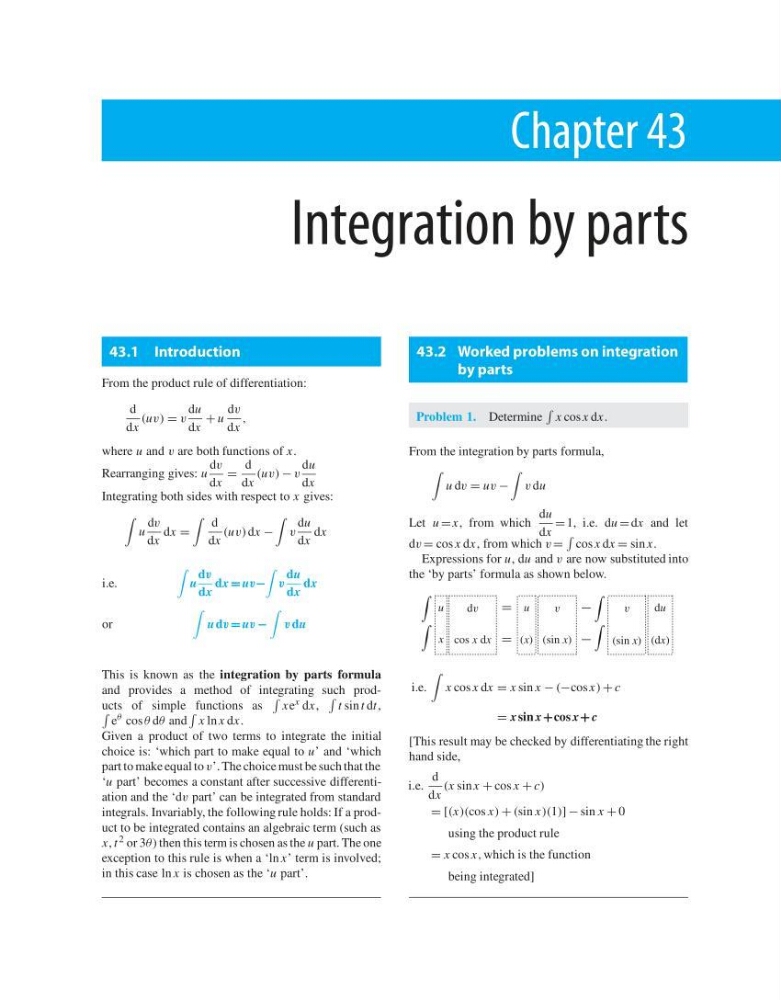
Chapter 43
Integration by parts
43.1 Introduction
From the product rule of differentiation:
d
dx
(uv) = v
du
dx
+ u
dv
dx
,
where u and v are both functions of x.
Rearranging gives: u
dv
dx
=
d
dx
(uv) − v
du
dx
Integrating both sides with respect to x gives:
u
dv
dx
dx =
d
dx
(uv) dx −
v
du
dx
dx
i.e.
u
dv
dx
dx = uv−
v
du
dx
dx
or
u dv = uv −
v du
This is known as the integration by parts formula
and provides a method of integrating such products of simple functions as
xe x dx,
t sin t dt ,
e θ cos θ dθ and
x ln x dx.
Given a product of two terms to integrate the initial
choice is: ‘which part to make equal to u’ and ‘which
part to make equal to v’. The choice must be such that the
‘u part’ becomes a constant after successive differentiation and the ‘dv part’ can be integrated from standard
integrals. Invariably, the following rule holds: If a product to be integrated contains an algebraic term (such as
x, t 2 or 3θ) then this term is chosen as the u part. The one
exception to this rule is when a ‘ln x’ term is involved;
in this case ln x is chosen as the ‘u part’.
43.2 Worked problems on integration
by parts
Problem 1. Determine
x cos x dx.
From the integration by parts formula,
u dv = uv −
v du
Let u = x, from which
du
dx
= 1, i.e. du = dx and let
dv = cos x dx, from which v =
cos x dx = sin x.
Expressions for u, du and v are now substituted into
the ‘by parts’ formula as shown below.
ϭ
ϭ
Ϫ
Ϫ
u
x
u
v
v
(x)
dv
du
cos x dx
(sin x)
(sin x) (dx)
i.e.
x cos x dx = x sin x − (−cos x) + c
= x sin x +cos x + c
[This result may be checked by differentiating the right
hand side,
i.e.
d
dx
(x sin x + cos x + c)
= [(x)(cos x) + (sin x)(1)] − sin x + 0
using the product rule
= x cos x, which is the function
being integrated]
Integration by parts
43.1 Introduction
From the product rule of differentiation:
d
dx
(uv) = v
du
dx
+ u
dv
dx
,
where u and v are both functions of x.
Rearranging gives: u
dv
dx
=
d
dx
(uv) − v
du
dx
Integrating both sides with respect to x gives:
u
dv
dx
dx =
d
dx
(uv) dx −
v
du
dx
dx
i.e.
u
dv
dx
dx = uv−
v
du
dx
dx
or
u dv = uv −
v du
This is known as the integration by parts formula
and provides a method of integrating such products of simple functions as
xe x dx,
t sin t dt ,
e θ cos θ dθ and
x ln x dx.
Given a product of two terms to integrate the initial
choice is: ‘which part to make equal to u’ and ‘which
part to make equal to v’. The choice must be such that the
‘u part’ becomes a constant after successive differentiation and the ‘dv part’ can be integrated from standard
integrals. Invariably, the following rule holds: If a product to be integrated contains an algebraic term (such as
x, t 2 or 3θ) then this term is chosen as the u part. The one
exception to this rule is when a ‘ln x’ term is involved;
in this case ln x is chosen as the ‘u part’.
43.2 Worked problems on integration
by parts
Problem 1. Determine
x cos x dx.
From the integration by parts formula,
u dv = uv −
v du
Let u = x, from which
du
dx
= 1, i.e. du = dx and let
dv = cos x dx, from which v =
cos x dx = sin x.
Expressions for u, du and v are now substituted into
the ‘by parts’ formula as shown below.
ϭ
ϭ
Ϫ
Ϫ
u
x
u
v
v
(x)
dv
du
cos x dx
(sin x)
(sin x) (dx)
i.e.
x cos x dx = x sin x − (−cos x) + c
= x sin x +cos x + c
[This result may be checked by differentiating the right
hand side,
i.e.
d
dx
(x sin x + cos x + c)
= [(x)(cos x) + (sin x)(1)] − sin x + 0
using the product rule
= x cos x, which is the function
being integrated]