

The t = tan
θ
2 substitution 415
42.2 Worked problems on the
t = tan
θ
2
substitution
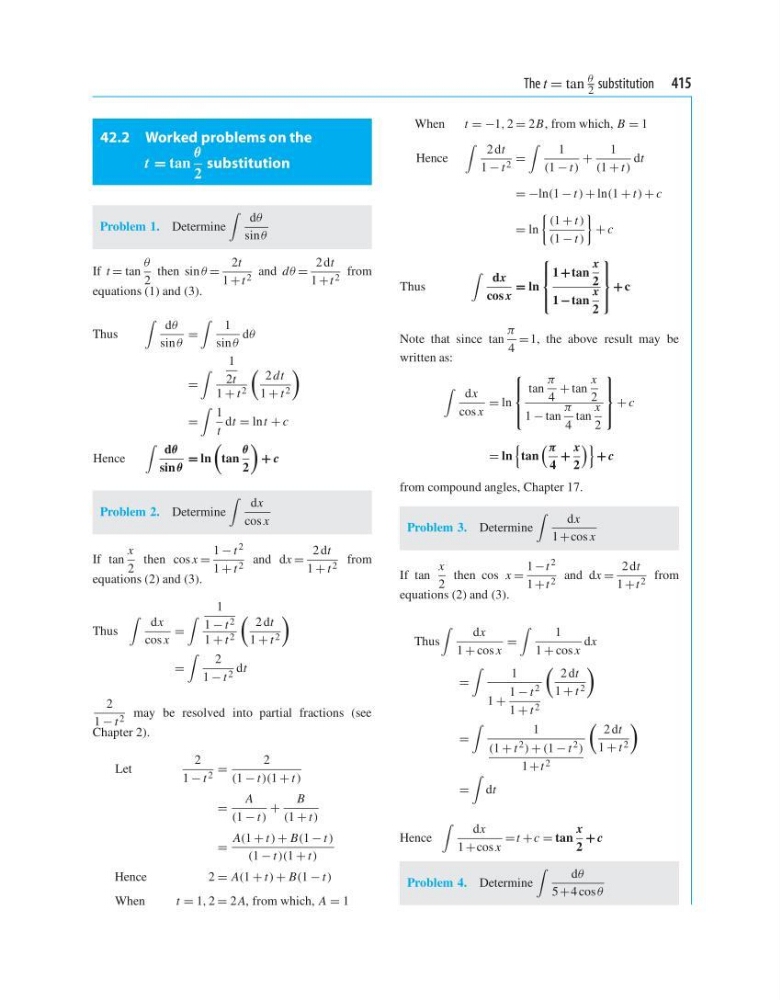
Problem 1. Determine
dθ
sin θ
If t = tan
θ
2
then sin θ =
2t
1 + t 2 and dθ =
2 dt
1 +t 2 from
equations (1) and (3).
Thus
dθ
sin θ
=
1
sin θ
dθ
=
1
2t
1 + t 2
2 dt
1 + t 2
=
1
t
dt = ln t + c
Hence
dθ
sin θ
= ln
tan
θ
2
+ c
Problem 2. Determine
dx
cos x
If tan
x
2
then cos x =
1 − t 2
1 + t 2 and dx =
2 dt
1 + t 2 from
equations (2) and (3).
Thus
dx
cos x
=
1
1 − t 2
1 + t 2
2 dt
1 + t 2
=
2
1 − t 2 dt
2
1 − t 2 may be resolved into partial fractions (see
Chapter 2).
Let
2
1 − t 2 =
2
(1 − t )(1 + t )
=
A
(1 − t )
+
B
(1 + t )
=
A(1 + t ) + B(1 − t )
(1 − t )(1 + t )
Hence
2 = A(1 + t ) + B(1 − t )
When
t = 1, 2 = 2 A, from which, A = 1
When
t = −1, 2 = 2B, from which, B = 1
Hence
2 dt
1 − t 2 =
1
(1 − t )
+
1
(1 + t )
dt
= −ln(1 − t ) + ln(1 + t ) + c
= ln
(1 + t )
(1 − t )
+ c
Thus
dx
cos x
= ln
⎧
⎪ ⎨
⎪ ⎩
1 +tan
x
2
1 −tan
x
2
⎫
⎪ ⎬
⎪ ⎭
+ c
Note that since tan
π
4
= 1, the above result may be
written as:
dx
cos x
= ln
⎧
⎪ ⎨
⎪ ⎩
tan
π
4
+ tan
x
2
1 − tan
π
4
tan
x
2
⎫
⎪ ⎬
⎪ ⎭
+ c
= ln
tan
π
4
+
x
2
+ c
from compound angles, Chapter 17.
Problem 3. Determine
dx
1 +cos x
If tan
x
2
then cos x =
1 −t
2
1 +t 2 and dx =
2 dt
1 +t 2 from
equations (2) and (3).
Thus
dx
1 + cos x
=
1
1 + cos x
dx
=
1
1 +
1 − t 2
1 + t 2
2 dt
1 + t 2
=
1
(1 + t 2 ) + (1 − t 2 )
1 +t 2
2 dt
1 + t 2
=
dt
Hence
dx
1 +cos x
= t + c = tan
x
2
+ c
Problem 4. Determine
dθ
5 +4 cos θ
θ
2 substitution 415
42.2 Worked problems on the
t = tan
θ
2
substitution
Problem 1. Determine
dθ
sin θ
If t = tan
θ
2
then sin θ =
2t
1 + t 2 and dθ =
2 dt
1 +t 2 from
equations (1) and (3).
Thus
dθ
sin θ
=
1
sin θ
dθ
=
1
2t
1 + t 2
2 dt
1 + t 2
=
1
t
dt = ln t + c
Hence
dθ
sin θ
= ln
tan
θ
2
+ c
Problem 2. Determine
dx
cos x
If tan
x
2
then cos x =
1 − t 2
1 + t 2 and dx =
2 dt
1 + t 2 from
equations (2) and (3).
Thus
dx
cos x
=
1
1 − t 2
1 + t 2
2 dt
1 + t 2
=
2
1 − t 2 dt
2
1 − t 2 may be resolved into partial fractions (see
Chapter 2).
Let
2
1 − t 2 =
2
(1 − t )(1 + t )
=
A
(1 − t )
+
B
(1 + t )
=
A(1 + t ) + B(1 − t )
(1 − t )(1 + t )
Hence
2 = A(1 + t ) + B(1 − t )
When
t = 1, 2 = 2 A, from which, A = 1
When
t = −1, 2 = 2B, from which, B = 1
Hence
2 dt
1 − t 2 =
1
(1 − t )
+
1
(1 + t )
dt
= −ln(1 − t ) + ln(1 + t ) + c
= ln
(1 + t )
(1 − t )
+ c
Thus
dx
cos x
= ln
⎧
⎪ ⎨
⎪ ⎩
1 +tan
x
2
1 −tan
x
2
⎫
⎪ ⎬
⎪ ⎭
+ c
Note that since tan
π
4
= 1, the above result may be
written as:
dx
cos x
= ln
⎧
⎪ ⎨
⎪ ⎩
tan
π
4
+ tan
x
2
1 − tan
π
4
tan
x
2
⎫
⎪ ⎬
⎪ ⎭
+ c
= ln
tan
π
4
+
x
2
+ c
from compound angles, Chapter 17.
Problem 3. Determine
dx
1 +cos x
If tan
x
2
then cos x =
1 −t
2
1 +t 2 and dx =
2 dt
1 +t 2 from
equations (2) and (3).
Thus
dx
1 + cos x
=
1
1 + cos x
dx
=
1
1 +
1 − t 2
1 + t 2
2 dt
1 + t 2
=
1
(1 + t 2 ) + (1 − t 2 )
1 +t 2
2 dt
1 + t 2
=
dt
Hence
dx
1 +cos x
= t + c = tan
x
2
+ c
Problem 4. Determine
dθ
5 +4 cos θ