

412 Higher Engineering Mathematics
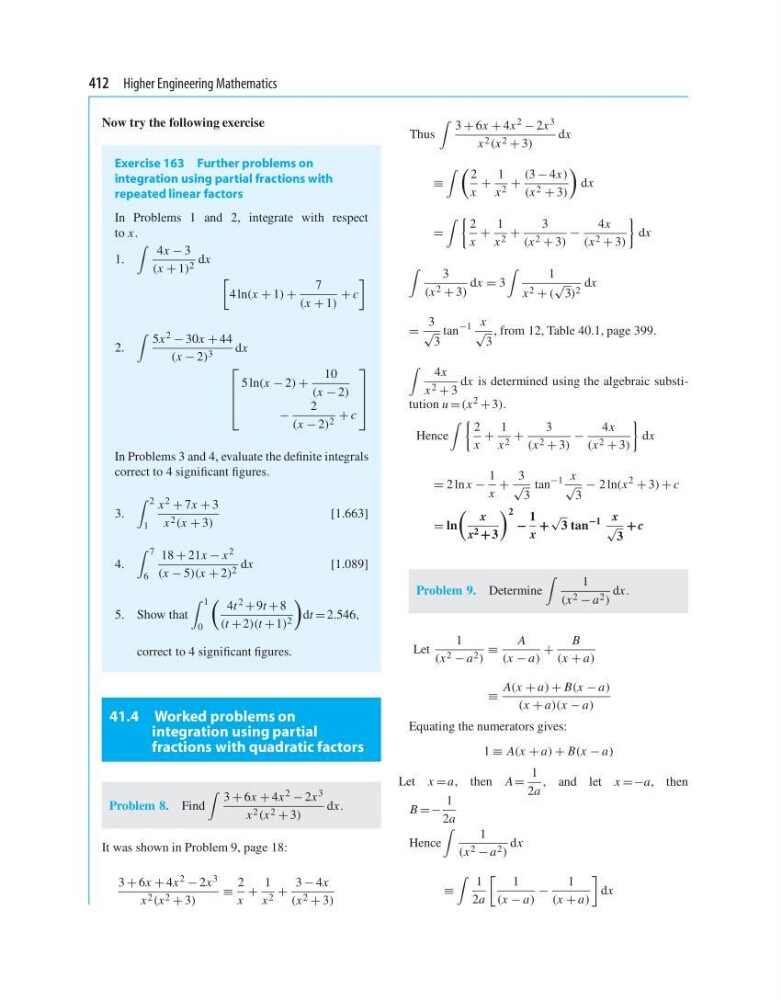
Now try the following exercise
Exercise 163 Further problems on
integration using partial fractions with
repeated linear factors
In Problems 1 and 2, integrate with respect
to x.
1.
4x − 3
(x + 1) 2 dx
4 ln(x + 1) +
7
(x + 1)
+ c
2.
5x 2 − 30x + 44
(x − 2) 3
dx
⎡
⎢
⎢
⎣
5 ln(x − 2) +
10
(x − 2)
−
2
(x − 2) 2 + c
⎤
⎥
⎥
⎦
In Problems 3 and 4, evaluate the definite integrals
correct to 4 significant figures.
3.
2
1
x 2 + 7x + 3
x 2 (x + 3)
[1.663]
4.
7
6
18 + 21x − x 2
(x − 5)(x + 2) 2 dx
[1.089]
5. Show that
1
0
4t 2 + 9t + 8
(t + 2)(t + 1) 2
dt = 2.546,
correct to 4 significant figures.
41.4 Worked problems on
integration using partial
fractions with quadratic factors
Problem 8. Find
3 + 6x + 4x 2 − 2x 3
x 2 (x 2 + 3)
dx.
It was shown in Problem 9, page 18:
3 + 6x + 4x 2 − 2x 3
x 2 (x 2 + 3)
≡
2
x
+
1
x 2 +
3 − 4x
(x 2 + 3)
Thus
3 + 6x + 4x 2 − 2x 3
x 2 (x 2 + 3)
dx
≡
2
x
+
1
x 2 +
(3 − 4x)
(x 2 + 3)
dx
=
2
x
+
1
x 2 +
3
(x 2 + 3)
−
4x
(x 2 + 3)
dx
3
(x 2 + 3)
dx = 3
1
x 2 + (
√
3) 2
dx
=
3
√
3
tan
−1 x
√
3
, from 12, Table 40.1, page 399.
4x
x 2 + 3
dx is determined using the algebraic substitution u =(x 2 + 3).
Hence
2
x
+
1
x 2 +
3
(x 2 + 3)
−
4x
(x 2 + 3)
dx
= 2 ln x −
1
x
+
3
√
3
tan
−1 x
√
3
− 2 ln(x
2
+ 3) + c
= ln
x
x 2 + 3
2
−
1
x
+
√
3 tan
−1 x
√
3
+ c
Problem 9. Determine
1
(x 2 − a 2 )
dx.
Let
1
(x 2 − a 2 )
≡
A
(x − a)
+
B
(x + a)
≡
A(x + a) + B(x − a)
(x + a)(x − a)
Equating the numerators gives:
1 ≡ A(x + a) + B(x − a)
Let x = a, then A =
1
2a
, and let x =−a, then
B =−
1
2a
Hence
1
(x 2 − a 2 )
dx
≡
1
2a
1
(x − a)
−
1
(x + a)
dx
Now try the following exercise
Exercise 163 Further problems on
integration using partial fractions with
repeated linear factors
In Problems 1 and 2, integrate with respect
to x.
1.
4x − 3
(x + 1) 2 dx
4 ln(x + 1) +
7
(x + 1)
+ c
2.
5x 2 − 30x + 44
(x − 2) 3
dx
⎡
⎢
⎢
⎣
5 ln(x − 2) +
10
(x − 2)
−
2
(x − 2) 2 + c
⎤
⎥
⎥
⎦
In Problems 3 and 4, evaluate the definite integrals
correct to 4 significant figures.
3.
2
1
x 2 + 7x + 3
x 2 (x + 3)
[1.663]
4.
7
6
18 + 21x − x 2
(x − 5)(x + 2) 2 dx
[1.089]
5. Show that
1
0
4t 2 + 9t + 8
(t + 2)(t + 1) 2
dt = 2.546,
correct to 4 significant figures.
41.4 Worked problems on
integration using partial
fractions with quadratic factors
Problem 8. Find
3 + 6x + 4x 2 − 2x 3
x 2 (x 2 + 3)
dx.
It was shown in Problem 9, page 18:
3 + 6x + 4x 2 − 2x 3
x 2 (x 2 + 3)
≡
2
x
+
1
x 2 +
3 − 4x
(x 2 + 3)
Thus
3 + 6x + 4x 2 − 2x 3
x 2 (x 2 + 3)
dx
≡
2
x
+
1
x 2 +
(3 − 4x)
(x 2 + 3)
dx
=
2
x
+
1
x 2 +
3
(x 2 + 3)
−
4x
(x 2 + 3)
dx
3
(x 2 + 3)
dx = 3
1
x 2 + (
√
3) 2
dx
=
3
√
3
tan
−1 x
√
3
, from 12, Table 40.1, page 399.
4x
x 2 + 3
dx is determined using the algebraic substitution u =(x 2 + 3).
Hence
2
x
+
1
x 2 +
3
(x 2 + 3)
−
4x
(x 2 + 3)
dx
= 2 ln x −
1
x
+
3
√
3
tan
−1 x
√
3
− 2 ln(x
2
+ 3) + c
= ln
x
x 2 + 3
2
−
1
x
+
√
3 tan
−1 x
√
3
+ c
Problem 9. Determine
1
(x 2 − a 2 )
dx.
Let
1
(x 2 − a 2 )
≡
A
(x − a)
+
B
(x + a)
≡
A(x + a) + B(x − a)
(x + a)(x − a)
Equating the numerators gives:
1 ≡ A(x + a) + B(x − a)
Let x = a, then A =
1
2a
, and let x =−a, then
B =−
1
2a
Hence
1
(x 2 − a 2 )
dx
≡
1
2a
1
(x − a)
−
1
(x + a)
dx