

Integration using trigonometric and hyperbolic substitutions 405
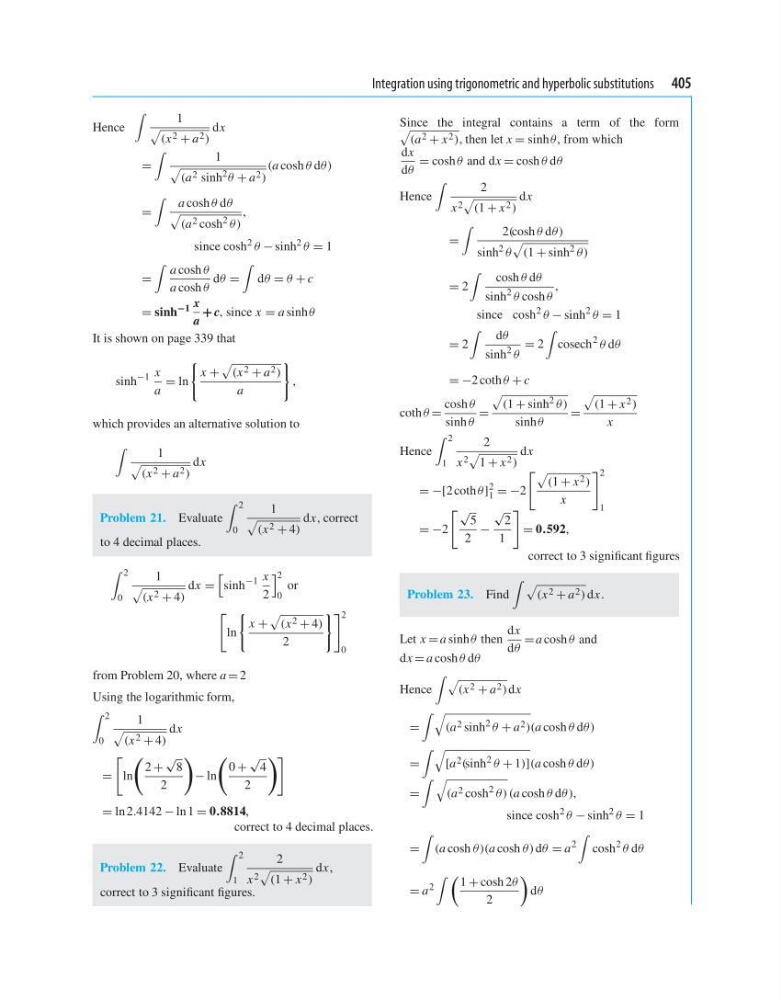
Hence
1
(x 2 + a 2 )
dx
=
1
(a 2 sinh 2 θ + a 2 )
(a cosh θ dθ)
=
a cosh θ dθ
(a 2 cosh 2 θ)
,
since cosh 2 θ − sinh 2 θ = 1
=
a cosh θ
a cosh θ
dθ =
dθ = θ + c
= sinh −1 x
a
+ c, since x = a sinh θ
It is shown on page 339 that
sinh
−1 x
a
= ln
x +
(x 2 + a 2 )
a
,
which provides an alternative solution to
1
(x 2 + a 2 )
dx
Problem 21. Evaluate
2
0
1
(x 2 + 4)
dx, correct
to 4 decimal places.
2
0
1
(x 2 + 4)
dx =
sinh
−1 x
2
2
0
or
ln
x +
(x 2 + 4)
2
2
0
from Problem 20, where a = 2
Using the logarithmic form,
2
0
1
(x 2 + 4)
dx
=
ln
2 +
√
8
2
− ln
0 +
√
4
2
= ln 2.4142 − ln 1 = 0.8814,
correct to 4 decimal places.
Problem 22. Evaluate
2
1
2
x 2
(1 + x 2 )
dx,
correct to 3 significant figures.
Since the integral contains a term of the form
(a 2 + x 2 ), then let x = sinh θ, from which
dx
dθ
= cosh θ and dx = cosh θ dθ
Hence
2
x 2
(1 + x 2 )
dx
=
2(cosh θ dθ)
sinh 2 θ
(1 + sinh 2 θ)
= 2
cosh θ dθ
sinh
2
θ cosh θ
,
since cosh
2
θ − sinh
2
θ = 1
= 2
dθ
sinh
2
θ
= 2
cosech
2
θ dθ
= −2 coth θ + c
coth θ =
cosh θ
sinh θ
=
(1 + sinh 2 θ)
sinh θ
=
(1 + x 2 )
x
Hence
2
1
2
x 2
1 + x 2 )
dx
= −[2 coth θ]
2
1 = −2
(1 + x 2 )
x
2
1
= −2
√
5
2
−
√
2
1
= 0.592,
correct to 3 significant figures
Problem 23. Find
(x 2 + a 2 ) dx.
Let x = a sinh θ then
dx
dθ
= a cosh θ and
dx = a cosh θ dθ
Hence
(x 2 + a 2 ) dx
=
(a 2 sinh 2 θ + a 2 )(a cosh θ dθ)
=
[a 2 (sinh 2 θ + 1)](a cosh θ dθ)
=
(a 2 cosh
2
θ)(a cosh θ dθ),
since cosh
2
θ − sinh
2
θ = 1
=
(a cosh θ)(a cosh θ)dθ = a
2
cosh
2
θ dθ
= a 2
1 + cosh 2θ
2
dθ
Hence
1
(x 2 + a 2 )
dx
=
1
(a 2 sinh 2 θ + a 2 )
(a cosh θ dθ)
=
a cosh θ dθ
(a 2 cosh 2 θ)
,
since cosh 2 θ − sinh 2 θ = 1
=
a cosh θ
a cosh θ
dθ =
dθ = θ + c
= sinh −1 x
a
+ c, since x = a sinh θ
It is shown on page 339 that
sinh
−1 x
a
= ln
x +
(x 2 + a 2 )
a
,
which provides an alternative solution to
1
(x 2 + a 2 )
dx
Problem 21. Evaluate
2
0
1
(x 2 + 4)
dx, correct
to 4 decimal places.
2
0
1
(x 2 + 4)
dx =
sinh
−1 x
2
2
0
or
ln
x +
(x 2 + 4)
2
2
0
from Problem 20, where a = 2
Using the logarithmic form,
2
0
1
(x 2 + 4)
dx
=
ln
2 +
√
8
2
− ln
0 +
√
4
2
= ln 2.4142 − ln 1 = 0.8814,
correct to 4 decimal places.
Problem 22. Evaluate
2
1
2
x 2
(1 + x 2 )
dx,
correct to 3 significant figures.
Since the integral contains a term of the form
(a 2 + x 2 ), then let x = sinh θ, from which
dx
dθ
= cosh θ and dx = cosh θ dθ
Hence
2
x 2
(1 + x 2 )
dx
=
2(cosh θ dθ)
sinh 2 θ
(1 + sinh 2 θ)
= 2
cosh θ dθ
sinh
2
θ cosh θ
,
since cosh
2
θ − sinh
2
θ = 1
= 2
dθ
sinh
2
θ
= 2
cosech
2
θ dθ
= −2 coth θ + c
coth θ =
cosh θ
sinh θ
=
(1 + sinh 2 θ)
sinh θ
=
(1 + x 2 )
x
Hence
2
1
2
x 2
1 + x 2 )
dx
= −[2 coth θ]
2
1 = −2
(1 + x 2 )
x
2
1
= −2
√
5
2
−
√
2
1
= 0.592,
correct to 3 significant figures
Problem 23. Find
(x 2 + a 2 ) dx.
Let x = a sinh θ then
dx
dθ
= a cosh θ and
dx = a cosh θ dθ
Hence
(x 2 + a 2 ) dx
=
(a 2 sinh 2 θ + a 2 )(a cosh θ dθ)
=
[a 2 (sinh 2 θ + 1)](a cosh θ dθ)
=
(a 2 cosh
2
θ)(a cosh θ dθ),
since cosh
2
θ − sinh
2
θ = 1
=
(a cosh θ)(a cosh θ)dθ = a
2
cosh
2
θ dθ
= a 2
1 + cosh 2θ
2
dθ