

382 Higher Engineering Mathematics
y
0
6
12
18
1
2
3
x
y 5 2x 2
x
y
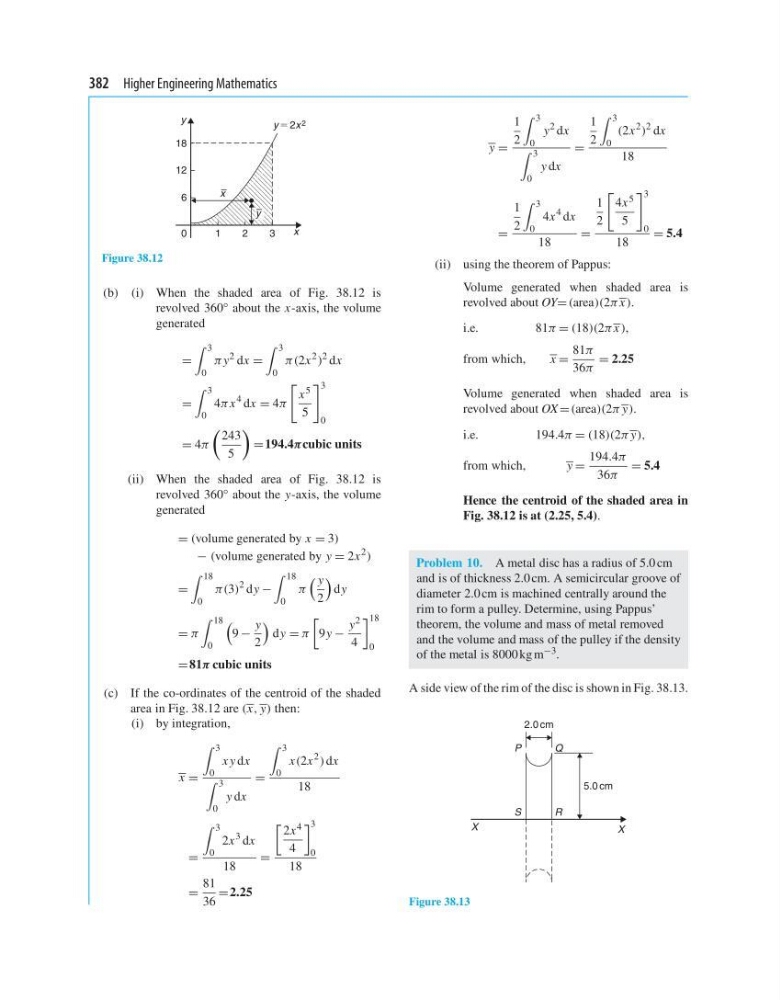
Figure 38.12
(b) (i) When the shaded area of Fig. 38.12 is
revolved 360 ◦ about the x-axis, the volume
generated
=
3
0
π y
2 dx =
3
0
π(2x
2
)
2 dx
=
3
0
4π x
4 dx = 4π
x
5
5
3
0
= 4π
243
5
= 194.4πcubic units
(ii) When the shaded area of Fig. 38.12 is
revolved 360 ◦ about the y-axis, the volume
generated
= (volume generated by x = 3)
− (volume generated by y = 2x
2
)
=
18
0
π(3)
2 dy −
18
0
π
y
2
dy
= π
18
0
9 −
y
2
dy = π
9y −
y
2
4
18
0
= 81π cubic units
(c) If the co-ordinates of the centroid of the shaded
area in Fig. 38.12 are (x, y) then:
(i) by integration,
x =
3
0
x y dx
3
0
y dx
=
3
0
x(2x
2
) dx
18
=
3
0
2x
3 dx
18
=
2x 4
4
3
0
18
=
81
36
= 2.25
y =
1
2
3
0
y
2 dx
3
0
y dx
=
1
2
3
0
(2x
2
)
2 dx
18
=
1
2
3
0
4x
4 dx
18
=
1
2
4x 5
5
3
0
18
= 5.4
(ii) using the theorem of Pappus:
Volume generated when shaded area is
revolved about OY= (area)(2π x ).
i.e.
81π = (18)(2π x ),
from which,
x =
81π
36π
= 2.25
Volume generated when shaded area is
revolved about OX = (area)(2π y).
i.e.
194.4π = (18)(2π y),
from which,
y =
194.4π
36π
= 5.4
Hence the centroid of the shaded area in
Fig. 38.12 is at (2.25, 5.4).
Problem 10. A metal disc has a radius of 5.0 cm
and is of thickness 2.0 cm. A semicircular groove of
diameter 2.0 cm is machined centrally around the
rim to form a pulley. Determine, using Pappus’
theorem, the volume and mass of metal removed
and the volume and mass of the pulley if the density
of the metal is 8000 kg m −3 .
A side view of the rim of the disc is shown in Fig. 38.13.
5.0 cm
2.0 cm
X
X
S
R
Q
P
Figure 38.13
y
0
6
12
18
1
2
3
x
y 5 2x 2
x
y
Figure 38.12
(b) (i) When the shaded area of Fig. 38.12 is
revolved 360 ◦ about the x-axis, the volume
generated
=
3
0
π y
2 dx =
3
0
π(2x
2
)
2 dx
=
3
0
4π x
4 dx = 4π
x
5
5
3
0
= 4π
243
5
= 194.4πcubic units
(ii) When the shaded area of Fig. 38.12 is
revolved 360 ◦ about the y-axis, the volume
generated
= (volume generated by x = 3)
− (volume generated by y = 2x
2
)
=
18
0
π(3)
2 dy −
18
0
π
y
2
dy
= π
18
0
9 −
y
2
dy = π
9y −
y
2
4
18
0
= 81π cubic units
(c) If the co-ordinates of the centroid of the shaded
area in Fig. 38.12 are (x, y) then:
(i) by integration,
x =
3
0
x y dx
3
0
y dx
=
3
0
x(2x
2
) dx
18
=
3
0
2x
3 dx
18
=
2x 4
4
3
0
18
=
81
36
= 2.25
y =
1
2
3
0
y
2 dx
3
0
y dx
=
1
2
3
0
(2x
2
)
2 dx
18
=
1
2
3
0
4x
4 dx
18
=
1
2
4x 5
5
3
0
18
= 5.4
(ii) using the theorem of Pappus:
Volume generated when shaded area is
revolved about OY= (area)(2π x ).
i.e.
81π = (18)(2π x ),
from which,
x =
81π
36π
= 2.25
Volume generated when shaded area is
revolved about OX = (area)(2π y).
i.e.
194.4π = (18)(2π y),
from which,
y =
194.4π
36π
= 5.4
Hence the centroid of the shaded area in
Fig. 38.12 is at (2.25, 5.4).
Problem 10. A metal disc has a radius of 5.0 cm
and is of thickness 2.0 cm. A semicircular groove of
diameter 2.0 cm is machined centrally around the
rim to form a pulley. Determine, using Pappus’
theorem, the volume and mass of metal removed
and the volume and mass of the pulley if the density
of the metal is 8000 kg m −3 .
A side view of the rim of the disc is shown in Fig. 38.13.
5.0 cm
2.0 cm
X
X
S
R
Q
P
Figure 38.13