

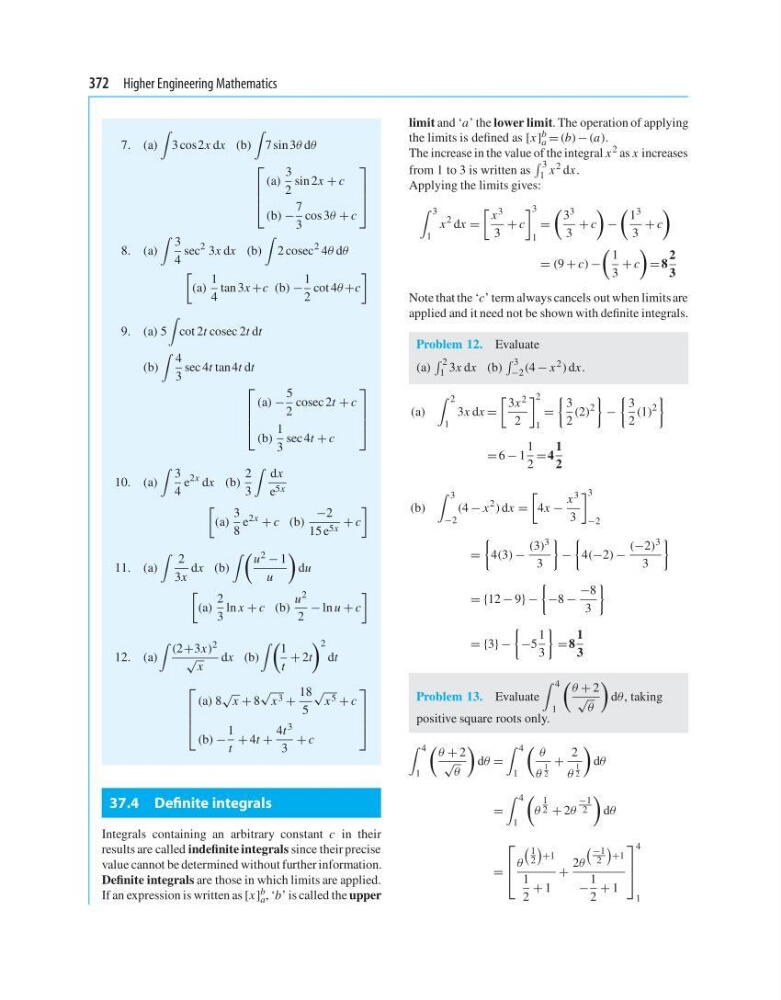
372 Higher Engineering Mathematics
7. (a)
3 cos2x dx (b)
7 sin 3θ dθ
⎡
⎢
⎢
⎣
(a)
3
2
sin 2x + c
(b) −
7
3
cos 3θ + c
⎤
⎥
⎥
⎦
8. (a)
3
4
sec
2 3x dx (b)
2 cosec
2 4θ dθ
(a)
1
4
tan 3x +c (b) −
1
2
cot 4θ +c
9. (a) 5
cot 2t cosec 2t dt
(b)
4
3
sec 4t tan 4t dt
⎡
⎢
⎢
⎣
(a) −
5
2
cosec 2t + c
(b)
1
3
sec 4t + c
⎤
⎥
⎥
⎦
10. (a)
3
4
e
2x dx (b)
2
3
dx
e 5x
(a)
3
8
e 2x + c (b)
−2
15 e 5x + c
11. (a)
2
3x
dx (b)
u 2 − 1
u
du
(a)
2
3
ln x + c (b)
u
2
2
− ln u + c
12. (a)
(2+3x) 2
√
x
dx (b)
1
t
+ 2t
2
dt
⎡
⎢
⎢
⎣
(a) 8
√
x + 8
√
x 3 +
18
5
√
x 5 + c
(b) −
1
t
+ 4t +
4t 3
3
+ c
⎤
⎥
⎥
⎦
37.4 Definite integrals
Integrals containing an arbitrary constant c in their
results are called indefinite integrals since their precise
value cannot be determined without further information.
Definite integrals are those in which limits are applied.
If an expression is written as [x] b
a , ‘b’ is called the upper
limit and ‘a’ the lower limit. The operation of applying
the limits is defined as [x] b
a = (b) − (a).
The increase in the value of the integral x 2 as x increases
from 1 to 3 is written as
3
1 x
2 dx.
Applying the limits gives:
3
1
x
2 dx =
x 3
3
+ c
3
1
=
3 3
3
+ c
−
1 3
3
+ c
= (9 + c) −
1
3
+ c
= 8
2
3
Note that the ‘c’ term always cancels out when limits are
applied and it need not be shown with definite integrals.
Problem 12. Evaluate
(a)
2
1 3x dx (b)
3
−2 (4 − x 2 ) dx.
(a)
2
1
3x dx =
3x 2
2
2
1
=
3
2
(2)
2
−
3
2
(1)
2
= 6 − 1
1
2
= 4
1
2
(b)
3
−2
(4 − x
2
) dx =
4x −
x 3
3
3
−2
=
4(3) −
(3) 3
3
−
4(−2) −
(−2) 3
3
= {12 − 9} −
−8 −
−8
3
= {3} −
−5
1
3
= 8
1
3
Problem 13. Evaluate
4
1
θ + 2
√
θ
dθ, taking
positive square roots only.
4
1
θ + 2
√
θ
dθ =
4
1
θ
θ
1
2
+
2
θ
1
2
dθ
=
4
1
θ
1
2 + 2θ
−1
2
dθ
=
⎡
⎢
⎣
θ
1
2
+1
1
2
+ 1
+
2θ
−1
2
+1
−
1
2
+ 1
⎤
⎥
⎦
4
1
7. (a)
3 cos2x dx (b)
7 sin 3θ dθ
⎡
⎢
⎢
⎣
(a)
3
2
sin 2x + c
(b) −
7
3
cos 3θ + c
⎤
⎥
⎥
⎦
8. (a)
3
4
sec
2 3x dx (b)
2 cosec
2 4θ dθ
(a)
1
4
tan 3x +c (b) −
1
2
cot 4θ +c
9. (a) 5
cot 2t cosec 2t dt
(b)
4
3
sec 4t tan 4t dt
⎡
⎢
⎢
⎣
(a) −
5
2
cosec 2t + c
(b)
1
3
sec 4t + c
⎤
⎥
⎥
⎦
10. (a)
3
4
e
2x dx (b)
2
3
dx
e 5x
(a)
3
8
e 2x + c (b)
−2
15 e 5x + c
11. (a)
2
3x
dx (b)
u 2 − 1
u
du
(a)
2
3
ln x + c (b)
u
2
2
− ln u + c
12. (a)
(2+3x) 2
√
x
dx (b)
1
t
+ 2t
2
dt
⎡
⎢
⎢
⎣
(a) 8
√
x + 8
√
x 3 +
18
5
√
x 5 + c
(b) −
1
t
+ 4t +
4t 3
3
+ c
⎤
⎥
⎥
⎦
37.4 Definite integrals
Integrals containing an arbitrary constant c in their
results are called indefinite integrals since their precise
value cannot be determined without further information.
Definite integrals are those in which limits are applied.
If an expression is written as [x] b
a , ‘b’ is called the upper
limit and ‘a’ the lower limit. The operation of applying
the limits is defined as [x] b
a = (b) − (a).
The increase in the value of the integral x 2 as x increases
from 1 to 3 is written as
3
1 x
2 dx.
Applying the limits gives:
3
1
x
2 dx =
x 3
3
+ c
3
1
=
3 3
3
+ c
−
1 3
3
+ c
= (9 + c) −
1
3
+ c
= 8
2
3
Note that the ‘c’ term always cancels out when limits are
applied and it need not be shown with definite integrals.
Problem 12. Evaluate
(a)
2
1 3x dx (b)
3
−2 (4 − x 2 ) dx.
(a)
2
1
3x dx =
3x 2
2
2
1
=
3
2
(2)
2
−
3
2
(1)
2
= 6 − 1
1
2
= 4
1
2
(b)
3
−2
(4 − x
2
) dx =
4x −
x 3
3
3
−2
=
4(3) −
(3) 3
3
−
4(−2) −
(−2) 3
3
= {12 − 9} −
−8 −
−8
3
= {3} −
−5
1
3
= 8
1
3
Problem 13. Evaluate
4
1
θ + 2
√
θ
dθ, taking
positive square roots only.
4
1
θ + 2
√
θ
dθ =
4
1
θ
θ
1
2
+
2
θ
1
2
dθ
=
4
1
θ
1
2 + 2θ
−1
2
dθ
=
⎡
⎢
⎣
θ
1
2
+1
1
2
+ 1
+
2θ
−1
2
+1
−
1
2
+ 1
⎤
⎥
⎦
4
1