

Standard integration 369
For example,
(3x + 2x
2
− 5) dx
=
3x dx +
2x
2 dx −
5 dx
=
3x 2
2
+
2x 3
3
− 5x + c
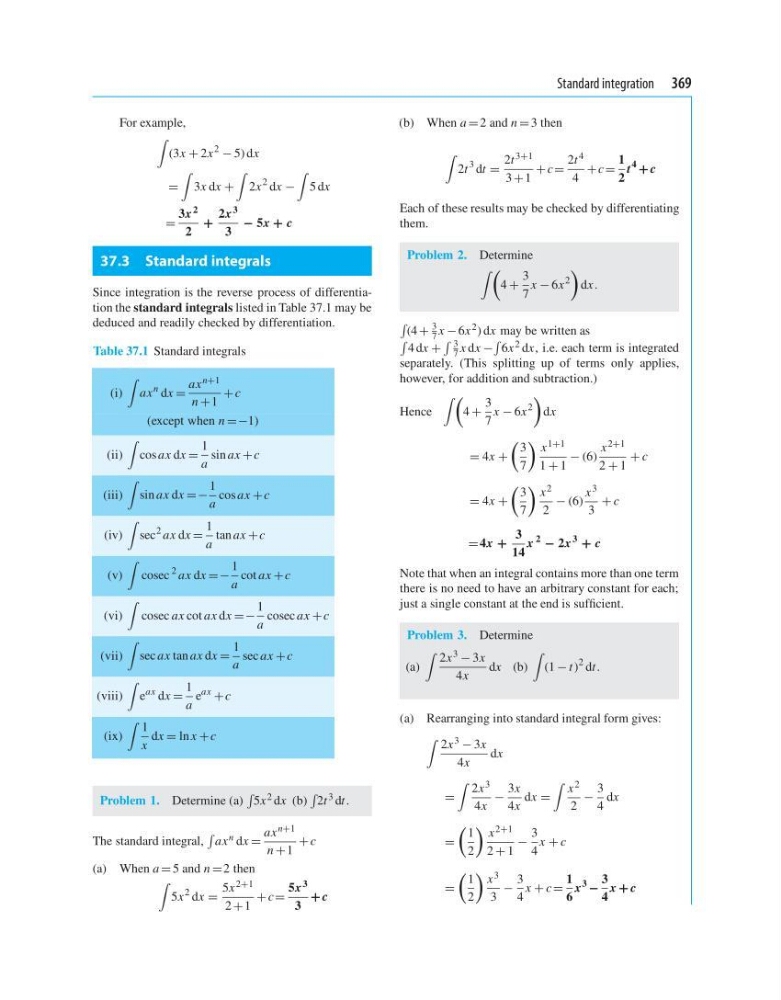
37.3 Standard integrals
Since integration is the reverse process of differentiation the standard integrals listed in Table 37.1 may be
deduced and readily checked by differentiation.
Table 37.1 Standard integrals
(i)
ax
n dx =
ax n+1
n +1
+ c
(except when n =−1)
(ii)
cos ax dx =
1
a
sin ax + c
(iii)
sin ax dx =−
1
a
cos ax + c
(iv)
sec
2 ax dx =
1
a
tan ax + c
(v)
cosec
2 ax dx =−
1
a
cot ax + c
(vi)
cosec ax cot ax dx =−
1
a
cosec ax + c
(vii)
sec ax tan ax dx =
1
a
sec ax + c
(viii)
e
ax dx =
1
a
e
ax
+ c
(ix)
1
x
dx = ln x + c
Problem 1. Determine (a)
5x 2 dx (b)
2t 3 dt .
The standard integral,
ax n dx =
ax n+1
n +1
+ c
(a) When a = 5 and n =2 then
5x
2 dx =
5x 2+1
2 + 1
+ c =
5x 3
3
+ c
(b) When a = 2 and n = 3 then
2t
3 dt =
2t 3+1
3 + 1
+ c =
2t 4
4
+ c =
1
2
t
4
+ c
Each of these results may be checked by differentiating
them.
Problem 2. Determine
4 +
3
7
x − 6x
2
dx.
(4 +
3
7 x − 6x 2 ) dx may be written as
4 dx +
3
7 x dx −
6x 2 dx, i.e. each term is integrated
separately. (This splitting up of terms only applies,
however, for addition and subtraction.)
Hence
4 +
3
7
x − 6x
2
dx
= 4x +
3
7
x 1+1
1 + 1
− (6)
x 2+1
2 + 1
+ c
= 4x +
3
7
x 2
2
− (6)
x 3
3
+ c
= 4x +
3
14
x
2
− 2x
3
+ c
Note that when an integral contains more than one term
there is no need to have an arbitrary constant for each;
just a single constant at the end is sufficient.
Problem 3. Determine
(a)
2x 3 − 3x
4x
dx (b)
(1 − t )
2 dt.
(a) Rearranging into standard integral form gives:
2x 3 − 3x
4x
dx
=
2x 3
4x
−
3x
4x
dx =
x 2
2
−
3
4
dx
=
1
2
x 2+1
2 + 1
−
3
4
x + c
=
1
2
x 3
3
−
3
4
x + c =
1
6
x
3
−
3
4
x + c
For example,
(3x + 2x
2
− 5) dx
=
3x dx +
2x
2 dx −
5 dx
=
3x 2
2
+
2x 3
3
− 5x + c
37.3 Standard integrals
Since integration is the reverse process of differentiation the standard integrals listed in Table 37.1 may be
deduced and readily checked by differentiation.
Table 37.1 Standard integrals
(i)
ax
n dx =
ax n+1
n +1
+ c
(except when n =−1)
(ii)
cos ax dx =
1
a
sin ax + c
(iii)
sin ax dx =−
1
a
cos ax + c
(iv)
sec
2 ax dx =
1
a
tan ax + c
(v)
cosec
2 ax dx =−
1
a
cot ax + c
(vi)
cosec ax cot ax dx =−
1
a
cosec ax + c
(vii)
sec ax tan ax dx =
1
a
sec ax + c
(viii)
e
ax dx =
1
a
e
ax
+ c
(ix)
1
x
dx = ln x + c
Problem 1. Determine (a)
5x 2 dx (b)
2t 3 dt .
The standard integral,
ax n dx =
ax n+1
n +1
+ c
(a) When a = 5 and n =2 then
5x
2 dx =
5x 2+1
2 + 1
+ c =
5x 3
3
+ c
(b) When a = 2 and n = 3 then
2t
3 dt =
2t 3+1
3 + 1
+ c =
2t 4
4
+ c =
1
2
t
4
+ c
Each of these results may be checked by differentiating
them.
Problem 2. Determine
4 +
3
7
x − 6x
2
dx.
(4 +
3
7 x − 6x 2 ) dx may be written as
4 dx +
3
7 x dx −
6x 2 dx, i.e. each term is integrated
separately. (This splitting up of terms only applies,
however, for addition and subtraction.)
Hence
4 +
3
7
x − 6x
2
dx
= 4x +
3
7
x 1+1
1 + 1
− (6)
x 2+1
2 + 1
+ c
= 4x +
3
7
x 2
2
− (6)
x 3
3
+ c
= 4x +
3
14
x
2
− 2x
3
+ c
Note that when an integral contains more than one term
there is no need to have an arbitrary constant for each;
just a single constant at the end is sufficient.
Problem 3. Determine
(a)
2x 3 − 3x
4x
dx (b)
(1 − t )
2 dt.
(a) Rearranging into standard integral form gives:
2x 3 − 3x
4x
dx
=
2x 3
4x
−
3x
4x
dx =
x 2
2
−
3
4
dx
=
1
2
x 2+1
2 + 1
−
3
4
x + c
=
1
2
x 3
3
−
3
4
x + c =
1
6
x
3
−
3
4
x + c