

Chapter 36
Maxima, minima and saddle
points for functions of two
variables
36.1 Functions of two independent
variables
If a relation between two real variables, x and y,
is such that when x is given, y is determined, then
y is said to be a function of x and is denoted by
y = f (x); x is called the independent variable and y
the dependent variable. If y = f (u, v), then y is a function of two independent variables u and v. For example,
if, say, y = f (u, v)= 3u
2
− 2v then when u = 2 and
v = 1, y = 3(2) 2 − 2(1) = 10. This may be written as
f (2, 1) = 10. Similarly, if u = 1 and v = 4, f (1, 4) =−5.
6
0
2
3
p
p9
x
z
y
Figure 36.1
Consider a function of two variables x and y
defined by z = f (x, y) = 3x 2 − 2y. If (x, y) = (0, 0),
then f (0, 0) = 0 and if (x , y) =(2, 1), then f (2, 1)=10.
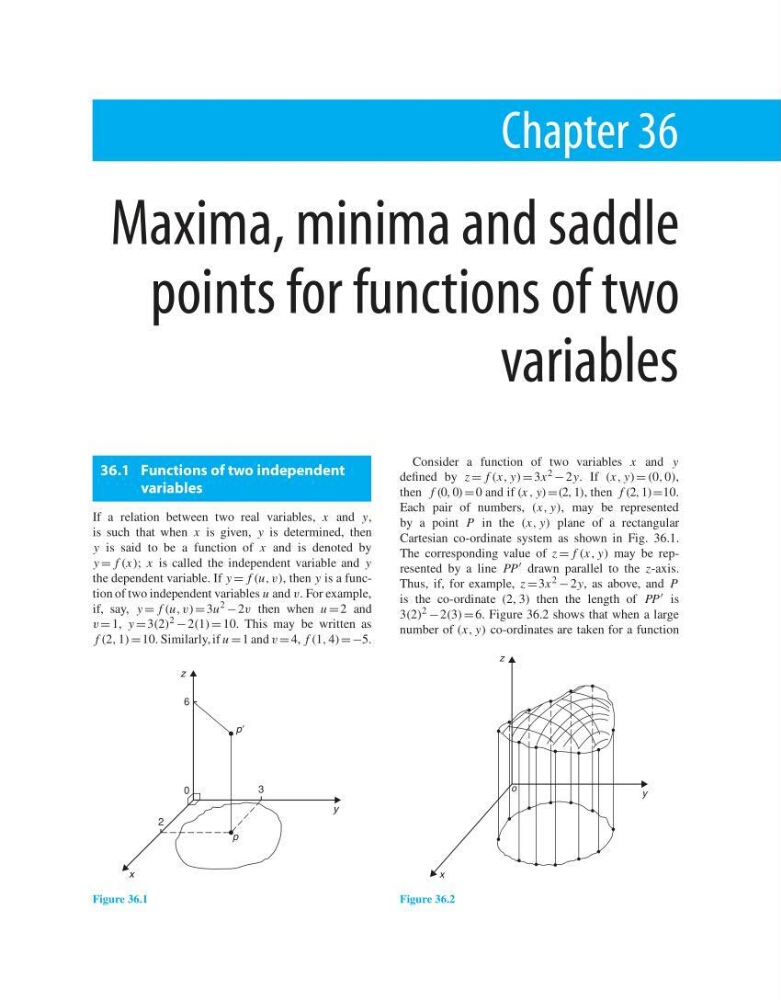
Each pair of numbers, (x, y), may be represented
by a point P in the (x, y) plane of a rectangular
Cartesian co-ordinate system as shown in Fig. 36.1.
The corresponding value of z = f (x, y) may be represented by a line PP drawn parallel to the z-axis.
Thus, if, for example, z =3x 2 − 2y, as above, and P
is the co-ordinate (2, 3) then the length of PP is
3(2) 2 − 2(3) = 6. Figure 36.2 shows that when a large
number of (x, y) co-ordinates are taken for a function
z
x
y
o
Figure 36.2
Maxima, minima and saddle
points for functions of two
variables
36.1 Functions of two independent
variables
If a relation between two real variables, x and y,
is such that when x is given, y is determined, then
y is said to be a function of x and is denoted by
y = f (x); x is called the independent variable and y
the dependent variable. If y = f (u, v), then y is a function of two independent variables u and v. For example,
if, say, y = f (u, v)= 3u
2
− 2v then when u = 2 and
v = 1, y = 3(2) 2 − 2(1) = 10. This may be written as
f (2, 1) = 10. Similarly, if u = 1 and v = 4, f (1, 4) =−5.
6
0
2
3
p
p9
x
z
y
Figure 36.1
Consider a function of two variables x and y
defined by z = f (x, y) = 3x 2 − 2y. If (x, y) = (0, 0),
then f (0, 0) = 0 and if (x , y) =(2, 1), then f (2, 1)=10.
Each pair of numbers, (x, y), may be represented
by a point P in the (x, y) plane of a rectangular
Cartesian co-ordinate system as shown in Fig. 36.1.
The corresponding value of z = f (x, y) may be represented by a line PP drawn parallel to the z-axis.
Thus, if, for example, z =3x 2 − 2y, as above, and P
is the co-ordinate (2, 3) then the length of PP is
3(2) 2 − 2(3) = 6. Figure 36.2 shows that when a large
number of (x, y) co-ordinates are taken for a function
z
x
y
o
Figure 36.2