

Total differential, rates of change and small changes 353
Hence the rate of change of z,
dz
dt
= 75.14 units/s,
correct to 4 significant figures.
Problem 5. The height of a right circular cone is
increasing at 3 mm/s and its radius is decreasing at
2 mm/s. Determine, correct to 3 significant figures,
the rate at which the volume is changing (in cm 3 /s)
when the height is 3.2 cm and the radius is 1.5 cm.
Volume of a right circular cone, V =
1
3
πr 2 h
Using equation (2), the rate of change of volume,
dV
dt
=
∂V
∂r
dr
dt
+
∂V
∂h
dh
dt
∂V
∂r
=
2
3
πrh and
∂V
∂h
=
1
3
πr
2
Since the height is increasing at 3 mm/s,
i.e. 0.3 cm/s, then
dh
dt
=+0.3
and since the radius is decreasing at 2 mm/s,
i.e. 0.2 cm/s, then
dr
dt
=−0.2
Hence
dV
dt
=
2
3
πrh
(−0.2) +
1
3
πr 2
(+0.3)
=
−0.4
3
πrh + 0.1πr 2
However, h = 3.2 cm and r = 1.5 cm.
Hence
dV
dt
=
−0.4
3
π(1.5)(3.2) + (0.1)π(1.5) 2
= −2.011 + 0.707 = −1.304 cm 3 /s
Thus the rate of change of volume is 1.30 cm 3 /s
decreasing.
Problem 6. The area A of a triangle is given by
A =
1
2 ac sin B, where B is the angle between sides a
and c. If a is increasing at 0.4 units/s, c is
decreasing at 0.8 units/s and B is increasing at 0.2
units/s, find the rate of change of the area of the
triangle, correct to 3 significant figures, when a is 3
units, c is 4 units and B is π/6 radians.
Using equation (2), the rate of change of area,
d A
dt
=
∂ A
∂a
da
dt
+
∂ A
∂c
dc
dt
+
∂ A
∂ B
dB
dt
Since
A =
1
2
ac sin B,
∂ A
∂a
=
1
2
c sin B,
∂ A
∂c
=
1
2
a sin B and
∂ A
∂ B
=
1
2
ac cos B
da
dt
= 0.4 units/s,
dc
dt
= −0.8 units/s
and
dB
dt
= 0.2 units/s
Hence
d A
dt
=
1
2
c sin B
(0.4) +
1
2
a sin B
(−0.8)
+
1
2
ac cos B
(0.2)
When a = 3, c = 4 and B =
π
6
then:
dA
dt
=
1
2
(4) sin
π
6
(0.4) +
1
2
(3) sin
π
6
(−0.8)
+
1
2
(3)(4) cos
π
6
(0.2)
= 0.4 − 0.6 + 1.039 = 0.839 units 2 /s, correct
to 3 significant figures.
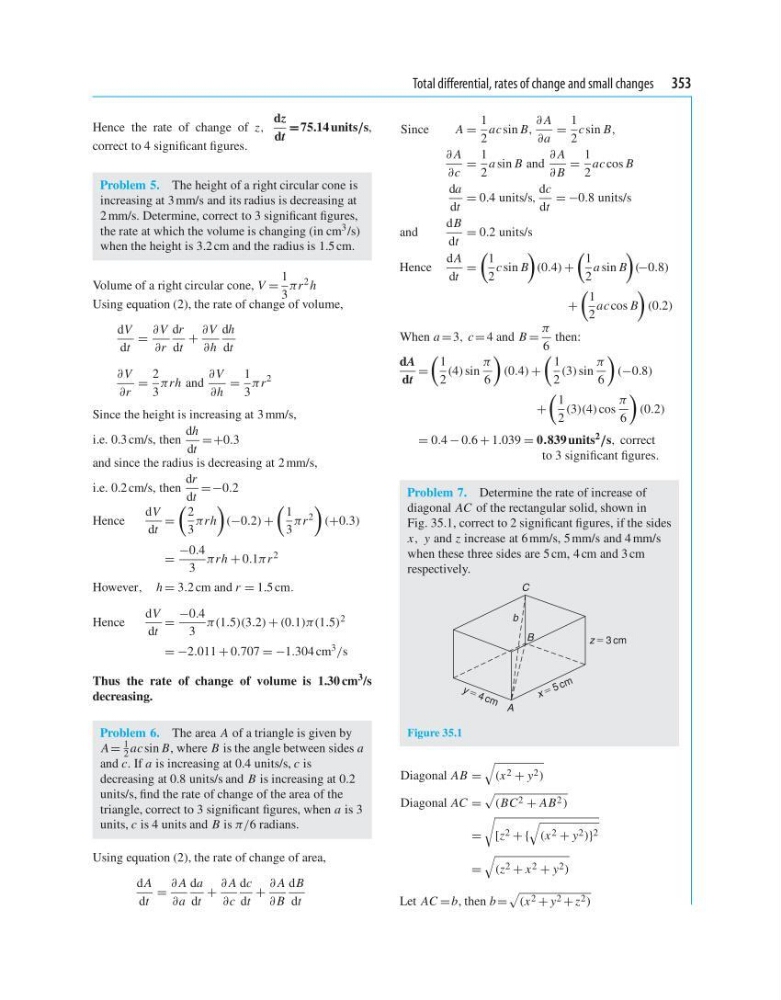
Problem 7. Determine the rate of increase of
diagonal AC of the rectangular solid, shown in
Fig. 35.1, correct to 2 significant figures, if the sides
x, y and z increase at 6 mm/s, 5 mm/s and 4 mm/s
when these three sides are 5 cm, 4 cm and 3 cm
respectively.
C
b
B
z 5 3 cm
x 5 5 c m
y 5 4 c m
A
Figure 35.1
Diagonal AB =
(x 2 + y 2 )
Diagonal AC =
(BC 2 + AB 2 )
=
[z 2 + {
(x 2 + y 2 )} 2
=
(z 2 + x 2 + y 2 )
Let AC = b, then b =
(x 2 + y 2 + z 2 )
Hence the rate of change of z,
dz
dt
= 75.14 units/s,
correct to 4 significant figures.
Problem 5. The height of a right circular cone is
increasing at 3 mm/s and its radius is decreasing at
2 mm/s. Determine, correct to 3 significant figures,
the rate at which the volume is changing (in cm 3 /s)
when the height is 3.2 cm and the radius is 1.5 cm.
Volume of a right circular cone, V =
1
3
πr 2 h
Using equation (2), the rate of change of volume,
dV
dt
=
∂V
∂r
dr
dt
+
∂V
∂h
dh
dt
∂V
∂r
=
2
3
πrh and
∂V
∂h
=
1
3
πr
2
Since the height is increasing at 3 mm/s,
i.e. 0.3 cm/s, then
dh
dt
=+0.3
and since the radius is decreasing at 2 mm/s,
i.e. 0.2 cm/s, then
dr
dt
=−0.2
Hence
dV
dt
=
2
3
πrh
(−0.2) +
1
3
πr 2
(+0.3)
=
−0.4
3
πrh + 0.1πr 2
However, h = 3.2 cm and r = 1.5 cm.
Hence
dV
dt
=
−0.4
3
π(1.5)(3.2) + (0.1)π(1.5) 2
= −2.011 + 0.707 = −1.304 cm 3 /s
Thus the rate of change of volume is 1.30 cm 3 /s
decreasing.
Problem 6. The area A of a triangle is given by
A =
1
2 ac sin B, where B is the angle between sides a
and c. If a is increasing at 0.4 units/s, c is
decreasing at 0.8 units/s and B is increasing at 0.2
units/s, find the rate of change of the area of the
triangle, correct to 3 significant figures, when a is 3
units, c is 4 units and B is π/6 radians.
Using equation (2), the rate of change of area,
d A
dt
=
∂ A
∂a
da
dt
+
∂ A
∂c
dc
dt
+
∂ A
∂ B
dB
dt
Since
A =
1
2
ac sin B,
∂ A
∂a
=
1
2
c sin B,
∂ A
∂c
=
1
2
a sin B and
∂ A
∂ B
=
1
2
ac cos B
da
dt
= 0.4 units/s,
dc
dt
= −0.8 units/s
and
dB
dt
= 0.2 units/s
Hence
d A
dt
=
1
2
c sin B
(0.4) +
1
2
a sin B
(−0.8)
+
1
2
ac cos B
(0.2)
When a = 3, c = 4 and B =
π
6
then:
dA
dt
=
1
2
(4) sin
π
6
(0.4) +
1
2
(3) sin
π
6
(−0.8)
+
1
2
(3)(4) cos
π
6
(0.2)
= 0.4 − 0.6 + 1.039 = 0.839 units 2 /s, correct
to 3 significant figures.
Problem 7. Determine the rate of increase of
diagonal AC of the rectangular solid, shown in
Fig. 35.1, correct to 2 significant figures, if the sides
x, y and z increase at 6 mm/s, 5 mm/s and 4 mm/s
when these three sides are 5 cm, 4 cm and 3 cm
respectively.
C
b
B
z 5 3 cm
x 5 5 c m
y 5 4 c m
A
Figure 35.1
Diagonal AB =
(x 2 + y 2 )
Diagonal AC =
(BC 2 + AB 2 )
=
[z 2 + {
(x 2 + y 2 )} 2
=
(z 2 + x 2 + y 2 )
Let AC = b, then b =
(x 2 + y 2 + z 2 )