

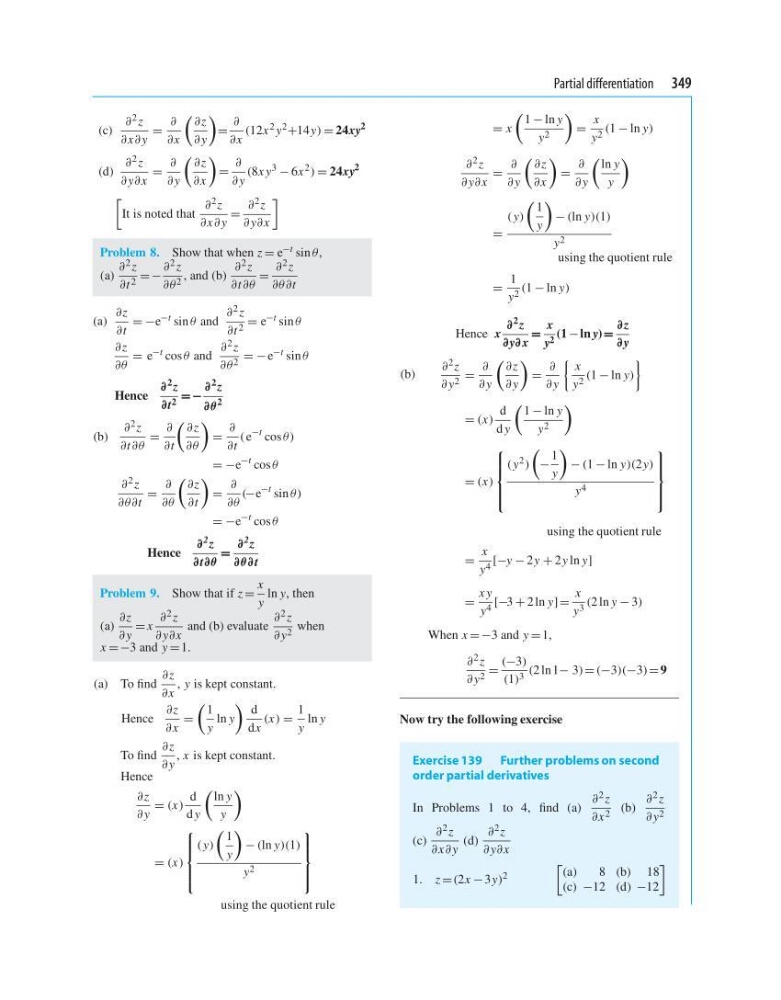
Partial differentiation 349
(c)
∂ 2 z
∂x∂ y
=
∂
∂x
∂z
∂ y
=
∂
∂x
(12x 2 y 2 +14y) = 24xy
2
(d)
∂ 2 z
∂ y∂x
=
∂
∂ y
∂z
∂x
=
∂
∂ y
(8x y 3 − 6x 2 ) = 24xy
2
It is noted that
∂ 2 z
∂x∂ y
=
∂ 2 z
∂ y∂x
Problem 8. Show that when z = e −t sin θ,
(a)
∂ 2 z
∂t 2 =−
∂ 2 z
∂θ 2 , and (b)
∂ 2 z
∂t ∂θ
=
∂ 2 z
∂θ∂t
(a)
∂z
∂t
= −e −t sin θ and
∂ 2 z
∂t 2 = e −t sin θ
∂z
∂θ
= e −t cos θ and
∂ 2 z
∂θ 2 = −e −t sin θ
Hence
∂
2 z
∂t 2 =−
∂
2 z
∂θ
2
(b)
∂ 2 z
∂t ∂θ
=
∂
∂t
∂z
∂θ
=
∂
∂t
( e
−t cos θ)
= −e
−t cos θ
∂ 2 z
∂θ∂t
=
∂
∂θ
∂z
∂t
=
∂
∂θ
(−e
−t sin θ)
= −e
−t cos θ
Hence
∂
2 z
∂t∂θ
=
∂
2 z
∂θ∂t
Problem 9. Show that if z =
x
y
ln y, then
(a)
∂z
∂ y
= x
∂ 2 z
∂ y∂x
and (b) evaluate
∂ 2 z
∂ y 2 when
x =−3 and y = 1.
(a) To find
∂z
∂x
, y is kept constant.
Hence
∂z
∂x
=
1
y
ln y
d
dx
(x) =
1
y
ln y
To find
∂z
∂ y
, x is kept constant.
Hence
∂z
∂ y
= (x)
d
d y
ln y
y
= (x)
⎧
⎪ ⎪ ⎨
⎪ ⎪ ⎩
( y)
1
y
− (ln y)(1)
y 2
⎫
⎪ ⎪ ⎬
⎪ ⎪ ⎭
using the quotient rule
= x
1 − ln y
y 2
=
x
y 2 (1 − ln y)
∂ 2 z
∂ y∂x
=
∂
∂ y
∂z
∂x
=
∂
∂ y
ln y
y
=
( y)
1
y
− (ln y)(1)
y 2
using the quotient rule
=
1
y 2 (1 − ln y)
Hence x
∂
2 z
∂y∂ x
=
x
y 2 (1 − ln y)=
∂z
∂y
(b)
∂ 2 z
∂ y 2 =
∂
∂ y
∂z
∂ y
=
∂
∂ y
x
y 2 (1 − ln y)
= (x)
d
d y
1 − ln y
y 2
= (x)
⎧
⎪ ⎪ ⎨
⎪ ⎪ ⎩
( y 2 )
−
1
y
− (1 − ln y)(2y)
y 4
⎫
⎪ ⎪ ⎬
⎪ ⎪ ⎭
using the quotient rule
=
x
y 4 [−y − 2y + 2y ln y]
=
x y
y 4 [−3 + 2 ln y] =
x
y 3 (2 ln y − 3)
When x =−3 and y = 1,
∂ 2 z
∂ y 2 =
(−3)
(1) 3 (2 ln1− 3) = (−3)(−3) = 9
Now try the following exercise
Exercise 139 Further problems on second
order partial derivatives
In Problems 1 to 4, find (a)
∂ 2 z
∂x 2 (b)
∂ 2 z
∂ y 2
(c)
∂ 2 z
∂x∂ y
(d)
∂ 2 z
∂ y∂x
1. z =(2x − 3y) 2
(a)
8 (b) 18
(c) −12 (d) −12
(c)
∂ 2 z
∂x∂ y
=
∂
∂x
∂z
∂ y
=
∂
∂x
(12x 2 y 2 +14y) = 24xy
2
(d)
∂ 2 z
∂ y∂x
=
∂
∂ y
∂z
∂x
=
∂
∂ y
(8x y 3 − 6x 2 ) = 24xy
2
It is noted that
∂ 2 z
∂x∂ y
=
∂ 2 z
∂ y∂x
Problem 8. Show that when z = e −t sin θ,
(a)
∂ 2 z
∂t 2 =−
∂ 2 z
∂θ 2 , and (b)
∂ 2 z
∂t ∂θ
=
∂ 2 z
∂θ∂t
(a)
∂z
∂t
= −e −t sin θ and
∂ 2 z
∂t 2 = e −t sin θ
∂z
∂θ
= e −t cos θ and
∂ 2 z
∂θ 2 = −e −t sin θ
Hence
∂
2 z
∂t 2 =−
∂
2 z
∂θ
2
(b)
∂ 2 z
∂t ∂θ
=
∂
∂t
∂z
∂θ
=
∂
∂t
( e
−t cos θ)
= −e
−t cos θ
∂ 2 z
∂θ∂t
=
∂
∂θ
∂z
∂t
=
∂
∂θ
(−e
−t sin θ)
= −e
−t cos θ
Hence
∂
2 z
∂t∂θ
=
∂
2 z
∂θ∂t
Problem 9. Show that if z =
x
y
ln y, then
(a)
∂z
∂ y
= x
∂ 2 z
∂ y∂x
and (b) evaluate
∂ 2 z
∂ y 2 when
x =−3 and y = 1.
(a) To find
∂z
∂x
, y is kept constant.
Hence
∂z
∂x
=
1
y
ln y
d
dx
(x) =
1
y
ln y
To find
∂z
∂ y
, x is kept constant.
Hence
∂z
∂ y
= (x)
d
d y
ln y
y
= (x)
⎧
⎪ ⎪ ⎨
⎪ ⎪ ⎩
( y)
1
y
− (ln y)(1)
y 2
⎫
⎪ ⎪ ⎬
⎪ ⎪ ⎭
using the quotient rule
= x
1 − ln y
y 2
=
x
y 2 (1 − ln y)
∂ 2 z
∂ y∂x
=
∂
∂ y
∂z
∂x
=
∂
∂ y
ln y
y
=
( y)
1
y
− (ln y)(1)
y 2
using the quotient rule
=
1
y 2 (1 − ln y)
Hence x
∂
2 z
∂y∂ x
=
x
y 2 (1 − ln y)=
∂z
∂y
(b)
∂ 2 z
∂ y 2 =
∂
∂ y
∂z
∂ y
=
∂
∂ y
x
y 2 (1 − ln y)
= (x)
d
d y
1 − ln y
y 2
= (x)
⎧
⎪ ⎪ ⎨
⎪ ⎪ ⎩
( y 2 )
−
1
y
− (1 − ln y)(2y)
y 4
⎫
⎪ ⎪ ⎬
⎪ ⎪ ⎭
using the quotient rule
=
x
y 4 [−y − 2y + 2y ln y]
=
x y
y 4 [−3 + 2 ln y] =
x
y 3 (2 ln y − 3)
When x =−3 and y = 1,
∂ 2 z
∂ y 2 =
(−3)
(1) 3 (2 ln1− 3) = (−3)(−3) = 9
Now try the following exercise
Exercise 139 Further problems on second
order partial derivatives
In Problems 1 to 4, find (a)
∂ 2 z
∂x 2 (b)
∂ 2 z
∂ y 2
(c)
∂ 2 z
∂x∂ y
(d)
∂ 2 z
∂ y∂x
1. z =(2x − 3y) 2
(a)
8 (b) 18
(c) −12 (d) −12