

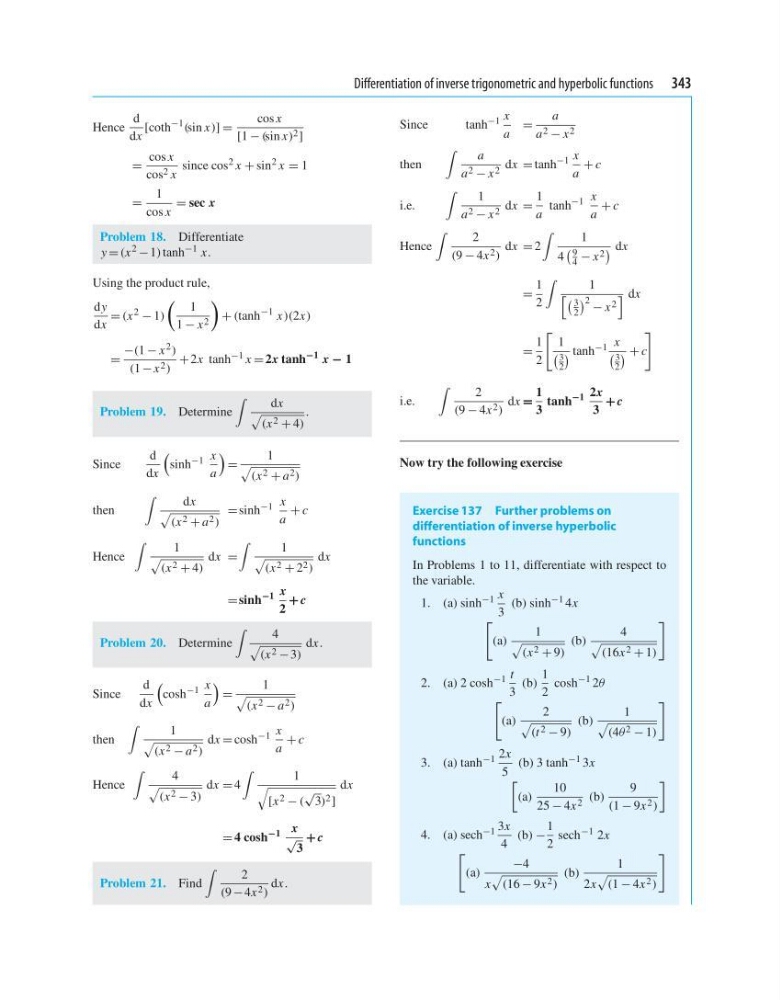
Differentiation of inverse trigonometric and hyperbolic functions 343
Hence
d
dx
[coth
−1
(sin x)] =
cos x
[1 − (sin x) 2 ]
=
cos x
cos 2 x
since cos 2 x + sin 2 x = 1
=
1
cos x
= sec x
Problem 18. Differentiate
y = (x 2 − 1) tanh −1 x.
Using the product rule,
dy
dx
= (x 2 − 1)
1
1 − x 2
+ (tanh
−1 x)(2x)
=
−(1 − x 2 )
(1 − x 2 )
+ 2x tanh −1 x = 2x tanh
−1 x − 1
Problem 19. Determine
dx
(x 2 + 4)
.
Since
d
dx
sinh −1 x
a
=
1
(x 2 + a 2 )
then
dx
(x 2 + a 2 )
= sinh −1 x
a
+ c
Hence
1
(x 2 + 4)
dx =
1
(x 2 + 2 2 )
dx
= sinh
−1 x
2
+ c
Problem 20. Determine
4
(x 2 − 3)
dx.
Since
d
dx
cosh
−1 x
a
=
1
(x 2 − a 2 )
then
1
(x 2 − a 2 )
dx = cosh −1 x
a
+ c
Hence
4
(x 2 − 3)
dx = 4
1
[x 2 − (
√
3) 2 ]
dx
= 4 cosh
−1 x
√
3
+ c
Problem 21. Find
2
(9 − 4x 2 )
dx.
Since
tanh −1 x
a
=
a
a 2 − x 2
then
a
a 2 − x 2 dx = tanh
−1 x
a
+ c
i.e.
1
a 2 − x 2 dx =
1
a
tanh
−1 x
a
+ c
Hence
2
(9 − 4x 2 )
dx = 2
1
4
9
4 − x 2
dx
=
1
2
1
3
2
2 − x 2
dx
=
1
2
1
3
2
tanh −1 x
3
2
+ c
i.e.
2
(9 − 4x 2 )
dx =
1
3
tanh
−1 2x
3
+ c
Now try the following exercise
Exercise 137 Further problems on
differentiation of inverse hyperbolic
functions
In Problems 1 to 11, differentiate with respect to
the variable.
1. (a) sinh −1 x
3
(b) sinh −1 4x
(a)
1
(x 2 + 9)
(b)
4
(16x 2 + 1)
2. (a) 2 cosh
−1 t
3
(b)
1
2
cosh
−1 2θ
(a)
2
(t 2 − 9)
(b)
1
(4θ 2 − 1)
3. (a) tanh −1 2x
5
(b) 3 tanh −1 3x
(a)
10
25 − 4x 2 (b)
9
(1 − 9x 2 )
4. (a) sech −1 3x
4
(b) −
1
2
sech −1 2x
(a)
−4
x
(16 − 9x 2 )
(b)
1
2x
(1 − 4x 2 )
Hence
d
dx
[coth
−1
(sin x)] =
cos x
[1 − (sin x) 2 ]
=
cos x
cos 2 x
since cos 2 x + sin 2 x = 1
=
1
cos x
= sec x
Problem 18. Differentiate
y = (x 2 − 1) tanh −1 x.
Using the product rule,
dy
dx
= (x 2 − 1)
1
1 − x 2
+ (tanh
−1 x)(2x)
=
−(1 − x 2 )
(1 − x 2 )
+ 2x tanh −1 x = 2x tanh
−1 x − 1
Problem 19. Determine
dx
(x 2 + 4)
.
Since
d
dx
sinh −1 x
a
=
1
(x 2 + a 2 )
then
dx
(x 2 + a 2 )
= sinh −1 x
a
+ c
Hence
1
(x 2 + 4)
dx =
1
(x 2 + 2 2 )
dx
= sinh
−1 x
2
+ c
Problem 20. Determine
4
(x 2 − 3)
dx.
Since
d
dx
cosh
−1 x
a
=
1
(x 2 − a 2 )
then
1
(x 2 − a 2 )
dx = cosh −1 x
a
+ c
Hence
4
(x 2 − 3)
dx = 4
1
[x 2 − (
√
3) 2 ]
dx
= 4 cosh
−1 x
√
3
+ c
Problem 21. Find
2
(9 − 4x 2 )
dx.
Since
tanh −1 x
a
=
a
a 2 − x 2
then
a
a 2 − x 2 dx = tanh
−1 x
a
+ c
i.e.
1
a 2 − x 2 dx =
1
a
tanh
−1 x
a
+ c
Hence
2
(9 − 4x 2 )
dx = 2
1
4
9
4 − x 2
dx
=
1
2
1
3
2
2 − x 2
dx
=
1
2
1
3
2
tanh −1 x
3
2
+ c
i.e.
2
(9 − 4x 2 )
dx =
1
3
tanh
−1 2x
3
+ c
Now try the following exercise
Exercise 137 Further problems on
differentiation of inverse hyperbolic
functions
In Problems 1 to 11, differentiate with respect to
the variable.
1. (a) sinh −1 x
3
(b) sinh −1 4x
(a)
1
(x 2 + 9)
(b)
4
(16x 2 + 1)
2. (a) 2 cosh
−1 t
3
(b)
1
2
cosh
−1 2θ
(a)
2
(t 2 − 9)
(b)
1
(4θ 2 − 1)
3. (a) tanh −1 2x
5
(b) 3 tanh −1 3x
(a)
10
25 − 4x 2 (b)
9
(1 − 9x 2 )
4. (a) sech −1 3x
4
(b) −
1
2
sech −1 2x
(a)
−4
x
(16 − 9x 2 )
(b)
1
2x
(1 − 4x 2 )