

Differentiation of inverse trigonometric and hyperbolic functions 341
33.4 Differentiation of inverse
hyperbolic functions
If y = sinh −1 x
a
then
x
a
= sinh y and x = a sinh y
dx
dy
= a cosh y (from Chapter 32).
Also cosh
2 y − sinh
2 y = 1, from which,
cosh y =
1 + sinh
2 y =
1 +
x
a
2
=
√
a 2 + x 2
a
Hence
dx
dy
= a cosh y =
a
√
a 2 + x 2
a
=
√
a 2 + x 2
Then
dy
dx
=
1
dx
dy
=
1
a 2 + x 2
[An alternative method of differentiating sinh
−1 x
a
is to differentiate the logarithmic form
ln
x +
√
a 2 + x 2
a
with respect to x.]
From the sketch of y = sinh
−1 x shown in Fig. 33.2(a)
it is seen that the gradient
i.e.
dy
dx
is always positive.
It follows from above that
1
√
x 2 + a 2
dx = sinh
−1 x
a
+ c
or
ln
x +
√
a 2 + x 2
a
+ c
It may be shown that
d
dx
(sinh
−1 x)=
1
x 2 + 1
or more generally
d
dx
[sinh
−1 f (x)] =
f (x)
[ f (x)]
2
+ 1
by using the function of a function rule as in
Section 33.2(iv).
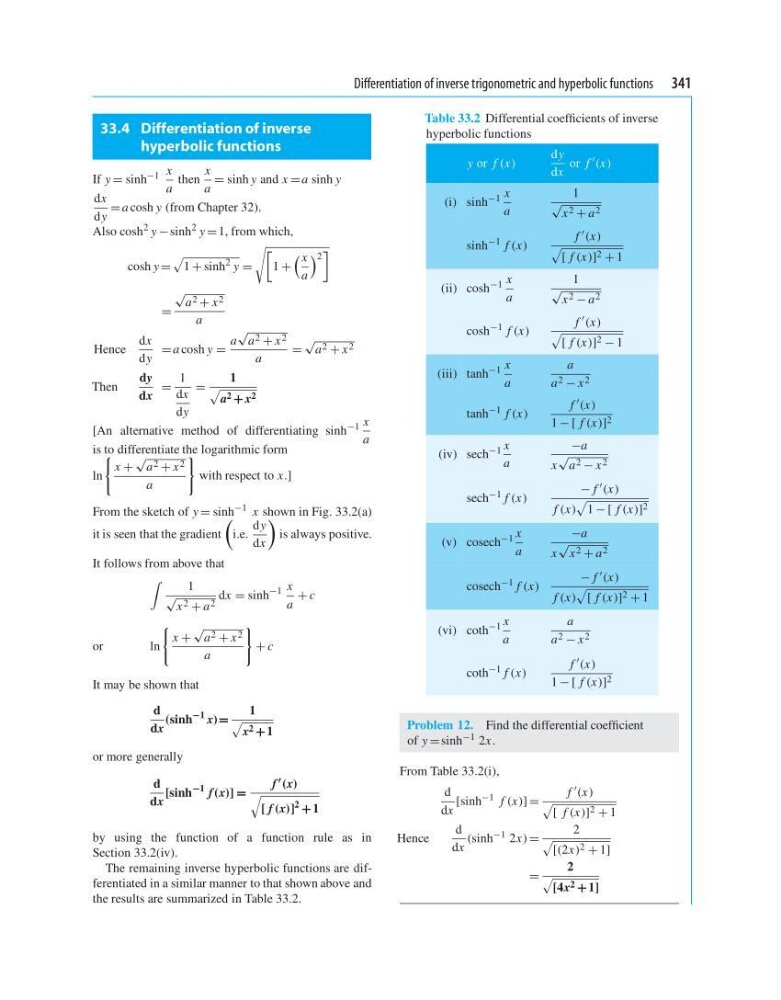
The remaining inverse hyperbolic functions are differentiated in a similar manner to that shown above and
the results are summarized in Table 33.2.
Table 33.2 Differential coefficients of inverse
hyperbolic functions
y or f (x)
dy
dx
or f (x)
(i) sinh −1 x
a
1
√
x 2 + a 2
sinh
−1 f (x)
f (x)
[ f (x)] 2 + 1
(ii) cosh −1 x
a
1
√
x 2 − a 2
cosh
−1 f (x)
f
(x)
[ f (x)] 2 − 1
(iii) tanh −1 x
a
a
a 2 − x 2
tanh −1 f (x)
f (x)
1 − [ f (x)] 2
(iv) sech −1 x
a
−a
x
√
a 2 − x 2
sech −1 f (x)
− f (x)
f (x)
1 − [ f (x)] 2
(v) cosech −1 x
a
−a
x
√
x 2 + a 2
cosech −1 f (x)
− f (x)
f (x)
[ f (x)] 2 + 1
(vi) coth
−1 x
a
a
a 2 − x 2
coth −1 f (x)
f (x)
1 − [ f (x)] 2
Problem 12. Find the differential coefficient
of y = sinh −1 2x.
From Table 33.2(i),
d
dx
[sinh −1 f (x)] =
f (x)
[ f (x)] 2 + 1
Hence
d
dx
(sinh −1 2x) =
2
[(2x) 2 + 1]
=
2
[4x 2 + 1]
33.4 Differentiation of inverse
hyperbolic functions
If y = sinh −1 x
a
then
x
a
= sinh y and x = a sinh y
dx
dy
= a cosh y (from Chapter 32).
Also cosh
2 y − sinh
2 y = 1, from which,
cosh y =
1 + sinh
2 y =
1 +
x
a
2
=
√
a 2 + x 2
a
Hence
dx
dy
= a cosh y =
a
√
a 2 + x 2
a
=
√
a 2 + x 2
Then
dy
dx
=
1
dx
dy
=
1
a 2 + x 2
[An alternative method of differentiating sinh
−1 x
a
is to differentiate the logarithmic form
ln
x +
√
a 2 + x 2
a
with respect to x.]
From the sketch of y = sinh
−1 x shown in Fig. 33.2(a)
it is seen that the gradient
i.e.
dy
dx
is always positive.
It follows from above that
1
√
x 2 + a 2
dx = sinh
−1 x
a
+ c
or
ln
x +
√
a 2 + x 2
a
+ c
It may be shown that
d
dx
(sinh
−1 x)=
1
x 2 + 1
or more generally
d
dx
[sinh
−1 f (x)] =
f (x)
[ f (x)]
2
+ 1
by using the function of a function rule as in
Section 33.2(iv).
The remaining inverse hyperbolic functions are differentiated in a similar manner to that shown above and
the results are summarized in Table 33.2.
Table 33.2 Differential coefficients of inverse
hyperbolic functions
y or f (x)
dy
dx
or f (x)
(i) sinh −1 x
a
1
√
x 2 + a 2
sinh
−1 f (x)
f (x)
[ f (x)] 2 + 1
(ii) cosh −1 x
a
1
√
x 2 − a 2
cosh
−1 f (x)
f
(x)
[ f (x)] 2 − 1
(iii) tanh −1 x
a
a
a 2 − x 2
tanh −1 f (x)
f (x)
1 − [ f (x)] 2
(iv) sech −1 x
a
−a
x
√
a 2 − x 2
sech −1 f (x)
− f (x)
f (x)
1 − [ f (x)] 2
(v) cosech −1 x
a
−a
x
√
x 2 + a 2
cosech −1 f (x)
− f (x)
f (x)
[ f (x)] 2 + 1
(vi) coth
−1 x
a
a
a 2 − x 2
coth −1 f (x)
f (x)
1 − [ f (x)] 2
Problem 12. Find the differential coefficient
of y = sinh −1 2x.
From Table 33.2(i),
d
dx
[sinh −1 f (x)] =
f (x)
[ f (x)] 2 + 1
Hence
d
dx
(sinh −1 2x) =
2
[(2x) 2 + 1]
=
2
[4x 2 + 1]