

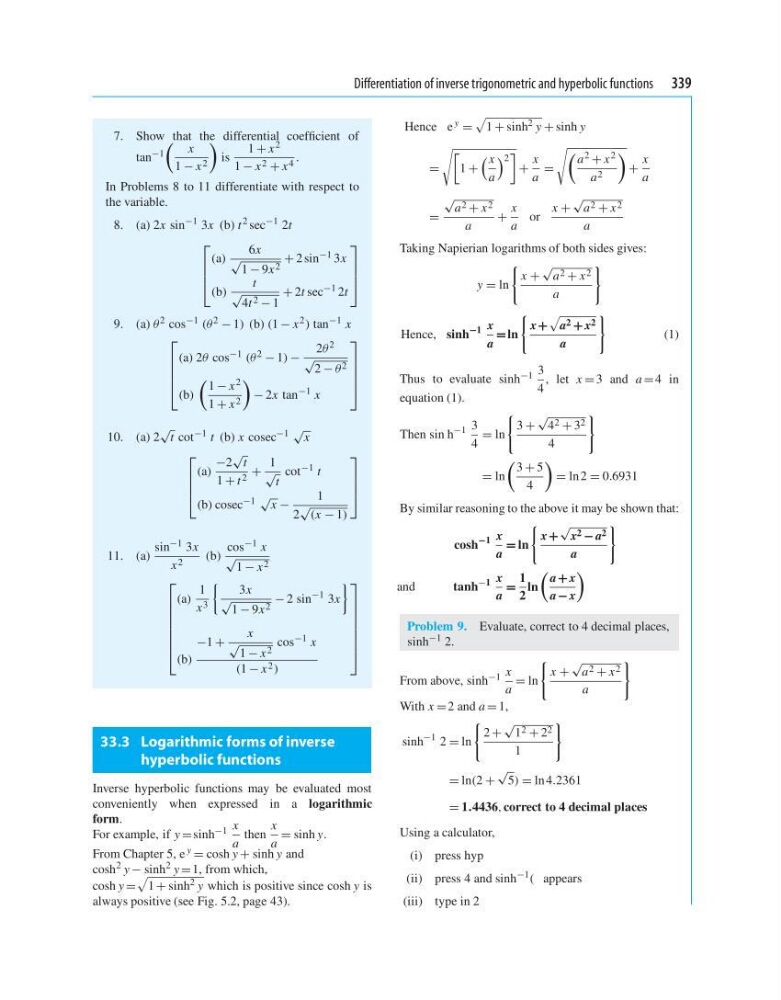
Differentiation of inverse trigonometric and hyperbolic functions 339
7. Show that the differential coefficient of
tan −1
x
1 − x 2
is
1 + x 2
1 − x 2 + x 4 .
In Problems 8 to 11 differentiate with respect to
the variable.
8. (a) 2x sin
−1 3x (b) t
2 sec
−1 2t
⎡
⎢
⎢
⎣
(a)
6x
√
1 − 9x 2
+ 2 sin −1 3x
(b)
t
√
4t 2 − 1
+ 2t sec −1 2t
⎤
⎥
⎥
⎦
9. (a) θ 2 cos −1 (θ 2 − 1) (b) (1 − x 2 ) tan −1 x
⎡
⎢
⎢
⎢
⎣
(a) 2θ cos −1 (θ 2 − 1) −
2θ 2
√
2 − θ 2
(b)
1 − x 2
1 + x 2
− 2x tan −1 x
⎤
⎥
⎥
⎥
⎦
10. (a) 2
√
t cot −1 t (b) x cosec −1 √
x
⎡
⎢
⎢
⎣
(a)
−2
√
t
1 + t 2 +
1
√
t
cot −1 t
(b) cosec −1 √
x −
1
2
√
(x − 1)
⎤
⎥
⎥
⎦
11. (a)
sin −1 3x
x 2
(b)
cos −1 x
√
1 − x 2
⎡
⎢
⎢
⎢
⎢
⎢
⎢
⎣
(a)
1
x 3
3x
√
1 − 9x 2
− 2 sin
−1 3x
(b)
−1 +
x
√
1 − x 2
cos −1 x
(1 − x 2 )
⎤
⎥
⎥
⎥
⎥
⎥
⎥
⎦
33.3 Logarithmic forms of inverse
hyperbolic functions
Inverse hyperbolic functions may be evaluated most
conveniently when expressed in a logarithmic
form.
For example, if y = sinh −1 x
a
then
x
a
= sinh y.
From Chapter 5, e y = cosh y + sinh y and
cosh
2 y − sinh
2 y = 1, from which,
cosh y =
1 + sinh 2 y which is positive since cosh y is
always positive (see Fig. 5.2, page 43).
Hence e y =
1 + sinh 2 y + sinh y
=
1 +
x
a
2
+
x
a
=
a 2 + x 2
a 2
+
x
a
=
√
a 2 + x 2
a
+
x
a
or
x +
√
a 2 + x 2
a
Taking Napierian logarithms of both sides gives:
y = ln
x +
√
a 2 + x 2
a
Hence, sinh
−1 x
a
= ln
x +
a 2 + x 2
a
(1)
Thus to evaluate sinh −1 3
4
, let x = 3 and a = 4 in
equation (1).
Then sin h
−1 3
4
= ln
3 +
√
4 2 + 3 2
4
= ln
3 + 5
4
= ln 2 = 0.6931
By similar reasoning to the above it may be shown that:
cosh
−1 x
a
= ln
x +
√
x 2 − a 2
a
and
tanh
−1 x
a
=
1
2
ln
a + x
a − x
Problem 9. Evaluate, correct to 4 decimal places,
sinh −1 2.
From above, sinh −1 x
a
= ln
x +
√
a 2 + x 2
a
With x = 2 and a = 1,
sinh
−1 2 = ln
2 +
√
1 2 + 2 2
1
= ln(2 +
√
5) = ln 4.2361
= 1.4436, correct to 4 decimal places
Using a calculator,
(i) press hyp
(ii) press 4 and sinh
−1 ( appears
(iii) type in 2
7. Show that the differential coefficient of
tan −1
x
1 − x 2
is
1 + x 2
1 − x 2 + x 4 .
In Problems 8 to 11 differentiate with respect to
the variable.
8. (a) 2x sin
−1 3x (b) t
2 sec
−1 2t
⎡
⎢
⎢
⎣
(a)
6x
√
1 − 9x 2
+ 2 sin −1 3x
(b)
t
√
4t 2 − 1
+ 2t sec −1 2t
⎤
⎥
⎥
⎦
9. (a) θ 2 cos −1 (θ 2 − 1) (b) (1 − x 2 ) tan −1 x
⎡
⎢
⎢
⎢
⎣
(a) 2θ cos −1 (θ 2 − 1) −
2θ 2
√
2 − θ 2
(b)
1 − x 2
1 + x 2
− 2x tan −1 x
⎤
⎥
⎥
⎥
⎦
10. (a) 2
√
t cot −1 t (b) x cosec −1 √
x
⎡
⎢
⎢
⎣
(a)
−2
√
t
1 + t 2 +
1
√
t
cot −1 t
(b) cosec −1 √
x −
1
2
√
(x − 1)
⎤
⎥
⎥
⎦
11. (a)
sin −1 3x
x 2
(b)
cos −1 x
√
1 − x 2
⎡
⎢
⎢
⎢
⎢
⎢
⎢
⎣
(a)
1
x 3
3x
√
1 − 9x 2
− 2 sin
−1 3x
(b)
−1 +
x
√
1 − x 2
cos −1 x
(1 − x 2 )
⎤
⎥
⎥
⎥
⎥
⎥
⎥
⎦
33.3 Logarithmic forms of inverse
hyperbolic functions
Inverse hyperbolic functions may be evaluated most
conveniently when expressed in a logarithmic
form.
For example, if y = sinh −1 x
a
then
x
a
= sinh y.
From Chapter 5, e y = cosh y + sinh y and
cosh
2 y − sinh
2 y = 1, from which,
cosh y =
1 + sinh 2 y which is positive since cosh y is
always positive (see Fig. 5.2, page 43).
Hence e y =
1 + sinh 2 y + sinh y
=
1 +
x
a
2
+
x
a
=
a 2 + x 2
a 2
+
x
a
=
√
a 2 + x 2
a
+
x
a
or
x +
√
a 2 + x 2
a
Taking Napierian logarithms of both sides gives:
y = ln
x +
√
a 2 + x 2
a
Hence, sinh
−1 x
a
= ln
x +
a 2 + x 2
a
(1)
Thus to evaluate sinh −1 3
4
, let x = 3 and a = 4 in
equation (1).
Then sin h
−1 3
4
= ln
3 +
√
4 2 + 3 2
4
= ln
3 + 5
4
= ln 2 = 0.6931
By similar reasoning to the above it may be shown that:
cosh
−1 x
a
= ln
x +
√
x 2 − a 2
a
and
tanh
−1 x
a
=
1
2
ln
a + x
a − x
Problem 9. Evaluate, correct to 4 decimal places,
sinh −1 2.
From above, sinh −1 x
a
= ln
x +
√
a 2 + x 2
a
With x = 2 and a = 1,
sinh
−1 2 = ln
2 +
√
1 2 + 2 2
1
= ln(2 +
√
5) = ln 4.2361
= 1.4436, correct to 4 decimal places
Using a calculator,
(i) press hyp
(ii) press 4 and sinh
−1 ( appears
(iii) type in 2