

Differentiation of implicit functions 323
i.e.
2x + 2y
dy
dx
= 0
Hence
dy
dx
= −
2x
2y
= −
x
y
Since x 2 +y 2 = 25, when x = 4, y =
(25 − 4 2 ) =±3
Thus when x = 4 and y =±3,
dy
dx
=−
4
±3
= ±
4
3
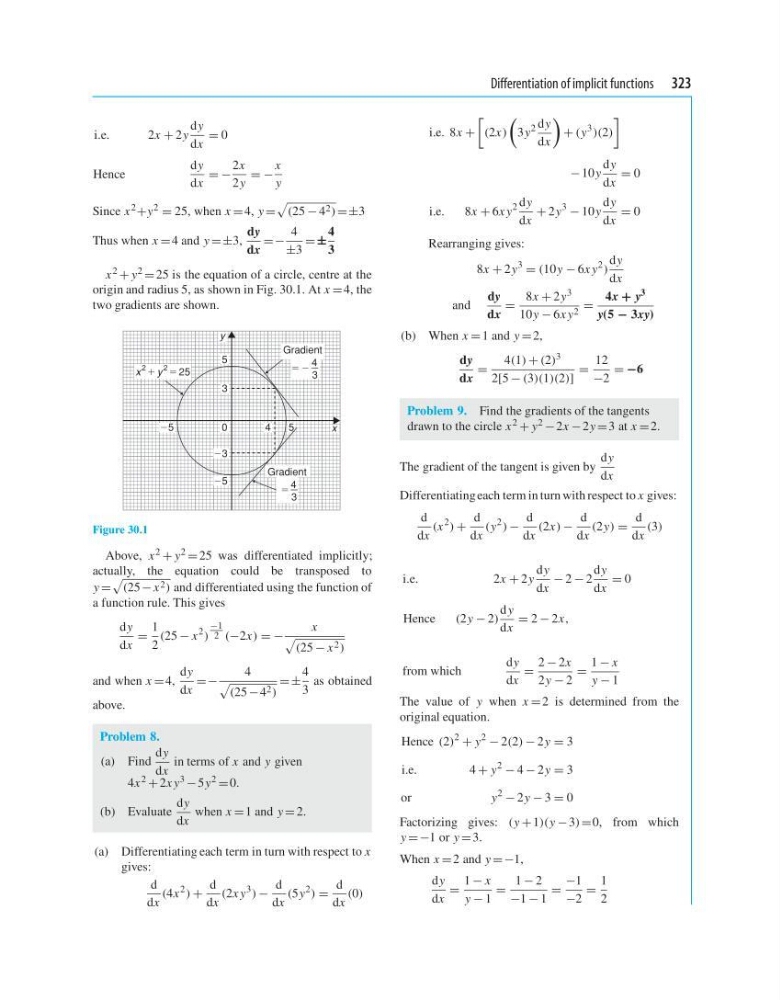
x 2 + y 2 = 25 is the equation of a circle, centre at the
origin and radius 5, as shown in Fig. 30.1. At x = 4, the
two gradients are shown.
y
5
3
0
4
5
x
23
25
25
Gradient
5 2
4
3
Gradient
5
4
3
x
2 1 y
2 5 25
Figure 30.1
Above, x 2 + y 2 = 25 was differentiated implicitly;
actually, the equation could be transposed to
y =
(25 − x 2 ) and differentiated using the function of
a function rule. This gives
dy
dx
=
1
2
(25 − x
2
)
−1
2 (−2x) = −
x
(25 − x 2 )
and when x = 4,
dy
dx
=−
4
(25 − 4 2 )
=±
4
3
as obtained
above.
Problem 8.
(a) Find
dy
dx
in terms of x and y given
4x 2 + 2x y 3 − 5y 2 = 0.
(b) Evaluate
dy
dx
when x = 1 and y = 2.
(a) Differentiating each term in turn with respect to x
gives:
d
dx
(4x
2
) +
d
dx
(2x y
3
) −
d
dx
(5y
2
) =
d
dx
(0)
i.e. 8x +
(2x)
3y
2 dy
dx
+ (y
3
)(2)
− 10y
dy
dx
= 0
i.e.
8x + 6x y
2 dy
dx
+ 2y
3
− 10y
dy
dx
= 0
Rearranging gives:
8x + 2y
3
= (10y − 6x y
2
)
dy
dx
and
dy
dx
=
8x + 2y 3
10y − 6x y 2 =
4x + y 3
y(5 − 3xy)
(b) When x = 1 and y = 2,
dy
dx
=
4(1) + (2) 3
2[5 − (3)(1)(2)]
=
12
−2
= −6
Problem 9. Find the gradients of the tangents
drawn to the circle x 2 + y 2 − 2x − 2y = 3 at x = 2.
The gradient of the tangent is given by
dy
dx
Differentiating each term in turn with respect to x gives:
d
dx
(x
2
) +
d
dx
(y
2
) −
d
dx
(2x) −
d
dx
(2y) =
d
dx
(3)
i.e.
2x + 2y
dy
dx
− 2 − 2
dy
dx
= 0
Hence
(2y − 2)
d y
dx
= 2 − 2x,
from which
dy
dx
=
2 − 2x
2y − 2
=
1 − x
y − 1
The value of y when x = 2 is determined from the
original equation.
Hence (2)
2
+ y
2
− 2(2) − 2y = 3
i.e.
4 + y
2
− 4 − 2y = 3
or
y
2
− 2y − 3 = 0
Factorizing gives: (y + 1)(y − 3) =0, from which
y =−1 or y = 3.
When x = 2 and y =−1,
dy
dx
=
1 − x
y − 1
=
1 − 2
−1 − 1
=
−1
−2
=
1
2
i.e.
2x + 2y
dy
dx
= 0
Hence
dy
dx
= −
2x
2y
= −
x
y
Since x 2 +y 2 = 25, when x = 4, y =
(25 − 4 2 ) =±3
Thus when x = 4 and y =±3,
dy
dx
=−
4
±3
= ±
4
3
x 2 + y 2 = 25 is the equation of a circle, centre at the
origin and radius 5, as shown in Fig. 30.1. At x = 4, the
two gradients are shown.
y
5
3
0
4
5
x
23
25
25
Gradient
5 2
4
3
Gradient
5
4
3
x
2 1 y
2 5 25
Figure 30.1
Above, x 2 + y 2 = 25 was differentiated implicitly;
actually, the equation could be transposed to
y =
(25 − x 2 ) and differentiated using the function of
a function rule. This gives
dy
dx
=
1
2
(25 − x
2
)
−1
2 (−2x) = −
x
(25 − x 2 )
and when x = 4,
dy
dx
=−
4
(25 − 4 2 )
=±
4
3
as obtained
above.
Problem 8.
(a) Find
dy
dx
in terms of x and y given
4x 2 + 2x y 3 − 5y 2 = 0.
(b) Evaluate
dy
dx
when x = 1 and y = 2.
(a) Differentiating each term in turn with respect to x
gives:
d
dx
(4x
2
) +
d
dx
(2x y
3
) −
d
dx
(5y
2
) =
d
dx
(0)
i.e. 8x +
(2x)
3y
2 dy
dx
+ (y
3
)(2)
− 10y
dy
dx
= 0
i.e.
8x + 6x y
2 dy
dx
+ 2y
3
− 10y
dy
dx
= 0
Rearranging gives:
8x + 2y
3
= (10y − 6x y
2
)
dy
dx
and
dy
dx
=
8x + 2y 3
10y − 6x y 2 =
4x + y 3
y(5 − 3xy)
(b) When x = 1 and y = 2,
dy
dx
=
4(1) + (2) 3
2[5 − (3)(1)(2)]
=
12
−2
= −6
Problem 9. Find the gradients of the tangents
drawn to the circle x 2 + y 2 − 2x − 2y = 3 at x = 2.
The gradient of the tangent is given by
dy
dx
Differentiating each term in turn with respect to x gives:
d
dx
(x
2
) +
d
dx
(y
2
) −
d
dx
(2x) −
d
dx
(2y) =
d
dx
(3)
i.e.
2x + 2y
dy
dx
− 2 − 2
dy
dx
= 0
Hence
(2y − 2)
d y
dx
= 2 − 2x,
from which
dy
dx
=
2 − 2x
2y − 2
=
1 − x
y − 1
The value of y when x = 2 is determined from the
original equation.
Hence (2)
2
+ y
2
− 2(2) − 2y = 3
i.e.
4 + y
2
− 4 − 2y = 3
or
y
2
− 2y − 3 = 0
Factorizing gives: (y + 1)(y − 3) =0, from which
y =−1 or y = 3.
When x = 2 and y =−1,
dy
dx
=
1 − x
y − 1
=
1 − 2
−1 − 1
=
−1
−2
=
1
2