

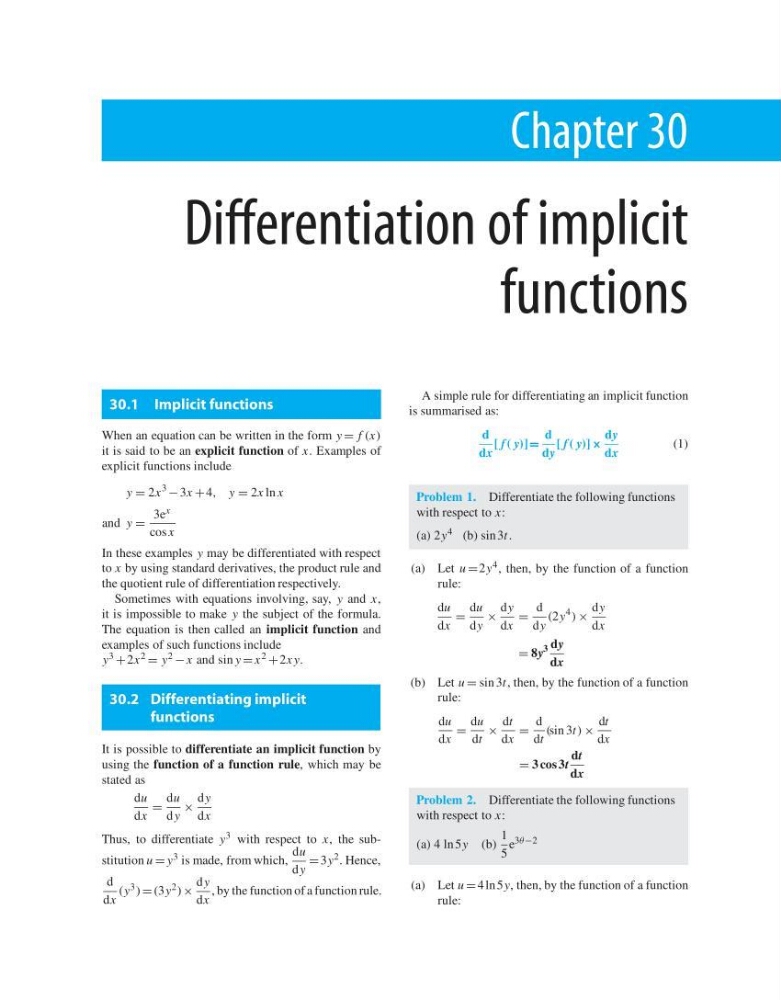
Chapter 30
Differentiation of implicit
functions
30.1 Implicit functions
When an equation can be written in the form y = f (x)
it is said to be an explicit function of x. Examples of
explicit functions include
y = 2x
3
− 3x + 4, y = 2x ln x
and y =
3e x
cos x
In these examples y may be differentiated with respect
to x by using standard derivatives, the product rule and
the quotient rule of differentiation respectively.
Sometimes with equations involving, say, y and x,
it is impossible to make y the subject of the formula.
The equation is then called an implicit function and
examples of such functions include
y 3 + 2x 2 = y 2 − x and sin y = x 2 + 2x y.
30.2 Differentiating implicit
functions
It is possible to differentiate an implicit function by
using the function of a function rule, which may be
stated as
du
dx
=
du
d y
×
d y
dx
Thus, to differentiate y 3 with respect to x, the substitution u = y 3 is made, from which,
du
d y
= 3y 2 . Hence,
d
dx
(y 3 ) = (3y 2 ) ×
d y
dx
, by the function of a function rule.
A simple rule for differentiating an implicit function
is summarised as:
d
dx
[ f ( y)]=
d
dy
[ f ( y)] ×
dy
dx
(1)
Problem 1. Differentiate the following functions
with respect to x:
(a) 2y 4 (b) sin 3t .
(a) Let u =2y 4 , then, by the function of a function
rule:
du
dx
=
du
dy
×
dy
dx
=
d
dy
(2y
4
) ×
dy
dx
= 8y
3 dy
dx
(b) Let u = sin 3t , then, by the function of a function
rule:
du
dx
=
du
dt
×
dt
dx
=
d
dt
(sin 3t ) ×
dt
dx
= 3 cos 3t
dt
dx
Problem 2. Differentiate the following functions
with respect to x:
(a) 4 ln 5y (b)
1
5
e 3θ−2
(a) Let u = 4 ln5y, then, by the function of a function
rule:
Differentiation of implicit
functions
30.1 Implicit functions
When an equation can be written in the form y = f (x)
it is said to be an explicit function of x. Examples of
explicit functions include
y = 2x
3
− 3x + 4, y = 2x ln x
and y =
3e x
cos x
In these examples y may be differentiated with respect
to x by using standard derivatives, the product rule and
the quotient rule of differentiation respectively.
Sometimes with equations involving, say, y and x,
it is impossible to make y the subject of the formula.
The equation is then called an implicit function and
examples of such functions include
y 3 + 2x 2 = y 2 − x and sin y = x 2 + 2x y.
30.2 Differentiating implicit
functions
It is possible to differentiate an implicit function by
using the function of a function rule, which may be
stated as
du
dx
=
du
d y
×
d y
dx
Thus, to differentiate y 3 with respect to x, the substitution u = y 3 is made, from which,
du
d y
= 3y 2 . Hence,
d
dx
(y 3 ) = (3y 2 ) ×
d y
dx
, by the function of a function rule.
A simple rule for differentiating an implicit function
is summarised as:
d
dx
[ f ( y)]=
d
dy
[ f ( y)] ×
dy
dx
(1)
Problem 1. Differentiate the following functions
with respect to x:
(a) 2y 4 (b) sin 3t .
(a) Let u =2y 4 , then, by the function of a function
rule:
du
dx
=
du
dy
×
dy
dx
=
d
dy
(2y
4
) ×
dy
dx
= 8y
3 dy
dx
(b) Let u = sin 3t , then, by the function of a function
rule:
du
dx
=
du
dt
×
dt
dx
=
d
dt
(sin 3t ) ×
dt
dx
= 3 cos 3t
dt
dx
Problem 2. Differentiate the following functions
with respect to x:
(a) 4 ln 5y (b)
1
5
e 3θ−2
(a) Let u = 4 ln5y, then, by the function of a function
rule: