

Some applications of differentiation 311
7. The power developed in a resistor R by a
battery of emf E and internal resistance r is
given by P =
E 2 R
(R + r) 2 . Differentiate P with
respect to R and show that the power is a
maximum when R = r.
8. Find the height and radius of a closed cylinder of volume 125 cm 3 which has the least
surface area.
height = 5.42 cm;
radius = 2.71 cm
9. Resistance to motion, F, of a moving vehicle, is given by F =
5
x + 100x. Determine the
minimum value of resistance.
[44.72]
10. An electrical voltage E is given by
E =(15 sin 50πt + 40 cos 50πt ) volts,
where t is the time in seconds. Determine the
maximum value of voltage.
[42.72 volts]
11. The fuel economy E of a car, in miles per
gallon, is given by:
E = 21 + 2.10 × 10
−2
v
2
− 3.80 × 10
−6
v
4
where v is the speed of the car in miles per
hour.
Determine, correct to 3 significant figures,
the most economical fuel consumption, and
the speed at which it is achieved.
[50.0 miles/gallon, 52.6 miles/hour]
28.5 Tangents and normals
Tangents
The equation of the tangent to a curve y = f (x) at the
point (x 1 , y 1 ) is given by:
y − y 1 = m(x − x 1 )
where m =
d y
dx
= gradient of the curve at (x 1 , y 1 ).
Problem 21. Find the equation of the tangent to
the curve y = x 2 − x − 2 at the point (1, −2).
Gradient, m
=
d y
dx
= 2x − 1
At the point (1, −2), x = 1 and m = 2(1) − 1 =1.
Hence the equation of the tangent is:
y − y 1 = m(x − x 1 )
i.e. y − (−2) = 1(x − 1)
i.e.
y + 2 = x − 1
or
y = x − 3
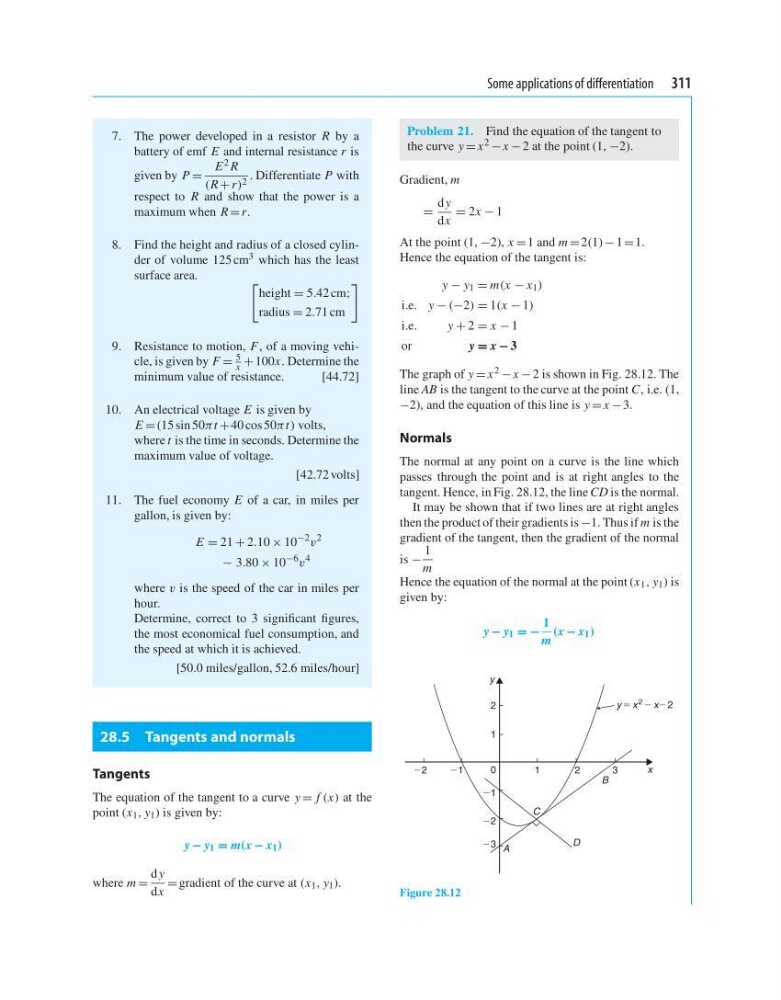
The graph of y = x 2 − x − 2 is shown in Fig. 28.12. The
line AB is the tangent to the curve at the point C, i.e. (1,
−2), and the equation of this line is y = x − 3.
Normals
The normal at any point on a curve is the line which
passes through the point and is at right angles to the
tangent. Hence, in Fig. 28.12, the line CD is the normal.
It may be shown that if two lines are at right angles
then the product of their gradients is −1. Thus if m is the
gradient of the tangent, then the gradient of the normal
is −
1
m
Hence the equation of the normal at the point (x 1 , y 1 ) is
given by:
y − y 1 = −
1
m
(x − x 1 )
2
1
1
2
3
0
Ϫ1
Ϫ1
Ϫ2
Ϫ2
Ϫ3
y ϭ x 2 Ϫ xϪ 2
y
x
B
C
D
A
Figure 28.12
7. The power developed in a resistor R by a
battery of emf E and internal resistance r is
given by P =
E 2 R
(R + r) 2 . Differentiate P with
respect to R and show that the power is a
maximum when R = r.
8. Find the height and radius of a closed cylinder of volume 125 cm 3 which has the least
surface area.
height = 5.42 cm;
radius = 2.71 cm
9. Resistance to motion, F, of a moving vehicle, is given by F =
5
x + 100x. Determine the
minimum value of resistance.
[44.72]
10. An electrical voltage E is given by
E =(15 sin 50πt + 40 cos 50πt ) volts,
where t is the time in seconds. Determine the
maximum value of voltage.
[42.72 volts]
11. The fuel economy E of a car, in miles per
gallon, is given by:
E = 21 + 2.10 × 10
−2
v
2
− 3.80 × 10
−6
v
4
where v is the speed of the car in miles per
hour.
Determine, correct to 3 significant figures,
the most economical fuel consumption, and
the speed at which it is achieved.
[50.0 miles/gallon, 52.6 miles/hour]
28.5 Tangents and normals
Tangents
The equation of the tangent to a curve y = f (x) at the
point (x 1 , y 1 ) is given by:
y − y 1 = m(x − x 1 )
where m =
d y
dx
= gradient of the curve at (x 1 , y 1 ).
Problem 21. Find the equation of the tangent to
the curve y = x 2 − x − 2 at the point (1, −2).
Gradient, m
=
d y
dx
= 2x − 1
At the point (1, −2), x = 1 and m = 2(1) − 1 =1.
Hence the equation of the tangent is:
y − y 1 = m(x − x 1 )
i.e. y − (−2) = 1(x − 1)
i.e.
y + 2 = x − 1
or
y = x − 3
The graph of y = x 2 − x − 2 is shown in Fig. 28.12. The
line AB is the tangent to the curve at the point C, i.e. (1,
−2), and the equation of this line is y = x − 3.
Normals
The normal at any point on a curve is the line which
passes through the point and is at right angles to the
tangent. Hence, in Fig. 28.12, the line CD is the normal.
It may be shown that if two lines are at right angles
then the product of their gradients is −1. Thus if m is the
gradient of the tangent, then the gradient of the normal
is −
1
m
Hence the equation of the normal at the point (x 1 , y 1 ) is
given by:
y − y 1 = −
1
m
(x − x 1 )
2
1
1
2
3
0
Ϫ1
Ϫ1
Ϫ2
Ϫ2
Ϫ3
y ϭ x 2 Ϫ xϪ 2
y
x
B
C
D
A
Figure 28.12