

308 Higher Engineering Mathematics
upwards to form an open box. Determine the
maximum possible volume of the box.
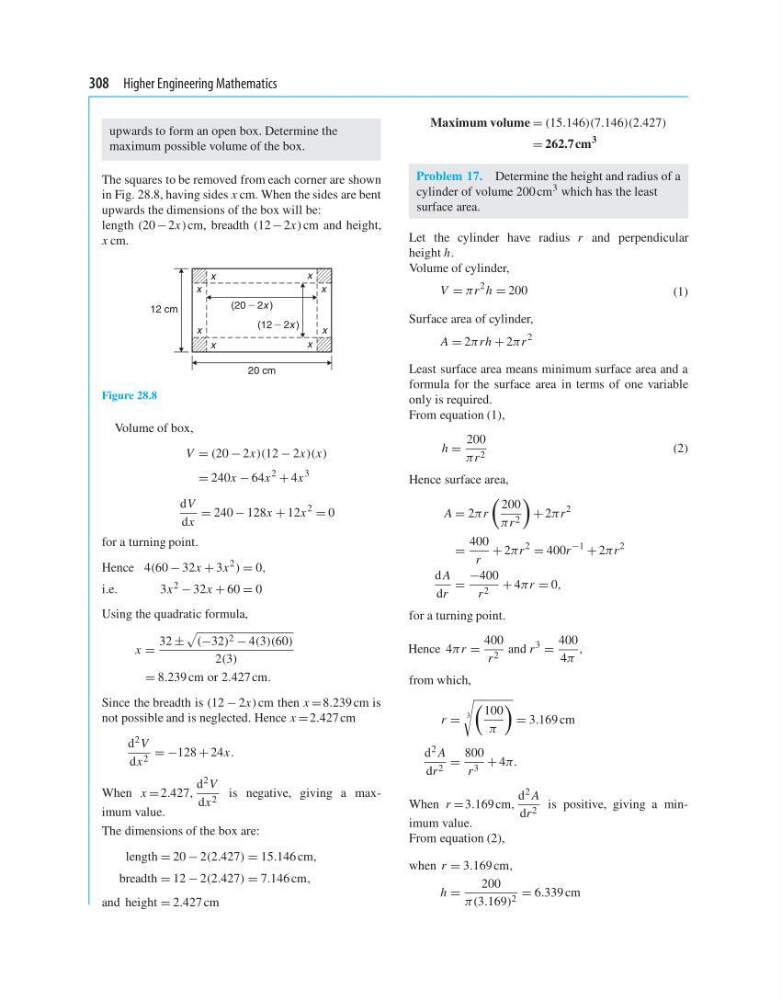
The squares to be removed from each corner are shown
in Fig. 28.8, having sides x cm. When the sides are bent
upwards the dimensions of the box will be:
length (20 − 2x) cm, breadth (12 − 2x) cm and height,
x cm.
12 cm
20 cm
(20 2 2x )
(12 2 2x )
x
x
x
x
x
x
x
x
Figure 28.8
Volume of box,
V = (20 − 2x)(12 − 2x)(x)
= 240x − 64x
2
+ 4x
3
dV
dx
= 240 − 128x + 12x
2
= 0
for a turning point.
Hence 4(60 − 32x + 3x
2
) = 0,
i.e.
3x 2 − 32x + 60 = 0
Using the quadratic formula,
x =
32 ±
(−32) 2 − 4(3)(60)
2(3)
= 8.239 cm or 2.427 cm.
Since the breadth is (12 − 2x) cm then x = 8.239 cm is
not possible and is neglected. Hence x = 2.427 cm
d 2 V
dx 2 = −128 + 24x.
When x = 2.427,
d 2 V
dx 2 is negative, giving a maximum value.
The dimensions of the box are:
length = 20 − 2(2.427) = 15.146 cm,
breadth = 12 − 2(2.427) = 7.146 cm,
and height = 2.427 cm
Maximum volume = (15.146)(7.146)(2.427)
= 262.7 cm
3
Problem 17. Determine the height and radius of a
cylinder of volume 200 cm 3 which has the least
surface area.
Let the cylinder have radius r and perpendicular
height h.
Volume of cylinder,
V = πr
2 h = 200
(1)
Surface area of cylinder,
A = 2πrh + 2πr
2
Least surface area means minimum surface area and a
formula for the surface area in terms of one variable
only is required.
From equation (1),
h =
200
πr 2
(2)
Hence surface area,
A = 2πr
200
πr 2
+ 2πr
2
=
400
r
+ 2πr
2
= 400r
−1
+ 2πr
2
d A
dr
=
−400
r 2 + 4πr = 0,
for a turning point.
Hence 4πr =
400
r 2 and r
3
=
400
4π
,
from which,
r =
3
100
π
= 3.169 cm
d 2 A
dr 2 =
800
r 3 + 4π.
When r = 3.169 cm,
d 2 A
dr 2 is positive, giving a minimum value.
From equation (2),
when r = 3.169 cm,
h =
200
π(3.169) 2 = 6.339 cm
upwards to form an open box. Determine the
maximum possible volume of the box.
The squares to be removed from each corner are shown
in Fig. 28.8, having sides x cm. When the sides are bent
upwards the dimensions of the box will be:
length (20 − 2x) cm, breadth (12 − 2x) cm and height,
x cm.
12 cm
20 cm
(20 2 2x )
(12 2 2x )
x
x
x
x
x
x
x
x
Figure 28.8
Volume of box,
V = (20 − 2x)(12 − 2x)(x)
= 240x − 64x
2
+ 4x
3
dV
dx
= 240 − 128x + 12x
2
= 0
for a turning point.
Hence 4(60 − 32x + 3x
2
) = 0,
i.e.
3x 2 − 32x + 60 = 0
Using the quadratic formula,
x =
32 ±
(−32) 2 − 4(3)(60)
2(3)
= 8.239 cm or 2.427 cm.
Since the breadth is (12 − 2x) cm then x = 8.239 cm is
not possible and is neglected. Hence x = 2.427 cm
d 2 V
dx 2 = −128 + 24x.
When x = 2.427,
d 2 V
dx 2 is negative, giving a maximum value.
The dimensions of the box are:
length = 20 − 2(2.427) = 15.146 cm,
breadth = 12 − 2(2.427) = 7.146 cm,
and height = 2.427 cm
Maximum volume = (15.146)(7.146)(2.427)
= 262.7 cm
3
Problem 17. Determine the height and radius of a
cylinder of volume 200 cm 3 which has the least
surface area.
Let the cylinder have radius r and perpendicular
height h.
Volume of cylinder,
V = πr
2 h = 200
(1)
Surface area of cylinder,
A = 2πrh + 2πr
2
Least surface area means minimum surface area and a
formula for the surface area in terms of one variable
only is required.
From equation (1),
h =
200
πr 2
(2)
Hence surface area,
A = 2πr
200
πr 2
+ 2πr
2
=
400
r
+ 2πr
2
= 400r
−1
+ 2πr
2
d A
dr
=
−400
r 2 + 4πr = 0,
for a turning point.
Hence 4πr =
400
r 2 and r
3
=
400
4π
,
from which,
r =
3
100
π
= 3.169 cm
d 2 A
dr 2 =
800
r 3 + 4π.
When r = 3.169 cm,
d 2 A
dr 2 is positive, giving a minimum value.
From equation (2),
when r = 3.169 cm,
h =
200
π(3.169) 2 = 6.339 cm