

306 Higher Engineering Mathematics
Hence (−2, 9) is a maximum point.
When x = 3,
d 2 y
dx 2 = 2(3) − 1 = 5,
which is positive.
Hence
3, −11
5
6
is a minimum point.
Knowing (−2, 9) is a maximum point (i.e. crest of
a wave), and
3, −11
5
6
is a minimum point (i.e.
bottom of a valley) and that when x = 0, y =
5
3 , a
sketch may be drawn as shown in Fig. 28.6.
x
y
2
1
0
21
22
212
211
5
6
28
24
4
8
9
12
x 3
3
x 2
2
5
3
26x 1
y5 2
3
Figure 28.6
Problem 14. Determine the turning points on the
curve y = 4 sin x − 3 cos x in the range x = 0 to
x = 2π radians, and distinguish between them.
Sketch the curve over one cycle.
Since y = 4 sin x − 3 cos x
then
d y
dx
= 4 cos x + 3 sin x = 0,
for a turning point, from which,
4 cos x = −3 sin x and
−4
3
=
sin x
cos x
= tan x
Hence x = tan −1
−4
3
= 126.87 ◦ or 306.87 ◦ , since
tangent is negative in the second and fourth quadrants.
When x = 126.87
◦ ,
y = 4 sin 126.87
◦
− 3 cos126.87
◦
= 5
When x = 306.87 ◦ ,
y = 4 sin 306.87
◦
− 3 cos 306.87
◦
= −5
126.87
◦
=
126.87
◦
×
π
180
radians
= 2.214 rad
306.87
◦
=
306.87
◦
×
π
180
radians
= 5.356 rad
Hence (2.214, 5) and (5.356, −5) are the
co-ordinates of the turning points.
d 2 y
dx 2 = −4 sin x + 3 cos x
When x = 2.214 rad,
d 2 y
dx 2 = −4 sin2.214 + 3 cos 2.214,
which is negative.
Hence (2.214, 5) is a maximum point.
When x = 5.356 rad,
d 2 y
dx 2 = −4 sin 5.356 + 3 cos5.356,
which is positive.
Hence (5.356, −5) is a minimum point.
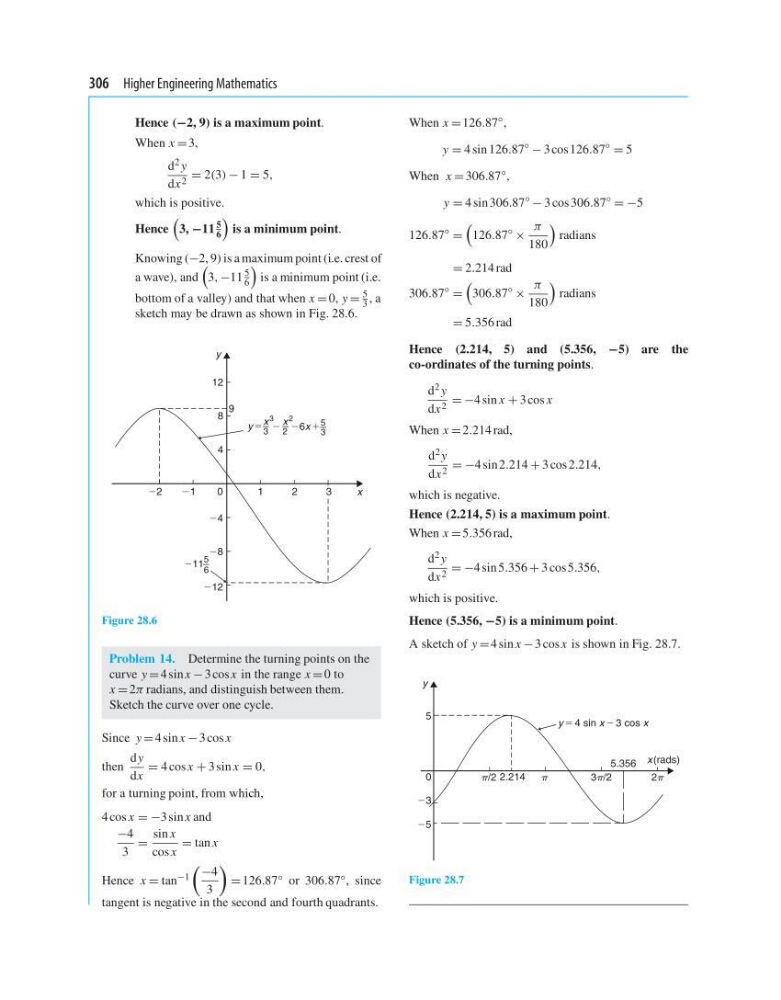
A sketch of y = 4 sin x − 3 cos x is shown in Fig. 28.7.
Ϫ3
Ϫ5
5
0
2.214
5.356
/2
3/2
2
y ϭ 4 sin x Ϫ 3 cos x
y
x (rads)
Figure 28.7
Hence (−2, 9) is a maximum point.
When x = 3,
d 2 y
dx 2 = 2(3) − 1 = 5,
which is positive.
Hence
3, −11
5
6
is a minimum point.
Knowing (−2, 9) is a maximum point (i.e. crest of
a wave), and
3, −11
5
6
is a minimum point (i.e.
bottom of a valley) and that when x = 0, y =
5
3 , a
sketch may be drawn as shown in Fig. 28.6.
x
y
2
1
0
21
22
212
211
5
6
28
24
4
8
9
12
x 3
3
x 2
2
5
3
26x 1
y5 2
3
Figure 28.6
Problem 14. Determine the turning points on the
curve y = 4 sin x − 3 cos x in the range x = 0 to
x = 2π radians, and distinguish between them.
Sketch the curve over one cycle.
Since y = 4 sin x − 3 cos x
then
d y
dx
= 4 cos x + 3 sin x = 0,
for a turning point, from which,
4 cos x = −3 sin x and
−4
3
=
sin x
cos x
= tan x
Hence x = tan −1
−4
3
= 126.87 ◦ or 306.87 ◦ , since
tangent is negative in the second and fourth quadrants.
When x = 126.87
◦ ,
y = 4 sin 126.87
◦
− 3 cos126.87
◦
= 5
When x = 306.87 ◦ ,
y = 4 sin 306.87
◦
− 3 cos 306.87
◦
= −5
126.87
◦
=
126.87
◦
×
π
180
radians
= 2.214 rad
306.87
◦
=
306.87
◦
×
π
180
radians
= 5.356 rad
Hence (2.214, 5) and (5.356, −5) are the
co-ordinates of the turning points.
d 2 y
dx 2 = −4 sin x + 3 cos x
When x = 2.214 rad,
d 2 y
dx 2 = −4 sin2.214 + 3 cos 2.214,
which is negative.
Hence (2.214, 5) is a maximum point.
When x = 5.356 rad,
d 2 y
dx 2 = −4 sin 5.356 + 3 cos5.356,
which is positive.
Hence (5.356, −5) is a minimum point.
A sketch of y = 4 sin x − 3 cos x is shown in Fig. 28.7.
Ϫ3
Ϫ5
5
0
2.214
5.356
/2
3/2
2
y ϭ 4 sin x Ϫ 3 cos x
y
x (rads)
Figure 28.7