

Some applications of differentiation 301
x
t
Time
Distance
Figure 28.1
␦x
␦t
B
A
Time
Distance
Figure 28.2
for the distance x is known in terms of time t then the
velocity is obtained by differentiating the expression.
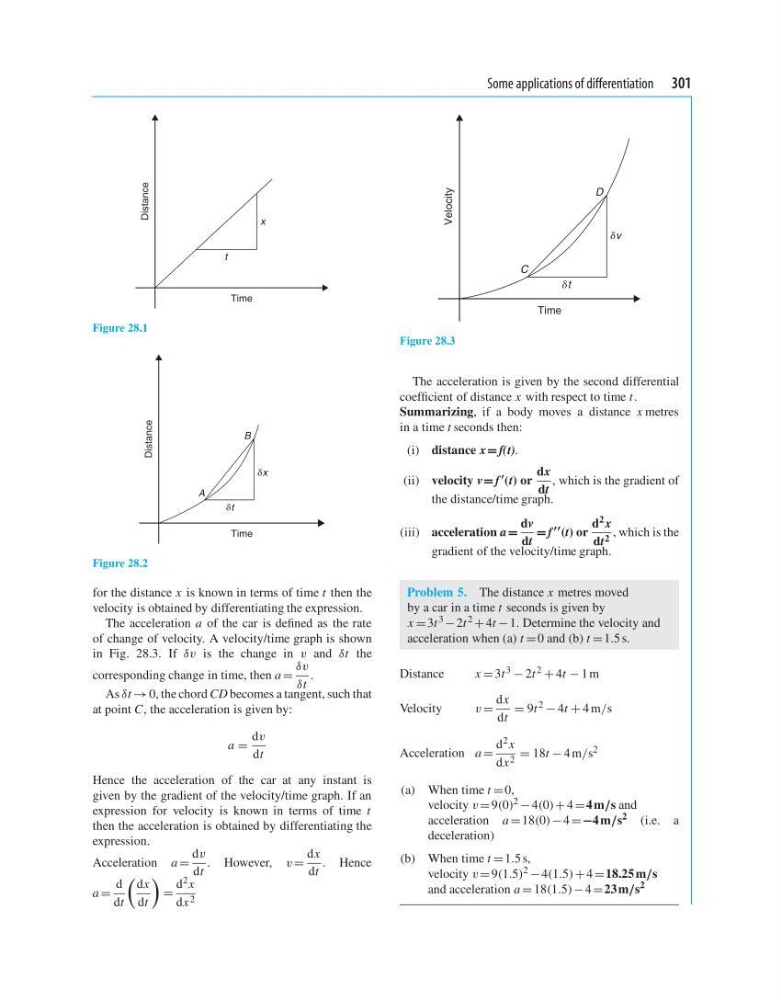
The acceleration a of the car is defined as the rate
of change of velocity. A velocity/time graph is shown
in Fig. 28.3. If δv is the change in v and δt the
corresponding change in time, then a =
δv
δt
.
As δt → 0, the chord CD becomes a tangent, such that
at point C, the acceleration is given by:
a =
dv
dt
Hence the acceleration of the car at any instant is
given by the gradient of the velocity/time graph. If an
expression for velocity is known in terms of time t
then the acceleration is obtained by differentiating the
expression.
Acceleration a =
dv
dt
. However, v =
dx
dt
. Hence
a =
d
dt
dx
dt
=
d 2 x
dx 2
␦v
␦t
D
C
Time
Velocity
Figure 28.3
The acceleration is given by the second differential
coefficient of distance x with respect to time t .
Summarizing, if a body moves a distance x metres
in a time t seconds then:
(i) distance x = f(t).
(ii) velocity v = f (t) or
dx
dt
, which is the gradient of
the distance/time graph.
(iii) acceleration a =
dv
dt
= f (t) or
d 2 x
dt 2 , which is the
gradient of the velocity/time graph.
Problem 5. The distance x metres moved
by a car in a time t seconds is given by
x = 3t 3 − 2t 2 + 4t − 1. Determine the velocity and
acceleration when (a) t = 0 and (b) t = 1.5 s.
Distance
x = 3t 3 − 2t 2 + 4t − 1 m
Velocity
v =
dx
dt
= 9t 2 − 4t + 4 m/s
Acceleration a =
d 2 x
dx 2 = 18t − 4 m/s 2
(a) When time t = 0,
velocity v = 9(0) 2 − 4(0) + 4 =4 m/s and
acceleration a = 18(0) − 4 = −4 m/s 2 (i.e. a
deceleration)
(b) When time t = 1.5 s,
velocity v = 9(1.5) 2 − 4(1.5) + 4 =18.25 m/s
and acceleration a = 18(1.5) − 4 =23 m/s
2
x
t
Time
Distance
Figure 28.1
␦x
␦t
B
A
Time
Distance
Figure 28.2
for the distance x is known in terms of time t then the
velocity is obtained by differentiating the expression.
The acceleration a of the car is defined as the rate
of change of velocity. A velocity/time graph is shown
in Fig. 28.3. If δv is the change in v and δt the
corresponding change in time, then a =
δv
δt
.
As δt → 0, the chord CD becomes a tangent, such that
at point C, the acceleration is given by:
a =
dv
dt
Hence the acceleration of the car at any instant is
given by the gradient of the velocity/time graph. If an
expression for velocity is known in terms of time t
then the acceleration is obtained by differentiating the
expression.
Acceleration a =
dv
dt
. However, v =
dx
dt
. Hence
a =
d
dt
dx
dt
=
d 2 x
dx 2
␦v
␦t
D
C
Time
Velocity
Figure 28.3
The acceleration is given by the second differential
coefficient of distance x with respect to time t .
Summarizing, if a body moves a distance x metres
in a time t seconds then:
(i) distance x = f(t).
(ii) velocity v = f (t) or
dx
dt
, which is the gradient of
the distance/time graph.
(iii) acceleration a =
dv
dt
= f (t) or
d 2 x
dt 2 , which is the
gradient of the velocity/time graph.
Problem 5. The distance x metres moved
by a car in a time t seconds is given by
x = 3t 3 − 2t 2 + 4t − 1. Determine the velocity and
acceleration when (a) t = 0 and (b) t = 1.5 s.
Distance
x = 3t 3 − 2t 2 + 4t − 1 m
Velocity
v =
dx
dt
= 9t 2 − 4t + 4 m/s
Acceleration a =
d 2 x
dx 2 = 18t − 4 m/s 2
(a) When time t = 0,
velocity v = 9(0) 2 − 4(0) + 4 =4 m/s and
acceleration a = 18(0) − 4 = −4 m/s 2 (i.e. a
deceleration)
(b) When time t = 1.5 s,
velocity v = 9(1.5) 2 − 4(1.5) + 4 =18.25 m/s
and acceleration a = 18(1.5) − 4 =23 m/s
2