

Scalar and vector products 283
Now try the following exercise
Exercise 113 Further problems on vector
products
In problems 1 to 4, determine the quantities
stated when
p =3i +2k, q =i − 2j +3k and
r =−4i +3j − k.
1. (a) p × q (b) q × p
[(a) 4i − 7j −6k (b) −4i + 7j +6k]
2. (a) |p × r| (b) |r × q|
[(a) 11.92 (b) 13.96]
3. (a) 2p × 3r (b) (p +r) × q
(a) −36i −30j −54k
(b) 11i +4j −k
4. (a) p × (r × q) (b) (3p × 2r) × q
(a) −22i − j +33k
(b) 18i +162j +102k
5. For vectors p =4i − j +2k and
q =−2i +3j − 2k determine: (i) p • q
(ii) p × q (iii) |p ×q| (iv) q × p and
(v) the angle between the vectors.
⎡
⎢
⎣
(i) −15 (ii) −4i + 4j +10k
(iii) 11.49 (iv) 4i −4j − 10k
(v) 142.55 ◦
⎤
⎥
⎦
6. For vectors a =−7i + 4j +
1
2 k and b =6i −
5j −k find (i) a • b (ii) a × b (iii) |a ×b|
(iv) b ×a and (v) the angle between the
vectors.
⎡
⎢
⎣
(i) −62
1
2 (ii) −1
1
2 i − 4j +11k
(iii) 11.80 (iv) 1
1
2 i +4j − 11k
(v) 169.31 ◦
⎤
⎥
⎦
7. Forces of (i + 3j), (−2i − j), (i − 2j) newtons
act at three points having position vectors of
(2i + 5j), 4j and (−i + j) metres respectively.
Calculate the magnitude of the moment.
[10 Nm]
8. A force of (2i − j + k) newtons acts on a line
through point P having co-ordinates (0, 3, 1)
metres. Determine the moment vector and its
magnitude about point Q having co-ordinates
(4, 0, −1) metres.
M = (5i + 8j − 2k) Nm,
|M| =9.64 Nm
9. A sphere is rotating with angular velocity ω
about the z-axis of a system, the axis coinciding with the axis of the sphere. Determine the
velocity vector and its magnitude at position
(−5i +2j − 7k) m, when the angular velocity
is (i + 2j) rad/s.
υ =−14i +7j +12k,
|υ|= 19.72 m/s
10. Calculate the velocity vector and its magnitude for a particle rotating about the z-axis
at an angular velocity of (3i − j +2k) rad/s
when the position vector of the particle is at
(i − 5j +4k) m.
[6i −10j −14k, 18.22 m/s]
26.4 Vector equation of a line
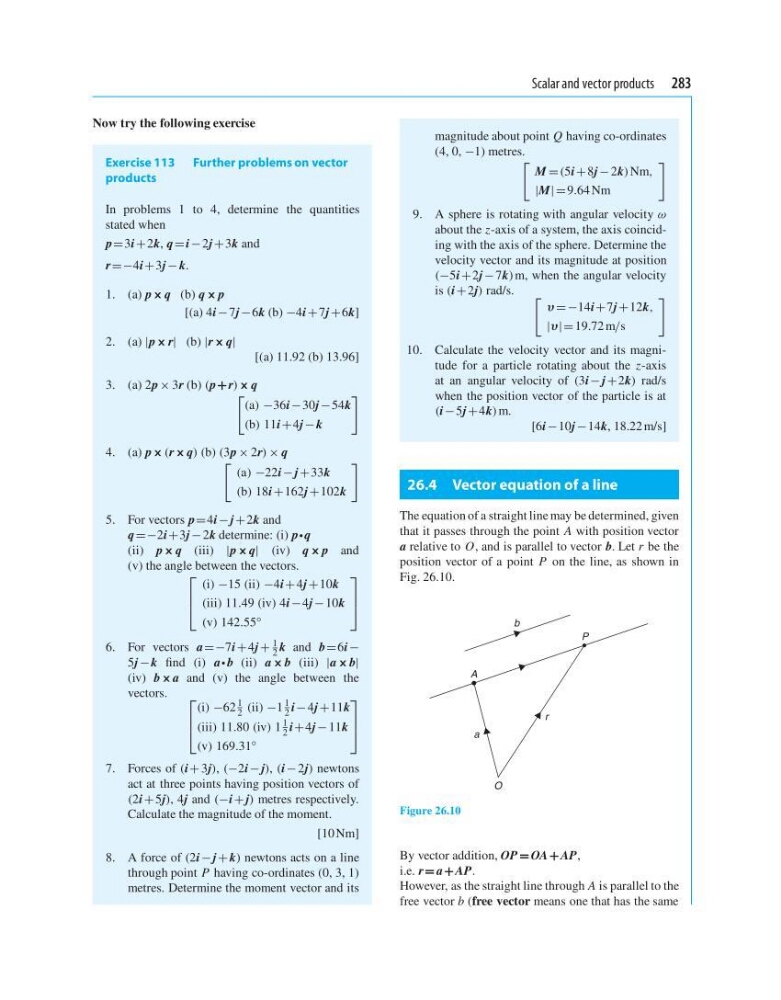
The equation of a straight line may be determined, given
that it passes through the point A with position vector
a relative to O, and is parallel to vector b. Let r be the
position vector of a point P on the line, as shown in
Fig. 26.10.
O
a
A
P
b
r
Figure 26.10
By vector addition, OP = OA + AP,
i.e. r = a +AP.
However, as the straight line through A is parallel to the
free vector b (free vector means one that has the same
Now try the following exercise
Exercise 113 Further problems on vector
products
In problems 1 to 4, determine the quantities
stated when
p =3i +2k, q =i − 2j +3k and
r =−4i +3j − k.
1. (a) p × q (b) q × p
[(a) 4i − 7j −6k (b) −4i + 7j +6k]
2. (a) |p × r| (b) |r × q|
[(a) 11.92 (b) 13.96]
3. (a) 2p × 3r (b) (p +r) × q
(a) −36i −30j −54k
(b) 11i +4j −k
4. (a) p × (r × q) (b) (3p × 2r) × q
(a) −22i − j +33k
(b) 18i +162j +102k
5. For vectors p =4i − j +2k and
q =−2i +3j − 2k determine: (i) p • q
(ii) p × q (iii) |p ×q| (iv) q × p and
(v) the angle between the vectors.
⎡
⎢
⎣
(i) −15 (ii) −4i + 4j +10k
(iii) 11.49 (iv) 4i −4j − 10k
(v) 142.55 ◦
⎤
⎥
⎦
6. For vectors a =−7i + 4j +
1
2 k and b =6i −
5j −k find (i) a • b (ii) a × b (iii) |a ×b|
(iv) b ×a and (v) the angle between the
vectors.
⎡
⎢
⎣
(i) −62
1
2 (ii) −1
1
2 i − 4j +11k
(iii) 11.80 (iv) 1
1
2 i +4j − 11k
(v) 169.31 ◦
⎤
⎥
⎦
7. Forces of (i + 3j), (−2i − j), (i − 2j) newtons
act at three points having position vectors of
(2i + 5j), 4j and (−i + j) metres respectively.
Calculate the magnitude of the moment.
[10 Nm]
8. A force of (2i − j + k) newtons acts on a line
through point P having co-ordinates (0, 3, 1)
metres. Determine the moment vector and its
magnitude about point Q having co-ordinates
(4, 0, −1) metres.
M = (5i + 8j − 2k) Nm,
|M| =9.64 Nm
9. A sphere is rotating with angular velocity ω
about the z-axis of a system, the axis coinciding with the axis of the sphere. Determine the
velocity vector and its magnitude at position
(−5i +2j − 7k) m, when the angular velocity
is (i + 2j) rad/s.
υ =−14i +7j +12k,
|υ|= 19.72 m/s
10. Calculate the velocity vector and its magnitude for a particle rotating about the z-axis
at an angular velocity of (3i − j +2k) rad/s
when the position vector of the particle is at
(i − 5j +4k) m.
[6i −10j −14k, 18.22 m/s]
26.4 Vector equation of a line
The equation of a straight line may be determined, given
that it passes through the point A with position vector
a relative to O, and is parallel to vector b. Let r be the
position vector of a point P on the line, as shown in
Fig. 26.10.
O
a
A
P
b
r
Figure 26.10
By vector addition, OP = OA + AP,
i.e. r = a +AP.
However, as the straight line through A is parallel to the
free vector b (free vector means one that has the same