

Methods of adding alternating waveforms 273
v 1 5 15 V
v 1
v R
v 2 5 25 V
/6 or 308
1508
(b)
(a)
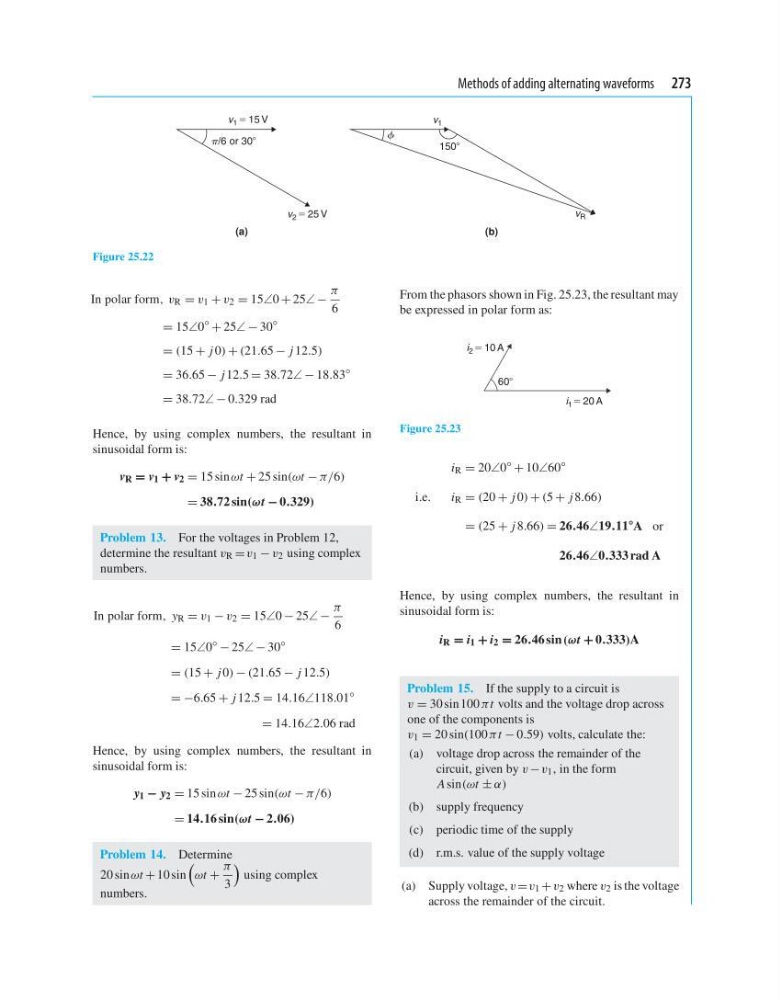
Figure 25.22
In polar form, v R = v 1 + v 2 = 15∠0 + 25∠ −
π
6
= 15∠0
◦
+ 25∠ − 30
◦
= (15 + j 0) + (21.65 − j 12.5)
= 36.65 − j 12.5 = 38.72∠ − 18.83
◦
= 38.72∠ − 0.329 rad
Hence, by using complex numbers, the resultant in
sinusoidal form is:
v R = v 1 + v 2 = 15 sin ωt + 25 sin(ωt − π/6)
= 38.72 sin(ωt − 0.329)
Problem 13. For the voltages in Problem 12,
determine the resultant v R = v 1 − v 2 using complex
numbers.
In polar form, y R = v 1 − v 2 = 15∠0 − 25∠ −
π
6
= 15∠0
◦
− 25∠ − 30
◦
= (15 + j 0) − (21.65 − j 12.5)
= −6.65 + j 12.5 = 14.16∠118.01
◦
= 14.16∠2.06 rad
Hence, by using complex numbers, the resultant in
sinusoidal form is:
y 1 − y 2 = 15 sin ωt − 25 sin(ωt − π/6)
= 14.16 sin(ωt − 2.06)
Problem 14. Determine
20 sin ωt + 10 sin
ωt +
π
3
using complex
numbers.
From the phasors shown in Fig. 25.23, the resultant may
be expressed in polar form as:
i 2 5 10 A
i 1 5 20 A
608
Figure 25.23
i R = 20∠0
◦
+ 10∠60
◦
i.e.
i R = (20 + j 0) + (5 + j 8.66)
= (25 + j 8.66) = 26.46∠19.11
◦ A or
26.46∠0.333 rad A
Hence, by using complex numbers, the resultant in
sinusoidal form is:
i R = i 1 + i 2 = 26.46 sin(ωt + 0.333)A
Problem 15. If the supply to a circuit is
v = 30 sin 100 πt volts and the voltage drop across
one of the components is
v 1 = 20 sin(100 πt − 0.59) volts, calculate the:
(a) voltage drop across the remainder of the
circuit, given by v − v 1 , in the form
A sin(ωt ± α)
(b) supply frequency
(c) periodic time of the supply
(d) r.m.s. value of the supply voltage
(a) Supply voltage, v =v 1 + v 2 where v 2 is the voltage
across the remainder of the circuit.
v 1 5 15 V
v 1
v R
v 2 5 25 V
/6 or 308
1508
(b)
(a)
Figure 25.22
In polar form, v R = v 1 + v 2 = 15∠0 + 25∠ −
π
6
= 15∠0
◦
+ 25∠ − 30
◦
= (15 + j 0) + (21.65 − j 12.5)
= 36.65 − j 12.5 = 38.72∠ − 18.83
◦
= 38.72∠ − 0.329 rad
Hence, by using complex numbers, the resultant in
sinusoidal form is:
v R = v 1 + v 2 = 15 sin ωt + 25 sin(ωt − π/6)
= 38.72 sin(ωt − 0.329)
Problem 13. For the voltages in Problem 12,
determine the resultant v R = v 1 − v 2 using complex
numbers.
In polar form, y R = v 1 − v 2 = 15∠0 − 25∠ −
π
6
= 15∠0
◦
− 25∠ − 30
◦
= (15 + j 0) − (21.65 − j 12.5)
= −6.65 + j 12.5 = 14.16∠118.01
◦
= 14.16∠2.06 rad
Hence, by using complex numbers, the resultant in
sinusoidal form is:
y 1 − y 2 = 15 sin ωt − 25 sin(ωt − π/6)
= 14.16 sin(ωt − 2.06)
Problem 14. Determine
20 sin ωt + 10 sin
ωt +
π
3
using complex
numbers.
From the phasors shown in Fig. 25.23, the resultant may
be expressed in polar form as:
i 2 5 10 A
i 1 5 20 A
608
Figure 25.23
i R = 20∠0
◦
+ 10∠60
◦
i.e.
i R = (20 + j 0) + (5 + j 8.66)
= (25 + j 8.66) = 26.46∠19.11
◦ A or
26.46∠0.333 rad A
Hence, by using complex numbers, the resultant in
sinusoidal form is:
i R = i 1 + i 2 = 26.46 sin(ωt + 0.333)A
Problem 15. If the supply to a circuit is
v = 30 sin 100 πt volts and the voltage drop across
one of the components is
v 1 = 20 sin(100 πt − 0.59) volts, calculate the:
(a) voltage drop across the remainder of the
circuit, given by v − v 1 , in the form
A sin(ωt ± α)
(b) supply frequency
(c) periodic time of the supply
(d) r.m.s. value of the supply voltage
(a) Supply voltage, v =v 1 + v 2 where v 2 is the voltage
across the remainder of the circuit.