

Chapter 25
Methods of adding
alternating waveforms
25.1 Combination of two periodic
functions
There are a number of instances in engineering and science where waveforms have to be combined and where
it is required to determine the single phasor (called
the resultant) that could replace two or more separate
phasors. Uses are found in electrical alternating current theory, in mechanical vibrations, in the addition of
forces and with sound waves.
There are a number of methods of determining the
resultant waveform. These include:
(a) by drawing the waveforms and adding graphically
(b) by drawing the phasors and measuring the
resultant
(c) by using the cosine and sine rules
(d) by using horizontal and vertical components
(e) by using complex numbers
25.2 Plotting periodic functions
This may be achieved by sketching the separate functions on the same axes and then adding (or subtracting)
ordinates at regular intervals. This is demonstrated in
the following worked problems.
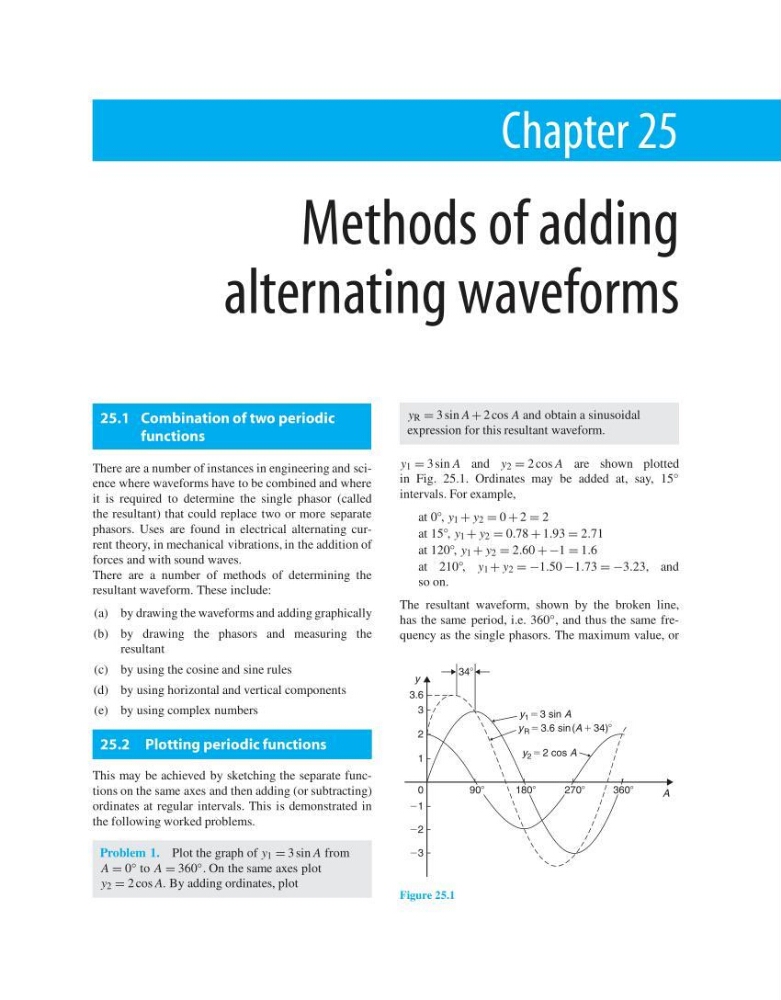
Problem 1. Plot the graph of y 1 = 3 sin A from
A = 0 ◦ to A = 360 ◦ . On the same axes plot
y 2 = 2 cos A. By adding ordinates, plot
y R = 3 sin A + 2 cos A and obtain a sinusoidal
expression for this resultant waveform.
y 1 = 3 sin A and y 2 = 2 cos A are shown plotted
in Fig. 25.1. Ordinates may be added at, say, 15 ◦
intervals. For example,
at 0 ◦ , y 1 + y 2 = 0 + 2 = 2
at 15 ◦ , y 1 + y 2 = 0.78 + 1.93 = 2.71
at 120 ◦ , y 1 + y 2 = 2.60 + −1 = 1.6
at 210 ◦ , y 1 + y 2 = −1.50 −1.73 = −3.23, and
so on.
The resultant waveform, shown by the broken line,
has the same period, i.e. 360 ◦ , and thus the same frequency as the single phasors. The maximum value, or
y
y 1 5 3 sin A
y 2 5 2 cos A
y R 5 3.6 sin (A 1 34)8
A
0
23
22
21
3
3.6
2
1
348
908
1808
2708
3608
Figure 25.1
Methods of adding
alternating waveforms
25.1 Combination of two periodic
functions
There are a number of instances in engineering and science where waveforms have to be combined and where
it is required to determine the single phasor (called
the resultant) that could replace two or more separate
phasors. Uses are found in electrical alternating current theory, in mechanical vibrations, in the addition of
forces and with sound waves.
There are a number of methods of determining the
resultant waveform. These include:
(a) by drawing the waveforms and adding graphically
(b) by drawing the phasors and measuring the
resultant
(c) by using the cosine and sine rules
(d) by using horizontal and vertical components
(e) by using complex numbers
25.2 Plotting periodic functions
This may be achieved by sketching the separate functions on the same axes and then adding (or subtracting)
ordinates at regular intervals. This is demonstrated in
the following worked problems.
Problem 1. Plot the graph of y 1 = 3 sin A from
A = 0 ◦ to A = 360 ◦ . On the same axes plot
y 2 = 2 cos A. By adding ordinates, plot
y R = 3 sin A + 2 cos A and obtain a sinusoidal
expression for this resultant waveform.
y 1 = 3 sin A and y 2 = 2 cos A are shown plotted
in Fig. 25.1. Ordinates may be added at, say, 15 ◦
intervals. For example,
at 0 ◦ , y 1 + y 2 = 0 + 2 = 2
at 15 ◦ , y 1 + y 2 = 0.78 + 1.93 = 2.71
at 120 ◦ , y 1 + y 2 = 2.60 + −1 = 1.6
at 210 ◦ , y 1 + y 2 = −1.50 −1.73 = −3.23, and
so on.
The resultant waveform, shown by the broken line,
has the same period, i.e. 360 ◦ , and thus the same frequency as the single phasors. The maximum value, or
y
y 1 5 3 sin A
y 2 5 2 cos A
y R 5 3.6 sin (A 1 34)8
A
0
23
22
21
3
3.6
2
1
348
908
1808
2708
3608
Figure 25.1