

Revision Test 7
This Revision Test covers the material contained in Chapters 20 to 23. The marks for each question are shown in
brackets at the end of each question.
1. Solve the quadratic equation x 2 − 2x + 5 =0 and
show the roots on an Argand diagram.
(9)
2. If Z 1 = 2 + j 5, Z 2 = 1 − j 3 and Z 3 = 4 − j determine, in both Cartesian and polar forms, the value
of
Z 1 Z 2
Z 1 + Z 2
+ Z 3 , correct to 2 decimal places.
(9)
3. Three vectors are represented by A, 4.2∠45 ◦ , B,
5.5∠−32 ◦ and C, 2.8∠75 ◦ . Determine in polar
form the resultant D, where D =B + C − A. (8)
4. Two impedances, Z 1 = (2 + j 7) ohms and
Z 2 = (3 − j 4) ohms, are connected in series to
a supply voltage V of 150∠0 ◦ V. Determine the
magnitude of the current I and its phase angle
relative to the voltage.
(6)
5. Determine in both polar and rectangular forms:
(a) [2.37∠35 ◦ ] 4 (b) [3.2 − j 4.8] 5
(c)
√
[−1 − j 3]
(15)
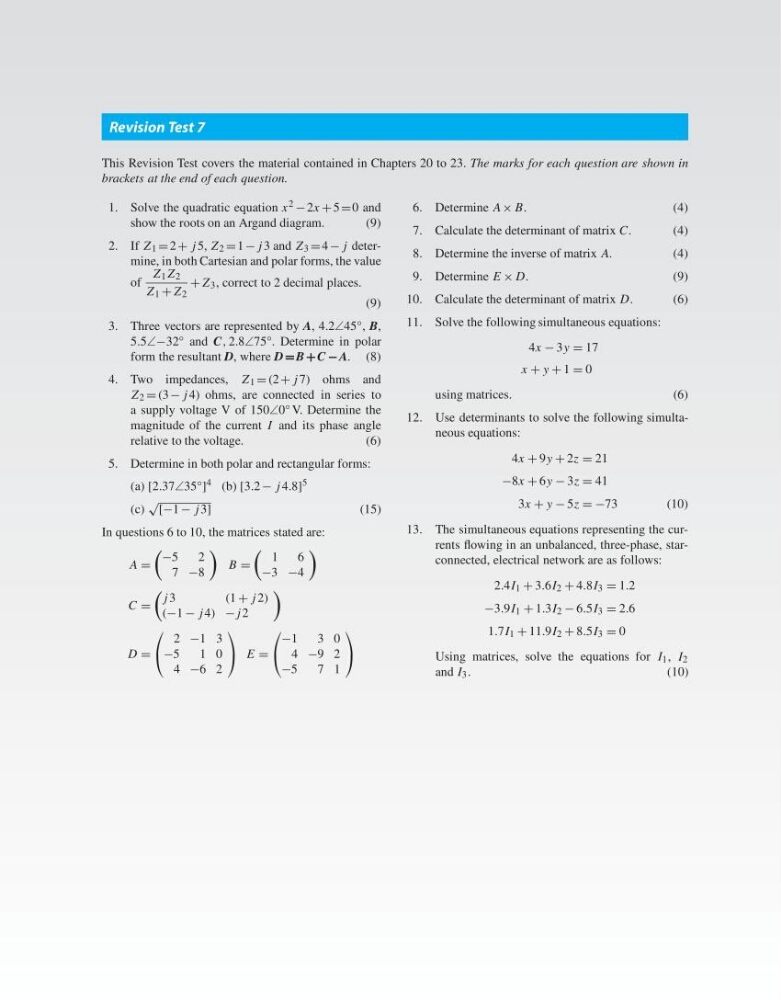
In questions 6 to 10, the matrices stated are:
A =
−5
2
7 −8
B =
1
6
−3 −4
C =
j 3
(1 + j 2)
(−1 − j 4) − j 2
D =
⎛
⎝
2 −1 3
−5
1 0
4 −6 2
⎞
⎠ E =
⎛
⎝
−1
3 0
4 −9 2
−5
7 1
⎞
⎠
6. Determine A × B.
( 4 )
7. Calculate the determinant of matrix C.
( 4 )
8. Determine the inverse of matrix A.
( 4 )
9. Determine E × D.
( 9 )
10. Calculate the determinant of matrix D.
( 6 )
11. Solve the following simultaneous equations:
4x − 3y = 17
x + y + 1 = 0
using matrices.
(6)
12. Use determinants to solve the following simultaneous equations:
4x + 9y + 2z = 21
−8x + 6y − 3z = 41
3x + y − 5z = −73
(10)
13. The simultaneous equations representing the currents flowing in an unbalanced, three-phase, starconnected, electrical network are as follows:
2.4I 1 + 3.6I 2 + 4.8I 3 = 1.2
−3.9I 1 + 1.3I 2 − 6.5I 3 = 2.6
1.7I 1 + 11.9I 2 + 8.5I 3 = 0
Using matrices, solve the equations for I 1 , I 2
and I 3 .
(10)
This Revision Test covers the material contained in Chapters 20 to 23. The marks for each question are shown in
brackets at the end of each question.
1. Solve the quadratic equation x 2 − 2x + 5 =0 and
show the roots on an Argand diagram.
(9)
2. If Z 1 = 2 + j 5, Z 2 = 1 − j 3 and Z 3 = 4 − j determine, in both Cartesian and polar forms, the value
of
Z 1 Z 2
Z 1 + Z 2
+ Z 3 , correct to 2 decimal places.
(9)
3. Three vectors are represented by A, 4.2∠45 ◦ , B,
5.5∠−32 ◦ and C, 2.8∠75 ◦ . Determine in polar
form the resultant D, where D =B + C − A. (8)
4. Two impedances, Z 1 = (2 + j 7) ohms and
Z 2 = (3 − j 4) ohms, are connected in series to
a supply voltage V of 150∠0 ◦ V. Determine the
magnitude of the current I and its phase angle
relative to the voltage.
(6)
5. Determine in both polar and rectangular forms:
(a) [2.37∠35 ◦ ] 4 (b) [3.2 − j 4.8] 5
(c)
√
[−1 − j 3]
(15)
In questions 6 to 10, the matrices stated are:
A =
−5
2
7 −8
B =
1
6
−3 −4
C =
j 3
(1 + j 2)
(−1 − j 4) − j 2
D =
⎛
⎝
2 −1 3
−5
1 0
4 −6 2
⎞
⎠ E =
⎛
⎝
−1
3 0
4 −9 2
−5
7 1
⎞
⎠
6. Determine A × B.
( 4 )
7. Calculate the determinant of matrix C.
( 4 )
8. Determine the inverse of matrix A.
( 4 )
9. Determine E × D.
( 9 )
10. Calculate the determinant of matrix D.
( 6 )
11. Solve the following simultaneous equations:
4x − 3y = 17
x + y + 1 = 0
using matrices.
(6)
12. Use determinants to solve the following simultaneous equations:
4x + 9y + 2z = 21
−8x + 6y − 3z = 41
3x + y − 5z = −73
(10)
13. The simultaneous equations representing the currents flowing in an unbalanced, three-phase, starconnected, electrical network are as follows:
2.4I 1 + 3.6I 2 + 4.8I 3 = 1.2
−3.9I 1 + 1.3I 2 − 6.5I 3 = 2.6
1.7I 1 + 11.9I 2 + 8.5I 3 = 0
Using matrices, solve the equations for I 1 , I 2
and I 3 .
(10)