

The theory of matrices and determinants 235
2. D + E
⎡
⎢
⎣
⎛
⎜
⎝
7 −1
8
3
1
7
4
7 −2
⎞
⎟
⎠
⎤
⎥
⎦
3. A − B
−2 −3
−3
1
4. A + B − C
9.3 −6.4
−7.5 16.9
5. 5 A + 6B
45 7
−26 71
6. 2D + 3E −4F ⎡
⎢
⎣
⎛
⎜
⎝
4.6 −5.6 −7.6
17.4 −16.2 28.6
−14.2
0.4 17.2
⎞
⎟
⎠
⎤
⎥
⎦
7. A × H
−11
43
8. A × B
16 0
−27 34
9. A × C
−6.4
26.1
22.7 −56.9
10. D × J
⎡
⎢
⎣
⎛
⎜
⎝
135
−52
−85
⎞
⎟
⎠
⎤
⎥
⎦
11. E × K
⎡
⎢
⎣
⎛
⎜
⎝
5
6
12 −3
1
0
⎞
⎟
⎠
⎤
⎥
⎦
12. D × F
⎡
⎢
⎣
⎛
⎜
⎝
55.4 3.4
10.1
−12.6 10.4 −20.4
−16.9 25.0
37.9
⎞
⎟
⎠
⎤
⎥
⎦
13. Show that A × C = C × A
⎡
⎢
⎢
⎢
⎢
⎢
⎢
⎢
⎣
A × C =
−6.4
26.1
22.7 −56.9
C × A =
−33.5 −53.1
23.1 −29.8
Hence they are not equal
⎤
⎥
⎥
⎥
⎥
⎥
⎥
⎥
⎦
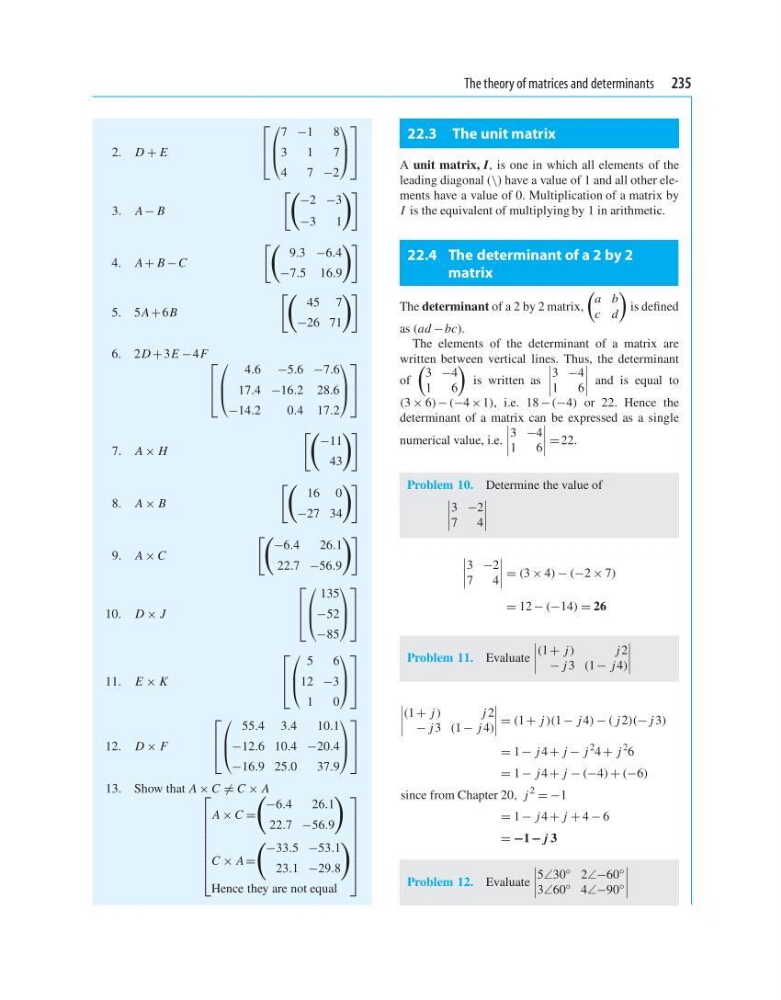
22.3 The unit matrix
A unit matrix, I, is one in which all elements of the
leading diagonal (\) have a value of 1 and all other elements have a value of 0. Multiplication of a matrix by
I is the equivalent of multiplying by 1 in arithmetic.
22.4 The determinant of a 2 by 2
matrix
The determinant of a 2 by 2 matrix,
a b
c d
is defined
as (ad − bc).
The elements of the determinant of a matrix are
written between vertical lines. Thus, the determinant
of
3 −4
1
6
is written as
3 −4
1
6
and is equal to
(3 × 6) − (−4 × 1), i.e. 18−(−4) or 22. Hence the
determinant of a matrix can be expressed as a single
numerical value, i.e.
3 −4
1
6
= 22.
Problem 10. Determine the value of
3 −2
7
4
3 −2
7
4
= (3 × 4) − (−2 × 7)
= 12 − (−14) = 26
Problem 11. Evaluate
(1 + j )
j 2
− j 3 (1 − j 4)
(1 + j )
j 2
− j 3 (1 − j 4)
= (1 + j )(1 − j 4) − ( j 2)(− j 3)
= 1 − j 4 + j − j
2 4 + j
2 6
= 1 − j 4 + j − (−4) + (−6)
since from Chapter 20, j
2
= −1
= 1 − j 4 + j + 4 − 6
= −1 − j 3
Problem 12. Evaluate
5∠30 ◦ 2∠−60 ◦
3∠60
◦ 4∠−90
◦
2. D + E
⎡
⎢
⎣
⎛
⎜
⎝
7 −1
8
3
1
7
4
7 −2
⎞
⎟
⎠
⎤
⎥
⎦
3. A − B
−2 −3
−3
1
4. A + B − C
9.3 −6.4
−7.5 16.9
5. 5 A + 6B
45 7
−26 71
6. 2D + 3E −4F ⎡
⎢
⎣
⎛
⎜
⎝
4.6 −5.6 −7.6
17.4 −16.2 28.6
−14.2
0.4 17.2
⎞
⎟
⎠
⎤
⎥
⎦
7. A × H
−11
43
8. A × B
16 0
−27 34
9. A × C
−6.4
26.1
22.7 −56.9
10. D × J
⎡
⎢
⎣
⎛
⎜
⎝
135
−52
−85
⎞
⎟
⎠
⎤
⎥
⎦
11. E × K
⎡
⎢
⎣
⎛
⎜
⎝
5
6
12 −3
1
0
⎞
⎟
⎠
⎤
⎥
⎦
12. D × F
⎡
⎢
⎣
⎛
⎜
⎝
55.4 3.4
10.1
−12.6 10.4 −20.4
−16.9 25.0
37.9
⎞
⎟
⎠
⎤
⎥
⎦
13. Show that A × C = C × A
⎡
⎢
⎢
⎢
⎢
⎢
⎢
⎢
⎣
A × C =
−6.4
26.1
22.7 −56.9
C × A =
−33.5 −53.1
23.1 −29.8
Hence they are not equal
⎤
⎥
⎥
⎥
⎥
⎥
⎥
⎥
⎦
22.3 The unit matrix
A unit matrix, I, is one in which all elements of the
leading diagonal (\) have a value of 1 and all other elements have a value of 0. Multiplication of a matrix by
I is the equivalent of multiplying by 1 in arithmetic.
22.4 The determinant of a 2 by 2
matrix
The determinant of a 2 by 2 matrix,
a b
c d
is defined
as (ad − bc).
The elements of the determinant of a matrix are
written between vertical lines. Thus, the determinant
of
3 −4
1
6
is written as
3 −4
1
6
and is equal to
(3 × 6) − (−4 × 1), i.e. 18−(−4) or 22. Hence the
determinant of a matrix can be expressed as a single
numerical value, i.e.
3 −4
1
6
= 22.
Problem 10. Determine the value of
3 −2
7
4
3 −2
7
4
= (3 × 4) − (−2 × 7)
= 12 − (−14) = 26
Problem 11. Evaluate
(1 + j )
j 2
− j 3 (1 − j 4)
(1 + j )
j 2
− j 3 (1 − j 4)
= (1 + j )(1 − j 4) − ( j 2)(− j 3)
= 1 − j 4 + j − j
2 4 + j
2 6
= 1 − j 4 + j − (−4) + (−6)
since from Chapter 20, j
2
= −1
= 1 − j 4 + j + 4 − 6
= −1 − j 3
Problem 12. Evaluate
5∠30 ◦ 2∠−60 ◦
3∠60
◦ 4∠−90
◦