

The theory of matrices and determinants 233
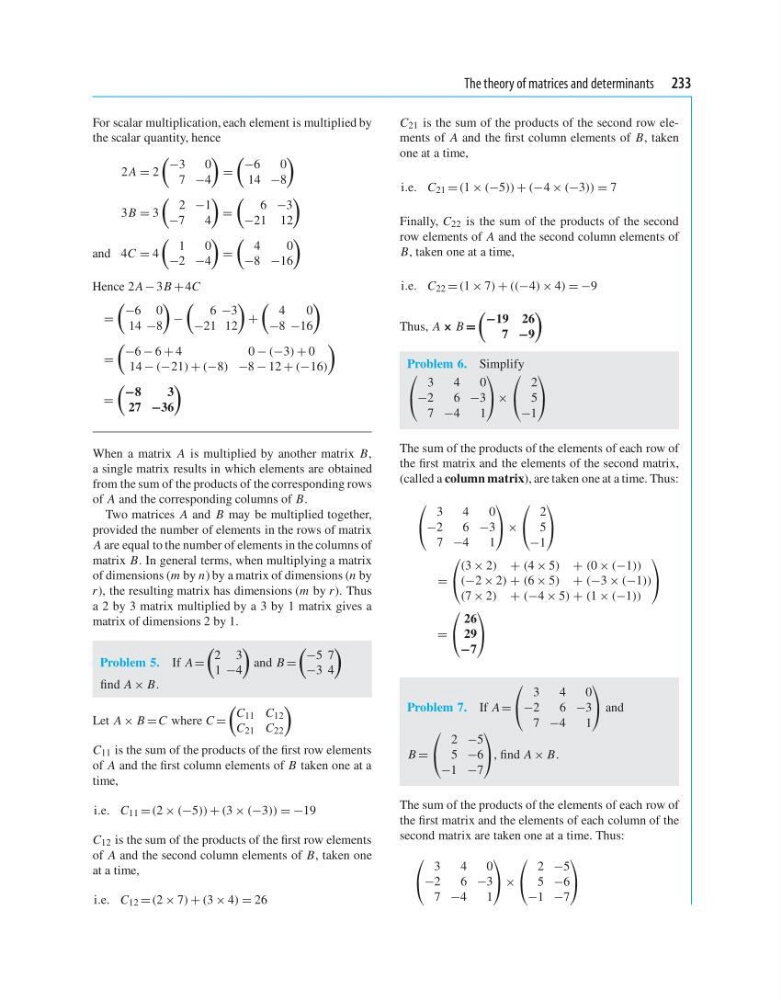
For scalar multiplication, each element is multiplied by
the scalar quantity, hence
2 A = 2
−3
0
7 −4
=
−6
0
14 −8
3B = 3
2 −1
−7
4
=
6 −3
−21 12
and 4C = 4
1
0
−2 −4
=
4
0
−8 −16
Hence 2 A − 3B + 4C
=
−6 0
14 −8
−
6 −3
−21 12
+
4
0
−8 −16
=
−6 − 6 + 4
0 − (−3) + 0
14 − (−21) + (−8) −8 − 12 + (−16)
=
−8
3
27 −36
When a matrix A is multiplied by another matrix B,
a single matrix results in which elements are obtained
from the sum of the products of the corresponding rows
of A and the corresponding columns of B.
Two matrices A and B may be multiplied together,
provided the number of elements in the rows of matrix
A are equal to the number of elements in the columns of
matrix B. In general terms, when multiplying a matrix
of dimensions (m by n) by a matrix of dimensions (n by
r), the resulting matrix has dimensions (m by r). Thus
a 2 by 3 matrix multiplied by a 3 by 1 matrix gives a
matrix of dimensions 2 by 1.
Problem 5. If A =
2 3
1 −4
and B =
−5 7
−3 4
find A × B.
Let A × B = C where C =
C 11 C 12
C 21 C 22
C 11 is the sum of the products of the first row elements
of A and the first column elements of B taken one at a
time,
i.e. C 11 = (2 × (−5)) + (3 × (−3)) = −19
C 12 is the sum of the products of the first row elements
of A and the second column elements of B, taken one
at a time,
i.e. C 12 = (2 × 7) + (3 × 4) = 26
C 21 is the sum of the products of the second row elements of A and the first column elements of B, taken
one at a time,
i.e. C 21 = (1 × (−5)) + (−4 × (−3)) = 7
Finally, C 22 is the sum of the products of the second
row elements of A and the second column elements of
B, taken one at a time,
i.e. C 22 = (1 × 7) + ((−4) × 4) = −9
Thus, A × B =
−19 26
7 −9
Problem 6. Simplify
⎛
⎝
3
4
0
−2
6 −3
7 −4
1
⎞
⎠ ×
⎛
⎝
2
5
−1
⎞
⎠
The sum of the products of the elements of each row of
the first matrix and the elements of the second matrix,
(called a column matrix), are taken one at a time. Thus:
⎛
⎝
3
4
0
−2
6 −3
7 −4
1
⎞
⎠ ×
⎛
⎝
2
5
−1
⎞
⎠
=
⎛
⎝
(3 × 2) + (4 × 5) + (0 × (−1))
(−2 × 2) + (6 × 5) + (−3 × (−1))
(7 × 2) + (−4 × 5) + (1 × (−1))
⎞
⎠
=
⎛
⎝
26
29
−7
⎞
⎠
Problem 7. If A =
⎛
⎝
3
4
0
−2
6 −3
7 −4
1
⎞
⎠ and
B =
⎛
⎝
2 −5
5 −6
−1 −7
⎞
⎠ , find A × B.
The sum of the products of the elements of each row of
the first matrix and the elements of each column of the
second matrix are taken one at a time. Thus:
⎛
⎝
3
4
0
−2
6 −3
7 −4
1
⎞
⎠ ×
⎛
⎝
2 −5
5 −6
−1 −7
⎞
⎠
For scalar multiplication, each element is multiplied by
the scalar quantity, hence
2 A = 2
−3
0
7 −4
=
−6
0
14 −8
3B = 3
2 −1
−7
4
=
6 −3
−21 12
and 4C = 4
1
0
−2 −4
=
4
0
−8 −16
Hence 2 A − 3B + 4C
=
−6 0
14 −8
−
6 −3
−21 12
+
4
0
−8 −16
=
−6 − 6 + 4
0 − (−3) + 0
14 − (−21) + (−8) −8 − 12 + (−16)
=
−8
3
27 −36
When a matrix A is multiplied by another matrix B,
a single matrix results in which elements are obtained
from the sum of the products of the corresponding rows
of A and the corresponding columns of B.
Two matrices A and B may be multiplied together,
provided the number of elements in the rows of matrix
A are equal to the number of elements in the columns of
matrix B. In general terms, when multiplying a matrix
of dimensions (m by n) by a matrix of dimensions (n by
r), the resulting matrix has dimensions (m by r). Thus
a 2 by 3 matrix multiplied by a 3 by 1 matrix gives a
matrix of dimensions 2 by 1.
Problem 5. If A =
2 3
1 −4
and B =
−5 7
−3 4
find A × B.
Let A × B = C where C =
C 11 C 12
C 21 C 22
C 11 is the sum of the products of the first row elements
of A and the first column elements of B taken one at a
time,
i.e. C 11 = (2 × (−5)) + (3 × (−3)) = −19
C 12 is the sum of the products of the first row elements
of A and the second column elements of B, taken one
at a time,
i.e. C 12 = (2 × 7) + (3 × 4) = 26
C 21 is the sum of the products of the second row elements of A and the first column elements of B, taken
one at a time,
i.e. C 21 = (1 × (−5)) + (−4 × (−3)) = 7
Finally, C 22 is the sum of the products of the second
row elements of A and the second column elements of
B, taken one at a time,
i.e. C 22 = (1 × 7) + ((−4) × 4) = −9
Thus, A × B =
−19 26
7 −9
Problem 6. Simplify
⎛
⎝
3
4
0
−2
6 −3
7 −4
1
⎞
⎠ ×
⎛
⎝
2
5
−1
⎞
⎠
The sum of the products of the elements of each row of
the first matrix and the elements of the second matrix,
(called a column matrix), are taken one at a time. Thus:
⎛
⎝
3
4
0
−2
6 −3
7 −4
1
⎞
⎠ ×
⎛
⎝
2
5
−1
⎞
⎠
=
⎛
⎝
(3 × 2) + (4 × 5) + (0 × (−1))
(−2 × 2) + (6 × 5) + (−3 × (−1))
(7 × 2) + (−4 × 5) + (1 × (−1))
⎞
⎠
=
⎛
⎝
26
29
−7
⎞
⎠
Problem 7. If A =
⎛
⎝
3
4
0
−2
6 −3
7 −4
1
⎞
⎠ and
B =
⎛
⎝
2 −5
5 −6
−1 −7
⎞
⎠ , find A × B.
The sum of the products of the elements of each row of
the first matrix and the elements of each column of the
second matrix are taken one at a time. Thus:
⎛
⎝
3
4
0
−2
6 −3
7 −4
1
⎞
⎠ ×
⎛
⎝
2 −5
5 −6
−1 −7
⎞
⎠