

226 Higher Engineering Mathematics
Now try the following exercise
Exercise 90 Further problems on powers
of complex numbers
1. Determine in polar form (a) [1.5∠15 ◦ ] 5
(b) (1 + j 2) 6 .
[(a) 7.594∠75 ◦ (b) 125∠20.61 ◦ ]
2. Determine in polar and cartesian forms
(a) [3∠41 ◦ ] 4 (b) (−2 − j ) 5 .
(a) 81∠164 ◦ , −77.86 + j 22.33
(b) 55.90∠−47.18 ◦ , 38 − j 41
3. Convert (3 − j ) into polar form and hence
evaluate (3 − j ) 7 , giving the answer in polar
form.
[
√
10∠−18.43
◦ , 3162∠−129
◦ ]
In problems 4 to 7, express in both polar and
rectangular forms.
4. (6 + j 5) 3
[476.4∠119.42 ◦ , −234 + j 415]
5. (3 − j 8) 5
[45530∠12.78 ◦ , 44400 + j 10070]
6. (−2 + j 7) 4 [2809∠63.78 ◦ , 1241 + j 2520]
7. (−16 − j 9)
6
(38.27 × 10 6 )∠176.15 ◦ ,
10 6 (−38.18 + j 2.570)
21.3 Roots of complex numbers
The square root of a complex number is determined by
letting n =1/2 in De Moivre’s theorem,
i.e.
[r∠θ] = [r∠θ]
1
2 = r
1
2 ∠
1
2
θ =
√
r ∠
θ
2
There are two square roots of a real number, equal in
size but opposite in sign.
Problem 3. Determine the two square roots of the
complex number (5 + j 12) in polar and cartesian
forms and show the roots on an Argand diagram.
(5 + j 12) =
[5 2 + 12 2 ]∠ tan
−1
12
5
= 13∠67.38
◦
When determining square roots two solutions result.
To obtain the second solution one way is to
express 13∠67.38 ◦ also as 13∠(67.38 ◦ + 360 ◦ ), i.e.
13∠427.38
◦ . When the angle is divided by 2 an angle
less than 360 ◦ is obtained.
Hence
(5 + j 12) =
[13∠67.38 ◦ ] and
[13∠427.38 ◦ ]
= [13∠67.38
◦ ]
1
2 and [13∠427.38
◦ ]
1
2
= 13
1
2 ∠
1
2
× 67.38
◦
and
13
1
2 ∠
1
2
× 427.38
◦
=
√
13∠33.69
◦ and
√
13∠213.69
◦
= 3.61∠33.69
◦ and 3.61∠213.69
◦
Thus, in polar form, the two roots are
3.61∠33.69 ◦ and 3.61∠−146.31 ◦ .
√
13∠33.69
◦
=
√
13(cos 33.69
◦
+ j sin 33.69
◦
)
= 3.0 + j 2.0
√
13∠213.69
◦
=
√
13(cos 213.69
◦
+ j sin 213.69
◦
)
= −3.0 − j 2.0
Thus, in cartesian form the two roots are
±(3.0 + j2.0).
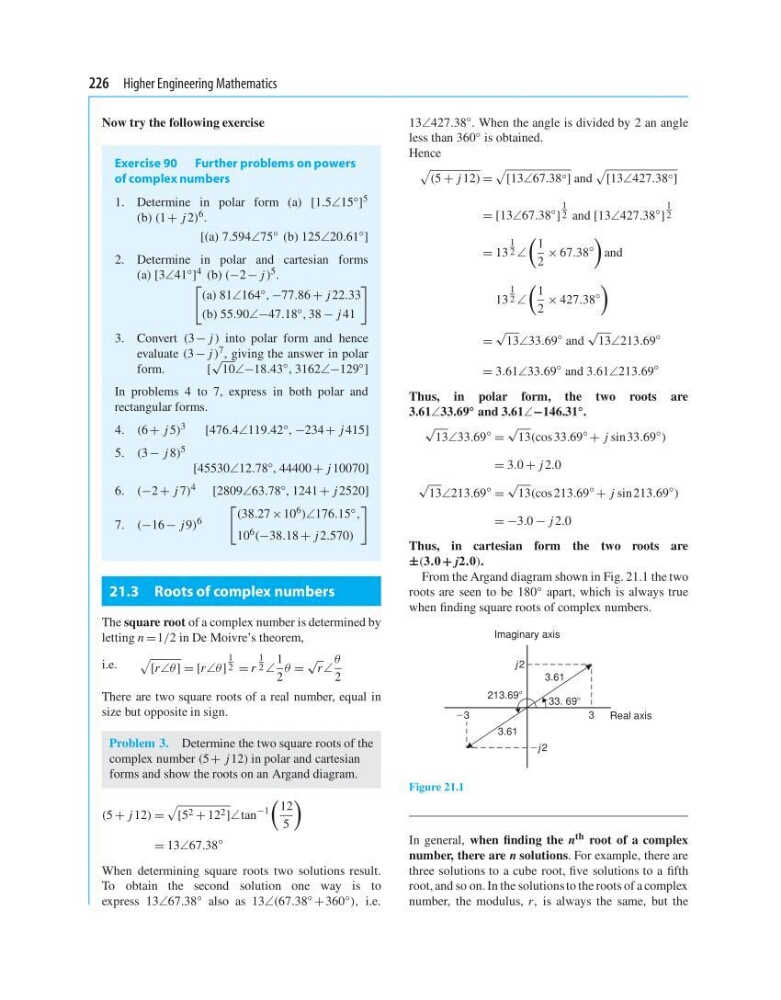
From the Argand diagram shown in Fig. 21.1 the two
roots are seen to be 180 ◦ apart, which is always true
when finding square roots of complex numbers.
j 2
2j 2
3
3.61
3.61
Imaginary axis
213.698
33. 698
23
Real axis
Figure 21.1
In general, when finding the n th root of a complex
number, there are n solutions. For example, there are
three solutions to a cube root, five solutions to a fifth
root, and so on. In the solutions to the roots of a complex
number, the modulus, r, is always the same, but the
Now try the following exercise
Exercise 90 Further problems on powers
of complex numbers
1. Determine in polar form (a) [1.5∠15 ◦ ] 5
(b) (1 + j 2) 6 .
[(a) 7.594∠75 ◦ (b) 125∠20.61 ◦ ]
2. Determine in polar and cartesian forms
(a) [3∠41 ◦ ] 4 (b) (−2 − j ) 5 .
(a) 81∠164 ◦ , −77.86 + j 22.33
(b) 55.90∠−47.18 ◦ , 38 − j 41
3. Convert (3 − j ) into polar form and hence
evaluate (3 − j ) 7 , giving the answer in polar
form.
[
√
10∠−18.43
◦ , 3162∠−129
◦ ]
In problems 4 to 7, express in both polar and
rectangular forms.
4. (6 + j 5) 3
[476.4∠119.42 ◦ , −234 + j 415]
5. (3 − j 8) 5
[45530∠12.78 ◦ , 44400 + j 10070]
6. (−2 + j 7) 4 [2809∠63.78 ◦ , 1241 + j 2520]
7. (−16 − j 9)
6
(38.27 × 10 6 )∠176.15 ◦ ,
10 6 (−38.18 + j 2.570)
21.3 Roots of complex numbers
The square root of a complex number is determined by
letting n =1/2 in De Moivre’s theorem,
i.e.
[r∠θ] = [r∠θ]
1
2 = r
1
2 ∠
1
2
θ =
√
r ∠
θ
2
There are two square roots of a real number, equal in
size but opposite in sign.
Problem 3. Determine the two square roots of the
complex number (5 + j 12) in polar and cartesian
forms and show the roots on an Argand diagram.
(5 + j 12) =
[5 2 + 12 2 ]∠ tan
−1
12
5
= 13∠67.38
◦
When determining square roots two solutions result.
To obtain the second solution one way is to
express 13∠67.38 ◦ also as 13∠(67.38 ◦ + 360 ◦ ), i.e.
13∠427.38
◦ . When the angle is divided by 2 an angle
less than 360 ◦ is obtained.
Hence
(5 + j 12) =
[13∠67.38 ◦ ] and
[13∠427.38 ◦ ]
= [13∠67.38
◦ ]
1
2 and [13∠427.38
◦ ]
1
2
= 13
1
2 ∠
1
2
× 67.38
◦
and
13
1
2 ∠
1
2
× 427.38
◦
=
√
13∠33.69
◦ and
√
13∠213.69
◦
= 3.61∠33.69
◦ and 3.61∠213.69
◦
Thus, in polar form, the two roots are
3.61∠33.69 ◦ and 3.61∠−146.31 ◦ .
√
13∠33.69
◦
=
√
13(cos 33.69
◦
+ j sin 33.69
◦
)
= 3.0 + j 2.0
√
13∠213.69
◦
=
√
13(cos 213.69
◦
+ j sin 213.69
◦
)
= −3.0 − j 2.0
Thus, in cartesian form the two roots are
±(3.0 + j2.0).
From the Argand diagram shown in Fig. 21.1 the two
roots are seen to be 180 ◦ apart, which is always true
when finding square roots of complex numbers.
j 2
2j 2
3
3.61
3.61
Imaginary axis
213.698
33. 698
23
Real axis
Figure 21.1
In general, when finding the n th root of a complex
number, there are n solutions. For example, there are
three solutions to a cube root, five solutions to a fifth
root, and so on. In the solutions to the roots of a complex
number, the modulus, r, is always the same, but the