

224 Higher Engineering Mathematics
2. Two impedances, Z 1 = (3 + j 6)) and
Z 2 = (4 − j 3)) are connected in series to
a supply voltage of 120 V. Determine the
magnitude of the current and its phase angle
relative to the voltage.
[15.76 A, 23.20
◦ lagging]
3. If the two impedances in Problem 2 are connected in parallel determine the current flowing and its phase relative to the 120 V supply
voltage.
[27.25 A, 3.37 ◦ lagging]
4. A series circuit consists of a 12 resistor, a
coil of inductance 0.10 H and a capacitance of
160 μF. Calculate the current flowing and its
phase relative to the supply voltage of 240 V,
50 Hz. Determine also the power factor of the
circuit.
[14.42 A, 43.85 ◦ lagging, 0.721]
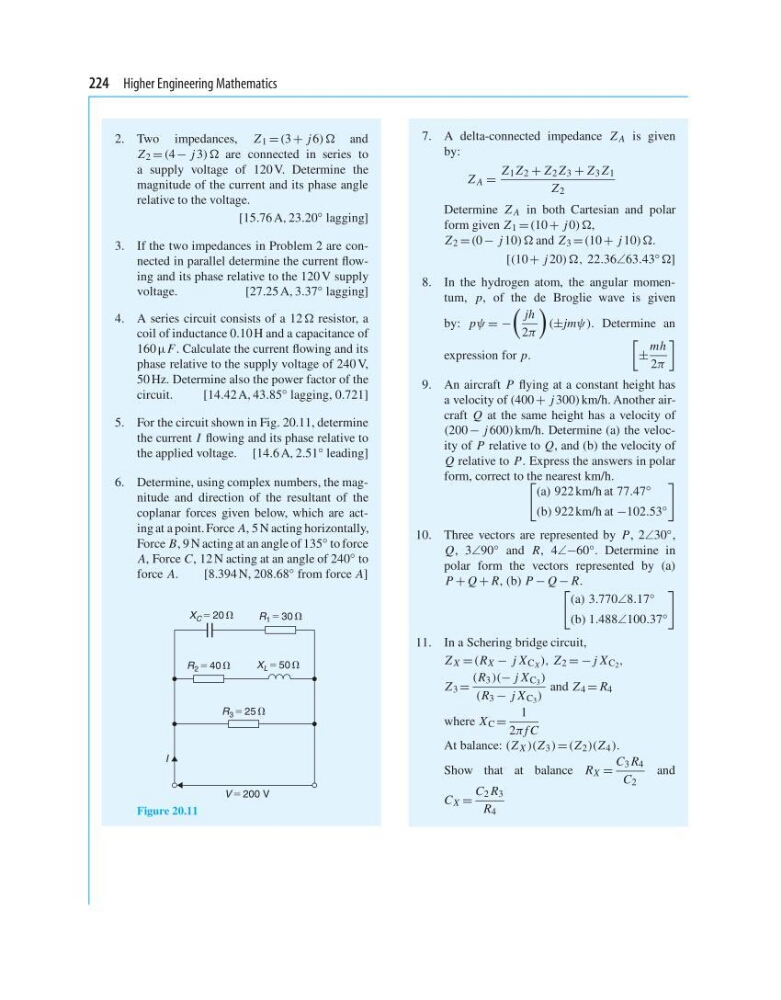
5. For the circuit shown in Fig. 20.11, determine
the current I flowing and its phase relative to
the applied voltage. [14.6 A, 2.51 ◦ leading]
6. Determine, using complex numbers, the magnitude and direction of the resultant of the
coplanar forces given below, which are acting at a point. Force A, 5 N acting horizontally,
Force B, 9 N acting at an angle of 135 ◦ to force
A, Force C, 12 N acting at an angle of 240
◦ to
force A.
[8.394 N, 208.68 ◦ from force A]
I
R 1 5 30 V
R 3 5 25 V
V 5 200 V
R 2 5 40 V
X L 5 50 V
X C 5 20 V
Figure 20.11
7. A delta-connected impedance Z A is given
by:
Z A =
Z 1 Z 2 + Z 2 Z 3 + Z 3 Z 1
Z 2
Determine Z A in both Cartesian and polar
form given Z 1 = (10 + j 0)),
Z 2 = (0 − j 10)) and Z 3 = (10 + j 10)).
[(10 + j 20)), 22.36∠63.43 ◦ ]
8. In the hydrogen atom, the angular momentum, p, of the de Broglie wave is given
by: pψ = −
jh
2π
(±jmψ). Determine an
expression for p.
±
mh
2π
9. An aircraft P flying at a constant height has
a velocity of (400 + j 300) km/h. Another aircraft Q at the same height has a velocity of
(200 − j 600) km/h. Determine (a) the velocity of P relative to Q, and (b) the velocity of
Q relative to P. Express the answers in polar
form, correct to the nearest km/h.
(a) 922 km/h at 77.47 ◦
(b) 922 km/h at −102.53 ◦
10. Three vectors are represented by P, 2∠30 ◦ ,
Q, 3∠90 ◦ and R, 4∠−60 ◦ . Determine in
polar form the vectors represented by (a)
P + Q + R, (b) P − Q − R.
(a) 3.770∠8.17 ◦
(b) 1.488∠100.37 ◦
11. In a Schering bridge circuit,
Z X = (R X − j X C X ), Z 2 = − j X C 2 ,
Z 3 =
(R 3 )(− j X C 3 )
(R 3 − j X C 3 )
and Z 4 = R 4
where X C =
1
2πf C
At balance: (Z X )(Z 3 ) = (Z 2 )(Z 4 ).
Show that at balance R X =
C 3 R 4
C 2
and
C X =
C 2 R 3
R 4
2. Two impedances, Z 1 = (3 + j 6)) and
Z 2 = (4 − j 3)) are connected in series to
a supply voltage of 120 V. Determine the
magnitude of the current and its phase angle
relative to the voltage.
[15.76 A, 23.20
◦ lagging]
3. If the two impedances in Problem 2 are connected in parallel determine the current flowing and its phase relative to the 120 V supply
voltage.
[27.25 A, 3.37 ◦ lagging]
4. A series circuit consists of a 12 resistor, a
coil of inductance 0.10 H and a capacitance of
160 μF. Calculate the current flowing and its
phase relative to the supply voltage of 240 V,
50 Hz. Determine also the power factor of the
circuit.
[14.42 A, 43.85 ◦ lagging, 0.721]
5. For the circuit shown in Fig. 20.11, determine
the current I flowing and its phase relative to
the applied voltage. [14.6 A, 2.51 ◦ leading]
6. Determine, using complex numbers, the magnitude and direction of the resultant of the
coplanar forces given below, which are acting at a point. Force A, 5 N acting horizontally,
Force B, 9 N acting at an angle of 135 ◦ to force
A, Force C, 12 N acting at an angle of 240
◦ to
force A.
[8.394 N, 208.68 ◦ from force A]
I
R 1 5 30 V
R 3 5 25 V
V 5 200 V
R 2 5 40 V
X L 5 50 V
X C 5 20 V
Figure 20.11
7. A delta-connected impedance Z A is given
by:
Z A =
Z 1 Z 2 + Z 2 Z 3 + Z 3 Z 1
Z 2
Determine Z A in both Cartesian and polar
form given Z 1 = (10 + j 0)),
Z 2 = (0 − j 10)) and Z 3 = (10 + j 10)).
[(10 + j 20)), 22.36∠63.43 ◦ ]
8. In the hydrogen atom, the angular momentum, p, of the de Broglie wave is given
by: pψ = −
jh
2π
(±jmψ). Determine an
expression for p.
±
mh
2π
9. An aircraft P flying at a constant height has
a velocity of (400 + j 300) km/h. Another aircraft Q at the same height has a velocity of
(200 − j 600) km/h. Determine (a) the velocity of P relative to Q, and (b) the velocity of
Q relative to P. Express the answers in polar
form, correct to the nearest km/h.
(a) 922 km/h at 77.47 ◦
(b) 922 km/h at −102.53 ◦
10. Three vectors are represented by P, 2∠30 ◦ ,
Q, 3∠90 ◦ and R, 4∠−60 ◦ . Determine in
polar form the vectors represented by (a)
P + Q + R, (b) P − Q − R.
(a) 3.770∠8.17 ◦
(b) 1.488∠100.37 ◦
11. In a Schering bridge circuit,
Z X = (R X − j X C X ), Z 2 = − j X C 2 ,
Z 3 =
(R 3 )(− j X C 3 )
(R 3 − j X C 3 )
and Z 4 = R 4
where X C =
1
2πf C
At balance: (Z X )(Z 3 ) = (Z 2 )(Z 4 ).
Show that at balance R X =
C 3 R 4
C 2
and
C X =
C 2 R 3
R 4