

218 Higher Engineering Mathematics
(b) (1 + j 2)(−2 − j 3) =a + j b
−2 − j 3 − j 4 − j 2 6 = a + j b
Hence 4 − j 7 =a + j b
Equating real and imaginary terms gives:
a = 4 and b = −7
Problem 8. Solve the equations:
(a) (2 − j 3) =
√
(a + j b)
(b) (x − j 2y) +( y − j 3x) =2 + j 3
(a) (2 − j 3) =
√
(a + j b)
Hence
(2 − j 3) 2 = a + j b,
i.e.
(2 − j 3)(2 − j 3)= a + j b
Hence 4 − j 6 − j 6 + j 2 9 = a + j b
and
−5 − j 12= a + j b
Thus a = −5 and b = −12
(b) (x − j 2y) +( y − j 3x) =2 + j 3
Hence (x + y) + j (−2y − 3x) = 2 + j 3
Equating real and imaginary parts gives:
x + y = 2
( 1 )
and −3x − 2y = 3
( 2 )
i.e. two simultaneous equations to solve.
Multiplying equation (1) by 2 gives:
2x + 2y = 4
( 3 )
Adding equations (2) and (3) gives:
−x = 7, i.e., x = −7
From equation (1), y = 9, which may be checked
in equation (2).
Now try the following exercise
Exercise 87 Further problems on complex
equations
In Problems 1 to 4 solve the complex equations.
1. (2 + j )(3 − j 2) =a + j b
[a = 8, b =−1]
2.
2 + j
1 − j
= j (x + j y)
x =
3
2
, y = −
1
2
3. (2 − j 3) =
√
(a + j b)
[a =−5, b =−12]
4. (x − j 2y) −( y − j x) =2 + j [x = 3, y = 1]
5. If Z = R + j ωL + 1/j ωC, express Z in
(a + j b) form when R = 10, L =5, C = 0.04
and ω = 4.
[Z = 10 + j 13.75]
20.6 The polar form of a complex
number
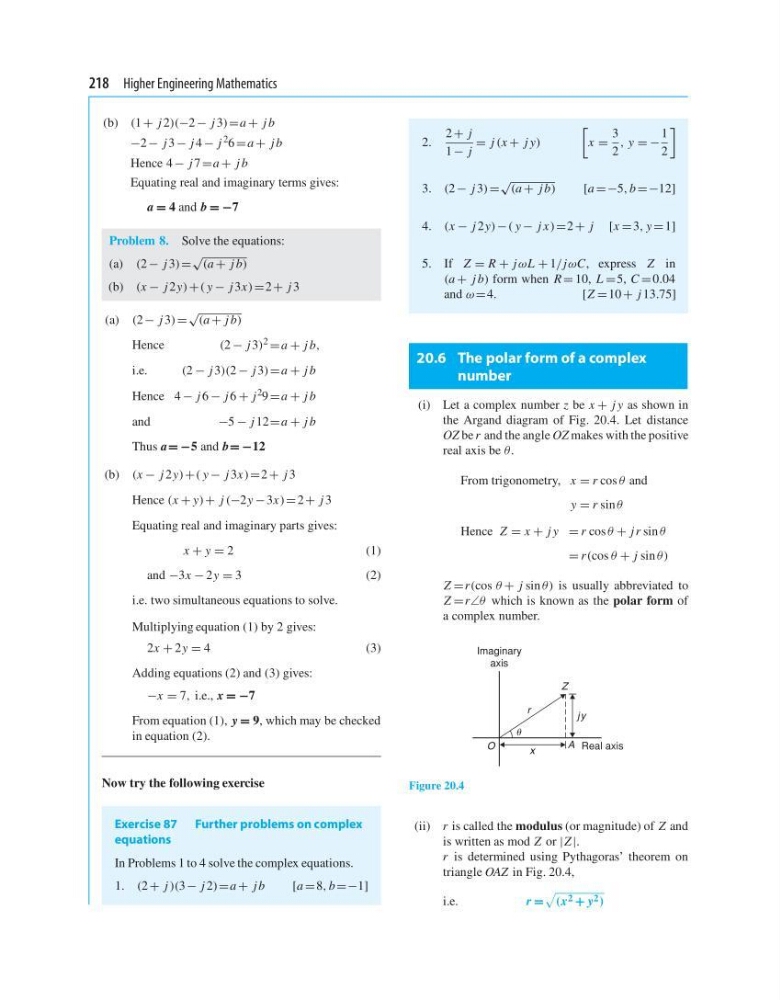
(i) Let a complex number z be x + j y as shown in
the Argand diagram of Fig. 20.4. Let distance
OZ be r and the angle OZ makes with the positive
real axis be θ.
From trigonometry, x = r cos θ and
y = r sin θ
Hence Z = x + j y = r cos θ + jr sin θ
= r(cos θ + j sin θ)
Z =r(cos θ + j sin θ) is usually abbreviated to
Z =r∠θ which is known as the polar form of
a complex number.
Real axis
Imaginary
axis
Z
A
x
r
O
jy
Figure 20.4
(ii) r is called the modulus (or magnitude) of Z and
is written as mod Z or |Z |.
r is determined using Pythagoras’ theorem on
triangle OAZ in Fig. 20.4,
i.e.
r =
(x 2 + y 2 )
(b) (1 + j 2)(−2 − j 3) =a + j b
−2 − j 3 − j 4 − j 2 6 = a + j b
Hence 4 − j 7 =a + j b
Equating real and imaginary terms gives:
a = 4 and b = −7
Problem 8. Solve the equations:
(a) (2 − j 3) =
√
(a + j b)
(b) (x − j 2y) +( y − j 3x) =2 + j 3
(a) (2 − j 3) =
√
(a + j b)
Hence
(2 − j 3) 2 = a + j b,
i.e.
(2 − j 3)(2 − j 3)= a + j b
Hence 4 − j 6 − j 6 + j 2 9 = a + j b
and
−5 − j 12= a + j b
Thus a = −5 and b = −12
(b) (x − j 2y) +( y − j 3x) =2 + j 3
Hence (x + y) + j (−2y − 3x) = 2 + j 3
Equating real and imaginary parts gives:
x + y = 2
( 1 )
and −3x − 2y = 3
( 2 )
i.e. two simultaneous equations to solve.
Multiplying equation (1) by 2 gives:
2x + 2y = 4
( 3 )
Adding equations (2) and (3) gives:
−x = 7, i.e., x = −7
From equation (1), y = 9, which may be checked
in equation (2).
Now try the following exercise
Exercise 87 Further problems on complex
equations
In Problems 1 to 4 solve the complex equations.
1. (2 + j )(3 − j 2) =a + j b
[a = 8, b =−1]
2.
2 + j
1 − j
= j (x + j y)
x =
3
2
, y = −
1
2
3. (2 − j 3) =
√
(a + j b)
[a =−5, b =−12]
4. (x − j 2y) −( y − j x) =2 + j [x = 3, y = 1]
5. If Z = R + j ωL + 1/j ωC, express Z in
(a + j b) form when R = 10, L =5, C = 0.04
and ω = 4.
[Z = 10 + j 13.75]
20.6 The polar form of a complex
number
(i) Let a complex number z be x + j y as shown in
the Argand diagram of Fig. 20.4. Let distance
OZ be r and the angle OZ makes with the positive
real axis be θ.
From trigonometry, x = r cos θ and
y = r sin θ
Hence Z = x + j y = r cos θ + jr sin θ
= r(cos θ + j sin θ)
Z =r(cos θ + j sin θ) is usually abbreviated to
Z =r∠θ which is known as the polar form of
a complex number.
Real axis
Imaginary
axis
Z
A
x
r
O
jy
Figure 20.4
(ii) r is called the modulus (or magnitude) of Z and
is written as mod Z or |Z |.
r is determined using Pythagoras’ theorem on
triangle OAZ in Fig. 20.4,
i.e.
r =
(x 2 + y 2 )