

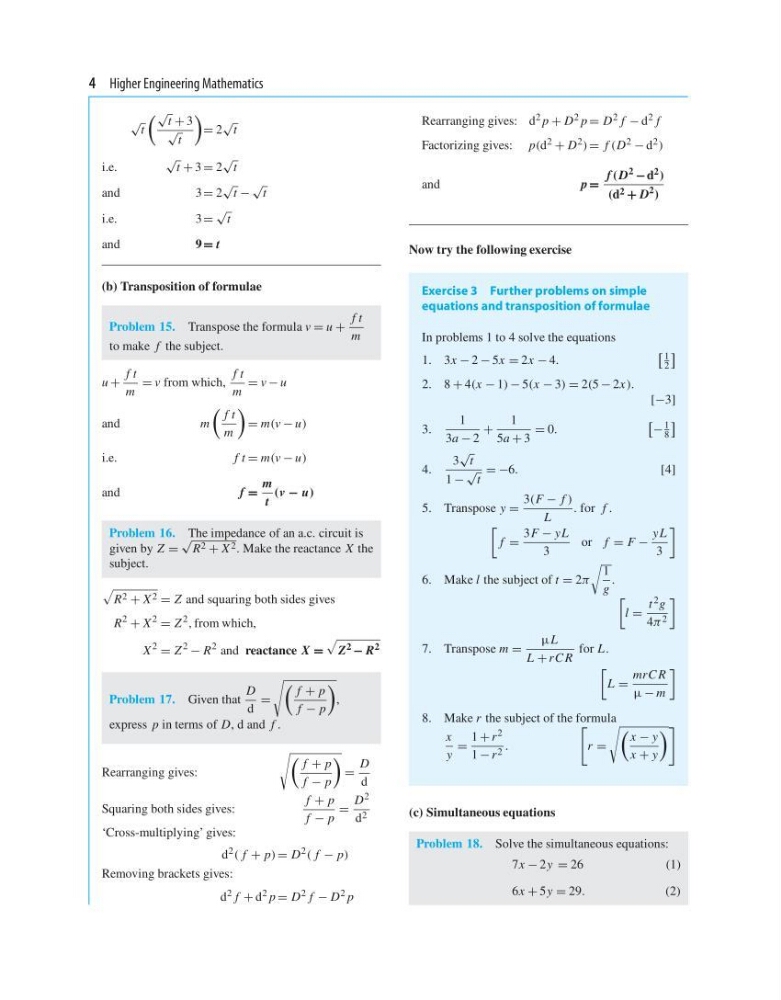
4 Higher Engineering Mathematics
√
t
√
t + 3
√
t
= 2
√
t
i.e.
√
t + 3 = 2
√
t
and
3 = 2
√
t −
√
t
i.e.
3 =
√
t
and
9 = t
(b) Transposition of formulae
Problem 15. Transpose the formula v = u +
f t
m
to make f the subject.
u +
f t
m
= v from which,
f t
m
= v − u
and
m
f t
m
= m(v − u)
i.e.
f t = m(v − u)
and
f =
m
t
(v − u)
Problem 16. The impedance of an a.c. circuit is
given by Z =
√
R 2 + X 2 . Make the reactance X the
subject.
R 2 + X 2 = Z and squaring both sides gives
R
2
+ X
2
= Z
2
, from which,
X
2
= Z
2
− R
2 and reactance X =
Z 2 − R 2
Problem 17. Given that
D
d
=
f + p
f − p
,
express p in terms of D, d and f .
Rearranging gives:
f + p
f − p
=
D
d
Squaring both sides gives:
f + p
f − p
=
D 2
d 2
‘Cross-multiplying’ gives:
d 2 ( f + p) = D 2 ( f − p)
Removing brackets gives:
d 2 f + d 2 p = D 2 f − D 2 p
Rearranging gives: d 2 p + D 2 p = D 2 f − d 2 f
Factorizing gives: p(d 2 + D 2 ) = f (D 2 − d 2 )
and
p =
f (D
2
− d 2 )
(d 2 + D
2 )
Now try the following exercise
Exercise 3 Further problems on simple
equations and transposition of formulae
In problems 1 to 4 solve the equations
1. 3x − 2 − 5x = 2x − 4.
1
2
2. 8 + 4(x − 1) − 5(x − 3) = 2(5 − 2x).
[−3]
3.
1
3a − 2
+
1
5a + 3
= 0.
−
1
8
4.
3
√
t
1 −
√
t
= −6.
[4]
5. Transpose y =
3(F − f )
L
. for f .
f =
3F − yL
3
or f = F −
yL
3
6. Make l the subject of t = 2π
1
g
.
l =
t 2 g
4π 2
7. Transpose m =
μL
L + rC R
for L.
L =
mrC R
μ − m
8. Make r the subject of the formula
x
y
=
1 + r 2
1 − r 2 .
r =
x − y
x + y
(c) Simultaneous equations
Problem 18. Solve the simultaneous equations:
7x − 2y = 26
(1)
6x + 5y = 29.
(2)
√
t
√
t + 3
√
t
= 2
√
t
i.e.
√
t + 3 = 2
√
t
and
3 = 2
√
t −
√
t
i.e.
3 =
√
t
and
9 = t
(b) Transposition of formulae
Problem 15. Transpose the formula v = u +
f t
m
to make f the subject.
u +
f t
m
= v from which,
f t
m
= v − u
and
m
f t
m
= m(v − u)
i.e.
f t = m(v − u)
and
f =
m
t
(v − u)
Problem 16. The impedance of an a.c. circuit is
given by Z =
√
R 2 + X 2 . Make the reactance X the
subject.
R 2 + X 2 = Z and squaring both sides gives
R
2
+ X
2
= Z
2
, from which,
X
2
= Z
2
− R
2 and reactance X =
Z 2 − R 2
Problem 17. Given that
D
d
=
f + p
f − p
,
express p in terms of D, d and f .
Rearranging gives:
f + p
f − p
=
D
d
Squaring both sides gives:
f + p
f − p
=
D 2
d 2
‘Cross-multiplying’ gives:
d 2 ( f + p) = D 2 ( f − p)
Removing brackets gives:
d 2 f + d 2 p = D 2 f − D 2 p
Rearranging gives: d 2 p + D 2 p = D 2 f − d 2 f
Factorizing gives: p(d 2 + D 2 ) = f (D 2 − d 2 )
and
p =
f (D
2
− d 2 )
(d 2 + D
2 )
Now try the following exercise
Exercise 3 Further problems on simple
equations and transposition of formulae
In problems 1 to 4 solve the equations
1. 3x − 2 − 5x = 2x − 4.
1
2
2. 8 + 4(x − 1) − 5(x − 3) = 2(5 − 2x).
[−3]
3.
1
3a − 2
+
1
5a + 3
= 0.
−
1
8
4.
3
√
t
1 −
√
t
= −6.
[4]
5. Transpose y =
3(F − f )
L
. for f .
f =
3F − yL
3
or f = F −
yL
3
6. Make l the subject of t = 2π
1
g
.
l =
t 2 g
4π 2
7. Transpose m =
μL
L + rC R
for L.
L =
mrC R
μ − m
8. Make r the subject of the formula
x
y
=
1 + r 2
1 − r 2 .
r =
x − y
x + y
(c) Simultaneous equations
Problem 18. Solve the simultaneous equations:
7x − 2y = 26
(1)
6x + 5y = 29.
(2)