

Functions and their curves 191
y
A
B
C
D
2
3
4
5
0
22
23
24
1
2
3
4
21
22
23
24
25
21
x 12
x 11
y 5
x 12
x 11
y 5
1
x
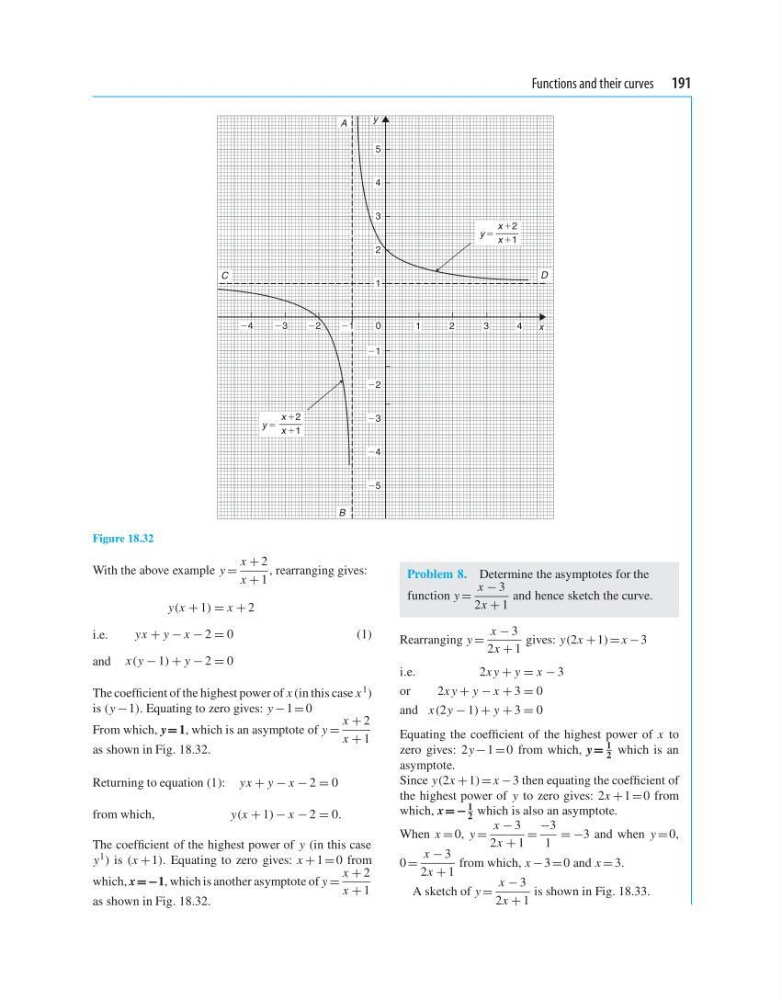
Figure 18.32
With the above example y =
x + 2
x + 1
, rearranging gives:
y(x + 1) = x + 2
i.e.
yx + y − x − 2 = 0
( 1 )
and x(y − 1) + y − 2 = 0
The coefficient of the highest power of x (in this case x 1 )
is (y − 1). Equating to zero gives: y − 1 = 0
From which, y = 1, which is an asymptote of y =
x + 2
x + 1
as shown in Fig. 18.32.
Returning to equation (1): yx + y − x − 2 = 0
from which,
y(x + 1) − x − 2 = 0.
The coefficient of the highest power of y (in this case
y 1 ) is (x + 1). Equating to zero gives: x + 1 = 0 from
which, x =−1, which is another asymptote of y =
x + 2
x + 1
as shown in Fig. 18.32.
Problem 8. Determine the asymptotes for the
function y =
x − 3
2x + 1
and hence sketch the curve.
Rearranging y =
x − 3
2x + 1
gives: y(2x + 1) = x − 3
i.e.
2x y + y = x − 3
or
2x y + y − x + 3 = 0
and x(2y − 1) + y + 3 = 0
Equating the coefficient of the highest power of x to
zero gives: 2y − 1 = 0 from which, y =
1
2 which is an
asymptote.
Since y(2x + 1) = x − 3 then equating the coefficient of
the highest power of y to zero gives: 2x + 1 = 0 from
which, x =−
1
2 which is also an asymptote.
When x = 0, y =
x − 3
2x + 1
=
−3
1
= −3 and when y = 0,
0 =
x − 3
2x + 1
from which, x − 3 = 0 and x = 3.
A sketch of y =
x − 3
2x + 1
is shown in Fig. 18.33.
y
A
B
C
D
2
3
4
5
0
22
23
24
1
2
3
4
21
22
23
24
25
21
x 12
x 11
y 5
x 12
x 11
y 5
1
x
Figure 18.32
With the above example y =
x + 2
x + 1
, rearranging gives:
y(x + 1) = x + 2
i.e.
yx + y − x − 2 = 0
( 1 )
and x(y − 1) + y − 2 = 0
The coefficient of the highest power of x (in this case x 1 )
is (y − 1). Equating to zero gives: y − 1 = 0
From which, y = 1, which is an asymptote of y =
x + 2
x + 1
as shown in Fig. 18.32.
Returning to equation (1): yx + y − x − 2 = 0
from which,
y(x + 1) − x − 2 = 0.
The coefficient of the highest power of y (in this case
y 1 ) is (x + 1). Equating to zero gives: x + 1 = 0 from
which, x =−1, which is another asymptote of y =
x + 2
x + 1
as shown in Fig. 18.32.
Problem 8. Determine the asymptotes for the
function y =
x − 3
2x + 1
and hence sketch the curve.
Rearranging y =
x − 3
2x + 1
gives: y(2x + 1) = x − 3
i.e.
2x y + y = x − 3
or
2x y + y − x + 3 = 0
and x(2y − 1) + y + 3 = 0
Equating the coefficient of the highest power of x to
zero gives: 2y − 1 = 0 from which, y =
1
2 which is an
asymptote.
Since y(2x + 1) = x − 3 then equating the coefficient of
the highest power of y to zero gives: 2x + 1 = 0 from
which, x =−
1
2 which is also an asymptote.
When x = 0, y =
x − 3
2x + 1
=
−3
1
= −3 and when y = 0,
0 =
x − 3
2x + 1
from which, x − 3 = 0 and x = 3.
A sketch of y =
x − 3
2x + 1
is shown in Fig. 18.33.