

154 Higher Engineering Mathematics
3. 2 cos 2 A − 1 = cos 2 A − sin 2 A
4.
cos x − cos 3 x
sin x
= sin x cos x
5. (1 + cot θ) 2 + (1 − cot θ) 2 = 2 cosec 2 θ
6.
sin
2 x(sec x + cosec x)
cos x tan x
= 1 + tan x
15.3 Trigonometric equations
Equations which contain trigonometric ratios are called
trigonometric equations. There are usually an infinite
number of solutions to such equations; however, solutions are often restricted to those between 0
◦ and 360
◦ .
A knowledge of angles of any magnitude is essential
in the solution of trigonometric equations and calculators cannot be relied upon to give all the solutions (as
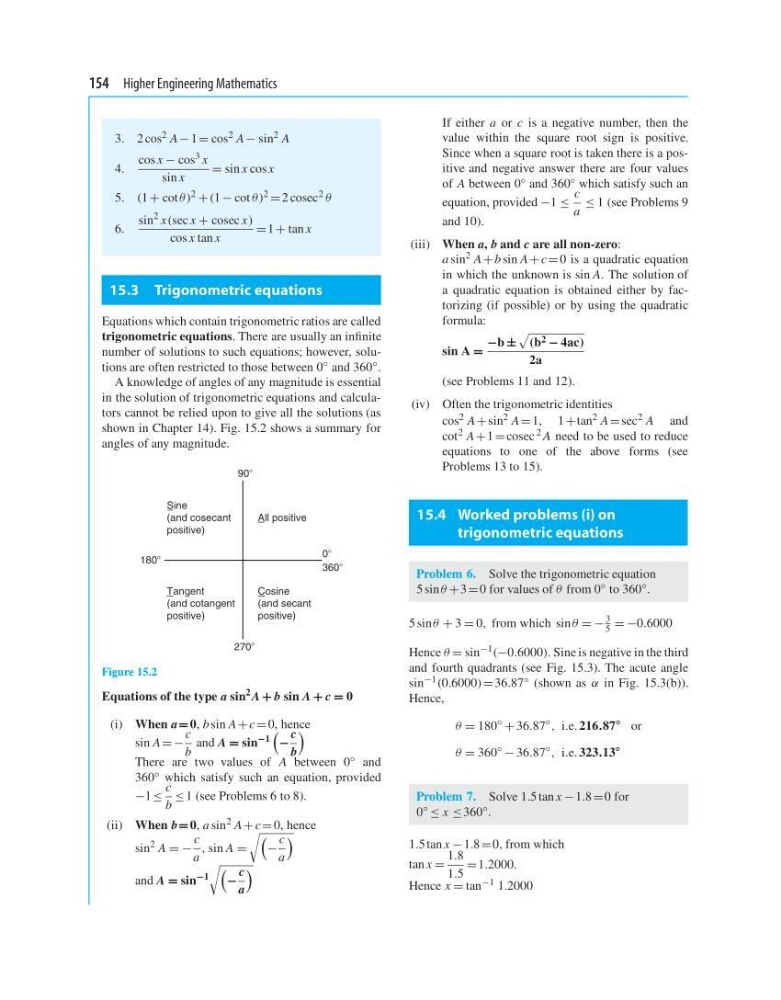
shown in Chapter 14). Fig. 15.2 shows a summary for
angles of any magnitude.
908
1808
2708
3608
08
Sine
(and cosecant
positive)
Tangent
(and cotangent
positive)
Cosine
(and secant
positive)
All positive
Figure 15.2
Equations of the type a sin
2 A + b sin A + c = 0
(i) When a = 0, b sin A + c = 0, hence
sin A = −
c
b
and A = sin
−1
−
c
b
There are two values of A between 0 ◦ and
360 ◦ which satisfy such an equation, provided
−1 ≤
c
b
≤ 1 (see Problems 6 to 8).
(ii) When b = 0, a sin 2 A + c = 0, hence
sin
2 A = −
c
a
, sin A =
−
c
a
and A = sin
−1
−
c
a
If either a or c is a negative number, then the
value within the square root sign is positive.
Since when a square root is taken there is a positive and negative answer there are four values
of A between 0 ◦ and 360 ◦ which satisfy such an
equation, provided −1 ≤
c
a
≤ 1 (see Problems 9
and 10).
(iii) When a, b and c are all non-zero:
a sin 2 A + b sin A + c = 0 is a quadratic equation
in which the unknown is sin A. The solution of
a quadratic equation is obtained either by factorizing (if possible) or by using the quadratic
formula:
sin A =
−b ±
(b 2 − 4ac)
2a
(see Problems 11 and 12).
(iv) Often the trigonometric identities
cos 2 A + sin 2 A = 1, 1 +tan 2 A = sec 2 A and
cot 2 A + 1 = cosec 2 A need to be used to reduce
equations to one of the above forms (see
Problems 13 to 15).
15.4 Worked problems (i) on
trigonometric equations
Problem 6. Solve the trigonometric equation
5 sinθ + 3 = 0 for values of θ from 0
◦ to 360
◦ .
5 sinθ + 3 = 0, from which sinθ = −
3
5 = −0.6000
Hence θ = sin −1 (−0.6000). Sine is negative in the third
and fourth quadrants (see Fig. 15.3). The acute angle
sin −1 (0.6000) = 36.87 ◦ (shown as α in Fig. 15.3(b)).
Hence,
θ = 180
◦
+ 36.87
◦
, i.e. 216.87
◦ or
θ = 360
◦
− 36.87
◦
, i.e. 323.13
◦
Problem 7. Solve 1.5 tan x − 1.8 =0 for
0
◦
≤ x ≤ 360
◦ .
1.5 tan x − 1.8 =0, from which
tan x =
1.8
1.5
= 1.2000.
Hence x = tan −1 1.2000
3. 2 cos 2 A − 1 = cos 2 A − sin 2 A
4.
cos x − cos 3 x
sin x
= sin x cos x
5. (1 + cot θ) 2 + (1 − cot θ) 2 = 2 cosec 2 θ
6.
sin
2 x(sec x + cosec x)
cos x tan x
= 1 + tan x
15.3 Trigonometric equations
Equations which contain trigonometric ratios are called
trigonometric equations. There are usually an infinite
number of solutions to such equations; however, solutions are often restricted to those between 0
◦ and 360
◦ .
A knowledge of angles of any magnitude is essential
in the solution of trigonometric equations and calculators cannot be relied upon to give all the solutions (as
shown in Chapter 14). Fig. 15.2 shows a summary for
angles of any magnitude.
908
1808
2708
3608
08
Sine
(and cosecant
positive)
Tangent
(and cotangent
positive)
Cosine
(and secant
positive)
All positive
Figure 15.2
Equations of the type a sin
2 A + b sin A + c = 0
(i) When a = 0, b sin A + c = 0, hence
sin A = −
c
b
and A = sin
−1
−
c
b
There are two values of A between 0 ◦ and
360 ◦ which satisfy such an equation, provided
−1 ≤
c
b
≤ 1 (see Problems 6 to 8).
(ii) When b = 0, a sin 2 A + c = 0, hence
sin
2 A = −
c
a
, sin A =
−
c
a
and A = sin
−1
−
c
a
If either a or c is a negative number, then the
value within the square root sign is positive.
Since when a square root is taken there is a positive and negative answer there are four values
of A between 0 ◦ and 360 ◦ which satisfy such an
equation, provided −1 ≤
c
a
≤ 1 (see Problems 9
and 10).
(iii) When a, b and c are all non-zero:
a sin 2 A + b sin A + c = 0 is a quadratic equation
in which the unknown is sin A. The solution of
a quadratic equation is obtained either by factorizing (if possible) or by using the quadratic
formula:
sin A =
−b ±
(b 2 − 4ac)
2a
(see Problems 11 and 12).
(iv) Often the trigonometric identities
cos 2 A + sin 2 A = 1, 1 +tan 2 A = sec 2 A and
cot 2 A + 1 = cosec 2 A need to be used to reduce
equations to one of the above forms (see
Problems 13 to 15).
15.4 Worked problems (i) on
trigonometric equations
Problem 6. Solve the trigonometric equation
5 sinθ + 3 = 0 for values of θ from 0
◦ to 360
◦ .
5 sinθ + 3 = 0, from which sinθ = −
3
5 = −0.6000
Hence θ = sin −1 (−0.6000). Sine is negative in the third
and fourth quadrants (see Fig. 15.3). The acute angle
sin −1 (0.6000) = 36.87 ◦ (shown as α in Fig. 15.3(b)).
Hence,
θ = 180
◦
+ 36.87
◦
, i.e. 216.87
◦ or
θ = 360
◦
− 36.87
◦
, i.e. 323.13
◦
Problem 7. Solve 1.5 tan x − 1.8 =0 for
0
◦
≤ x ≤ 360
◦ .
1.5 tan x − 1.8 =0, from which
tan x =
1.8
1.5
= 1.2000.
Hence x = tan −1 1.2000