

150 Higher Engineering Mathematics
339.4
Voltage
v (V)
67.9
267.9
2339.4
v 5 339.4 sin 100 t 1 67.9 sin(300 t 2
)
3
4
67.9 sin(300 t 2 )
3
4
339.4 sin 100 t
Time t (ms)
20
15
5
10
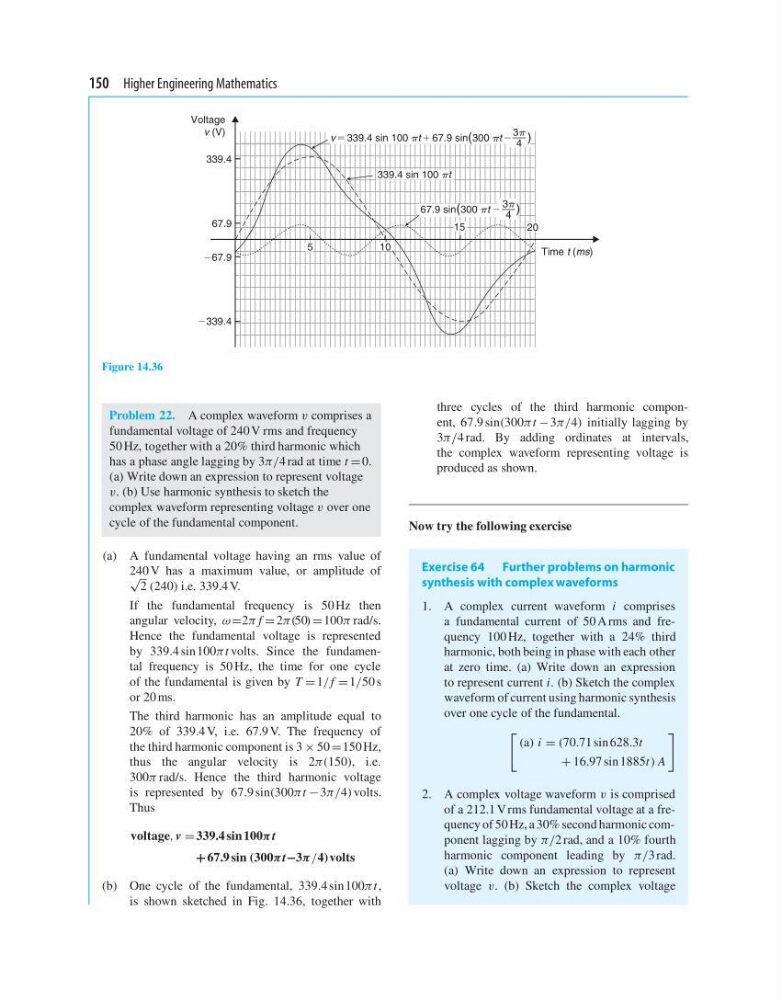
Figure 14.36
Problem 22. A complex waveform v comprises a
fundamental voltage of 240 V rms and frequency
50 Hz, together with a 20% third harmonic which
has a phase angle lagging by 3π/4 rad at time t = 0.
(a) Write down an expression to represent voltage
v. (b) Use harmonic synthesis to sketch the
complex waveform representing voltage v over one
cycle of the fundamental component.
(a) A fundamental voltage having an rms value of
240 V has a maximum value, or amplitude of
√
2 (240) i.e. 339.4 V.
If the fundamental frequency is 50 Hz then
angular velocity, ω =2π f = 2π(50) = 100π rad/s.
Hence the fundamental voltage is represented
by 339.4 sin 100πt volts. Since the fundamental frequency is 50 Hz, the time for one cycle
of the fundamental is given by T = 1/ f = 1/50 s
or 20 ms.
The third harmonic has an amplitude equal to
20% of 339.4 V, i.e. 67.9 V. The frequency of
the third harmonic component is 3 × 50 =150 Hz,
thus the angular velocity is 2π (150), i.e.
300π rad/s. Hence the third harmonic voltage
is represented by 67.9 sin(300πt − 3π/4) volts.
Thus
voltage, v = 339.4 sin 100πt
+ 67.9 sin (300πt−3π/4)volts
(b) One cycle of the fundamental, 339.4 sin 100πt ,
is shown sketched in Fig. 14.36, together with
three cycles of the third harmonic component, 67.9 sin(300πt − 3π/4) initially lagging by
3π/4 rad. By adding ordinates at intervals,
the complex waveform representing voltage is
produced as shown.
Now try the following exercise
Exercise 64 Further problems on harmonic
synthesis with complex waveforms
1. A complex current waveform i comprises
a fundamental current of 50 A rms and frequency 100 Hz, together with a 24% third
harmonic, both being in phase with each other
at zero time. (a) Write down an expression
to represent current i. (b) Sketch the complex
waveform of current using harmonic synthesis
over one cycle of the fundamental.
(a) i = (70.71 sin 628.3t
+ 16.97 sin 1885t ) A
2. A complex voltage waveform v is comprised
of a 212.1 V rms fundamental voltage at a frequency of 50 Hz, a 30% second harmonic component lagging by π/2 rad, and a 10% fourth
harmonic component leading by π/3 rad.
(a) Write down an expression to represent
voltage v. (b) Sketch the complex voltage
339.4
Voltage
v (V)
67.9
267.9
2339.4
v 5 339.4 sin 100 t 1 67.9 sin(300 t 2
)
3
4
67.9 sin(300 t 2 )
3
4
339.4 sin 100 t
Time t (ms)
20
15
5
10
Figure 14.36
Problem 22. A complex waveform v comprises a
fundamental voltage of 240 V rms and frequency
50 Hz, together with a 20% third harmonic which
has a phase angle lagging by 3π/4 rad at time t = 0.
(a) Write down an expression to represent voltage
v. (b) Use harmonic synthesis to sketch the
complex waveform representing voltage v over one
cycle of the fundamental component.
(a) A fundamental voltage having an rms value of
240 V has a maximum value, or amplitude of
√
2 (240) i.e. 339.4 V.
If the fundamental frequency is 50 Hz then
angular velocity, ω =2π f = 2π(50) = 100π rad/s.
Hence the fundamental voltage is represented
by 339.4 sin 100πt volts. Since the fundamental frequency is 50 Hz, the time for one cycle
of the fundamental is given by T = 1/ f = 1/50 s
or 20 ms.
The third harmonic has an amplitude equal to
20% of 339.4 V, i.e. 67.9 V. The frequency of
the third harmonic component is 3 × 50 =150 Hz,
thus the angular velocity is 2π (150), i.e.
300π rad/s. Hence the third harmonic voltage
is represented by 67.9 sin(300πt − 3π/4) volts.
Thus
voltage, v = 339.4 sin 100πt
+ 67.9 sin (300πt−3π/4)volts
(b) One cycle of the fundamental, 339.4 sin 100πt ,
is shown sketched in Fig. 14.36, together with
three cycles of the third harmonic component, 67.9 sin(300πt − 3π/4) initially lagging by
3π/4 rad. By adding ordinates at intervals,
the complex waveform representing voltage is
produced as shown.
Now try the following exercise
Exercise 64 Further problems on harmonic
synthesis with complex waveforms
1. A complex current waveform i comprises
a fundamental current of 50 A rms and frequency 100 Hz, together with a 24% third
harmonic, both being in phase with each other
at zero time. (a) Write down an expression
to represent current i. (b) Sketch the complex
waveform of current using harmonic synthesis
over one cycle of the fundamental.
(a) i = (70.71 sin 628.3t
+ 16.97 sin 1885t ) A
2. A complex voltage waveform v is comprised
of a 212.1 V rms fundamental voltage at a frequency of 50 Hz, a 30% second harmonic component lagging by π/2 rad, and a 10% fourth
harmonic component leading by π/3 rad.
(a) Write down an expression to represent
voltage v. (b) Sketch the complex voltage