

148 Higher Engineering Mathematics
0
4
24
210
10
T
i 1 5 10 sin t 1 4 sin 2t
10 sin t
4 sin 2t
3T
4
T
2
T
4
Current
i (A)
Time t (s)
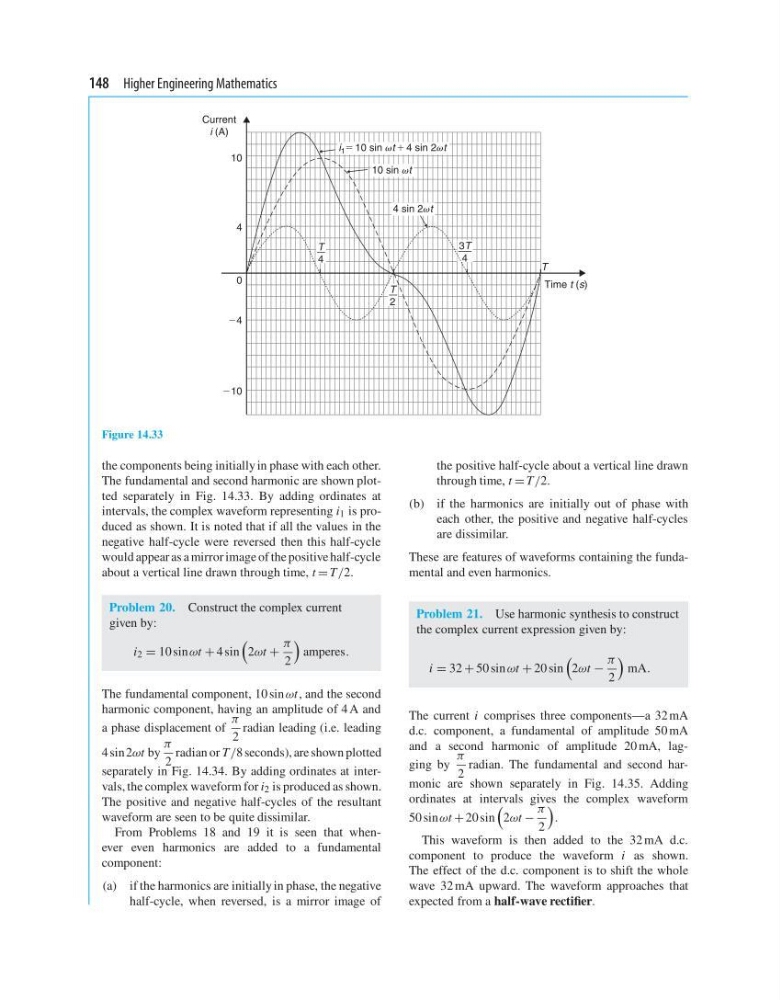
Figure 14.33
the components being initially in phase with each other.
The fundamental and second harmonic are shown plotted separately in Fig. 14.33. By adding ordinates at
intervals, the complex waveform representing i 1 is produced as shown. It is noted that if all the values in the
negative half-cycle were reversed then this half-cycle
would appear as a mirror image of the positive half-cycle
about a vertical line drawn through time, t = T/2.
Problem 20. Construct the complex current
given by:
i 2 = 10 sin ωt + 4 sin
2ωt +
π
2
amperes.
The fundamental component, 10 sin ωt , and the second
harmonic component, having an amplitude of 4 A and
a phase displacement of
π
2
radian leading (i.e. leading
4 sin2ωt by
π
2
radian or T/8 seconds), are shown plotted
separately in Fig. 14.34. By adding ordinates at intervals, the complex waveform for i 2 is produced as shown.
The positive and negative half-cycles of the resultant
waveform are seen to be quite dissimilar.
From Problems 18 and 19 it is seen that whenever even harmonics are added to a fundamental
component:
(a) if the harmonics are initially in phase, the negative
half-cycle, when reversed, is a mirror image of
the positive half-cycle about a vertical line drawn
through time, t = T/2.
(b) if the harmonics are initially out of phase with
each other, the positive and negative half-cycles
are dissimilar.
These are features of waveforms containing the fundamental and even harmonics.
Problem 21. Use harmonic synthesis to construct
the complex current expression given by:
i = 32 + 50 sin ωt + 20 sin
2ωt −
π
2
mA.
The current i comprises three components—a 32 mA
d.c. component, a fundamental of amplitude 50 mA
and a second harmonic of amplitude 20 mA, lagging by
π
2
radian. The fundamental and second harmonic are shown separately in Fig. 14.35. Adding
ordinates at intervals gives the complex waveform
50 sin ωt + 20 sin
2ωt −
π
2
.
This waveform is then added to the 32 mA d.c.
component to produce the waveform i as shown.
The effect of the d.c. component is to shift the whole
wave 32 mA upward. The waveform approaches that
expected from a half-wave rectifier.
0
4
24
210
10
T
i 1 5 10 sin t 1 4 sin 2t
10 sin t
4 sin 2t
3T
4
T
2
T
4
Current
i (A)
Time t (s)
Figure 14.33
the components being initially in phase with each other.
The fundamental and second harmonic are shown plotted separately in Fig. 14.33. By adding ordinates at
intervals, the complex waveform representing i 1 is produced as shown. It is noted that if all the values in the
negative half-cycle were reversed then this half-cycle
would appear as a mirror image of the positive half-cycle
about a vertical line drawn through time, t = T/2.
Problem 20. Construct the complex current
given by:
i 2 = 10 sin ωt + 4 sin
2ωt +
π
2
amperes.
The fundamental component, 10 sin ωt , and the second
harmonic component, having an amplitude of 4 A and
a phase displacement of
π
2
radian leading (i.e. leading
4 sin2ωt by
π
2
radian or T/8 seconds), are shown plotted
separately in Fig. 14.34. By adding ordinates at intervals, the complex waveform for i 2 is produced as shown.
The positive and negative half-cycles of the resultant
waveform are seen to be quite dissimilar.
From Problems 18 and 19 it is seen that whenever even harmonics are added to a fundamental
component:
(a) if the harmonics are initially in phase, the negative
half-cycle, when reversed, is a mirror image of
the positive half-cycle about a vertical line drawn
through time, t = T/2.
(b) if the harmonics are initially out of phase with
each other, the positive and negative half-cycles
are dissimilar.
These are features of waveforms containing the fundamental and even harmonics.
Problem 21. Use harmonic synthesis to construct
the complex current expression given by:
i = 32 + 50 sin ωt + 20 sin
2ωt −
π
2
mA.
The current i comprises three components—a 32 mA
d.c. component, a fundamental of amplitude 50 mA
and a second harmonic of amplitude 20 mA, lagging by
π
2
radian. The fundamental and second harmonic are shown separately in Fig. 14.35. Adding
ordinates at intervals gives the complex waveform
50 sin ωt + 20 sin
2ωt −
π
2
.
This waveform is then added to the 32 mA d.c.
component to produce the waveform i as shown.
The effect of the d.c. component is to shift the whole
wave 32 mA upward. The waveform approaches that
expected from a half-wave rectifier.