

Trigonometric waveforms 145
(c) When t = 10 ms
then v = 340 sin
50π
10
10 3 − 0.541
= 340 sin(1.0298) = 340 sin 59
◦
= 291.4 V
(d) When v = 200 volts
then 200 = 340 sin(50πt − 0.541)
200
340
= sin(50πt − 0.541)
Hence (50πt − 0.541) = arcsin
200
340
= 36.03
◦ or 0.6288 rad
50πt = 0.6288 + 0.541
= 1.1698
Hence when v = 200 V,
time, t =
1.1698
50π
= 7.447 ms
(e) When the voltage is a maximum, v = 340 V.
Hence
340 = 340 sin(50πt − 0.541)
1 = sin(50πt − 0.541)
50πt − 0.541 = arcsin 1
= 90
◦ or 1.5708 rad
50πt = 1.5708 + 0.541 = 2.1118
Hence time, t =
2.1118
50π
= 13.44 ms
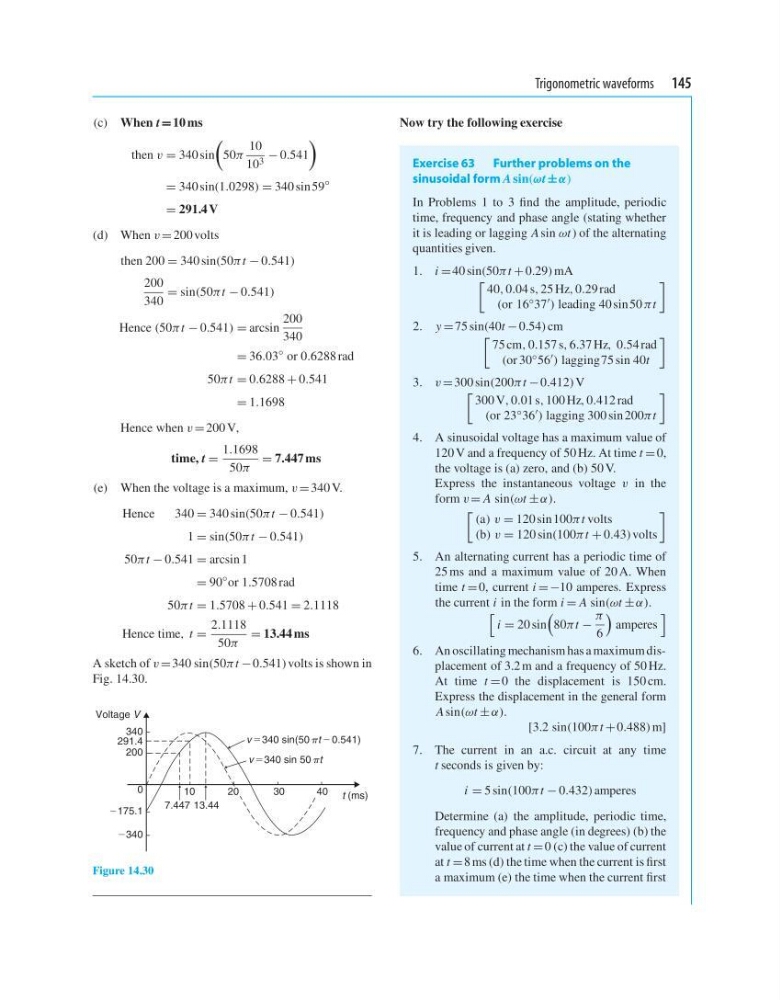
A sketch of v = 340 sin(50πt − 0.541) volts is shown in
Fig. 14.30.
v 5340 sin(50 t 2 0.541)
v 5340 sin 50 t
0
t (ms)
10
30
40
7.447 13.44
2340
2175.1
200
291.4
340
Voltage V
20
Figure 14.30
Now try the following exercise
Exercise 63 Further problems on the
sinusoidal form A sin(ωt ± α)
In Problems 1 to 3 find the amplitude, periodic
time, frequency and phase angle (stating whether
it is leading or lagging A sin ωt ) of the alternating
quantities given.
1. i = 40 sin(50πt + 0.29) mA
40, 0.04 s, 25 Hz, 0.29 rad
(or 16 ◦ 37 ) leading 40 sin 50 πt
2. y = 75 sin(40t − 0.54) cm
75 cm, 0.157 s, 6.37 Hz, 0.54 rad
(or 30 ◦ 56 ) lagging75 sin 40t
3. v = 300 sin(200πt − 0.412) V
300 V, 0.01 s, 100 Hz, 0.412 rad
(or 23 ◦ 36 ) lagging 300 sin 200πt
4. A sinusoidal voltage has a maximum value of
120 V and a frequency of 50 Hz. At time t = 0,
the voltage is (a) zero, and (b) 50 V.
Express the instantaneous voltage v in the
form v = A sin(ωt ± α).
(a) v = 120 sin 100πt volts
(b) v = 120 sin(100πt + 0.43) volts
5. An alternating current has a periodic time of
25 ms and a maximum value of 20 A. When
time t = 0, current i =−10 amperes. Express
the current i in the form i = A sin(ωt ± α).
i = 20 sin
80πt −
π
6
amperes
6. An oscillating mechanism has a maximum displacement of 3.2 m and a frequency of 50 Hz.
At time t = 0 the displacement is 150 cm.
Express the displacement in the general form
A sin(ωt ± α).
[3.2 sin(100πt + 0.488) m]
7. The current in an a.c. circuit at any time
t seconds is given by:
i = 5 sin(100πt − 0.432) amperes
Determine (a) the amplitude, periodic time,
frequency and phase angle (in degrees) (b) the
value of current at t = 0 (c) the value of current
at t = 8 ms (d) the time when the current is first
a maximum (e) the time when the current first
(c) When t = 10 ms
then v = 340 sin
50π
10
10 3 − 0.541
= 340 sin(1.0298) = 340 sin 59
◦
= 291.4 V
(d) When v = 200 volts
then 200 = 340 sin(50πt − 0.541)
200
340
= sin(50πt − 0.541)
Hence (50πt − 0.541) = arcsin
200
340
= 36.03
◦ or 0.6288 rad
50πt = 0.6288 + 0.541
= 1.1698
Hence when v = 200 V,
time, t =
1.1698
50π
= 7.447 ms
(e) When the voltage is a maximum, v = 340 V.
Hence
340 = 340 sin(50πt − 0.541)
1 = sin(50πt − 0.541)
50πt − 0.541 = arcsin 1
= 90
◦ or 1.5708 rad
50πt = 1.5708 + 0.541 = 2.1118
Hence time, t =
2.1118
50π
= 13.44 ms
A sketch of v = 340 sin(50πt − 0.541) volts is shown in
Fig. 14.30.
v 5340 sin(50 t 2 0.541)
v 5340 sin 50 t
0
t (ms)
10
30
40
7.447 13.44
2340
2175.1
200
291.4
340
Voltage V
20
Figure 14.30
Now try the following exercise
Exercise 63 Further problems on the
sinusoidal form A sin(ωt ± α)
In Problems 1 to 3 find the amplitude, periodic
time, frequency and phase angle (stating whether
it is leading or lagging A sin ωt ) of the alternating
quantities given.
1. i = 40 sin(50πt + 0.29) mA
40, 0.04 s, 25 Hz, 0.29 rad
(or 16 ◦ 37 ) leading 40 sin 50 πt
2. y = 75 sin(40t − 0.54) cm
75 cm, 0.157 s, 6.37 Hz, 0.54 rad
(or 30 ◦ 56 ) lagging75 sin 40t
3. v = 300 sin(200πt − 0.412) V
300 V, 0.01 s, 100 Hz, 0.412 rad
(or 23 ◦ 36 ) lagging 300 sin 200πt
4. A sinusoidal voltage has a maximum value of
120 V and a frequency of 50 Hz. At time t = 0,
the voltage is (a) zero, and (b) 50 V.
Express the instantaneous voltage v in the
form v = A sin(ωt ± α).
(a) v = 120 sin 100πt volts
(b) v = 120 sin(100πt + 0.43) volts
5. An alternating current has a periodic time of
25 ms and a maximum value of 20 A. When
time t = 0, current i =−10 amperes. Express
the current i in the form i = A sin(ωt ± α).
i = 20 sin
80πt −
π
6
amperes
6. An oscillating mechanism has a maximum displacement of 3.2 m and a frequency of 50 Hz.
At time t = 0 the displacement is 150 cm.
Express the displacement in the general form
A sin(ωt ± α).
[3.2 sin(100πt + 0.488) m]
7. The current in an a.c. circuit at any time
t seconds is given by:
i = 5 sin(100πt − 0.432) amperes
Determine (a) the amplitude, periodic time,
frequency and phase angle (in degrees) (b) the
value of current at t = 0 (c) the value of current
at t = 8 ms (d) the time when the current is first
a maximum (e) the time when the current first