

The circle and its properties 131
r
r
(a)
5 t
v 2
v 1
(b)
V
2v 1
v 2
v
2
2
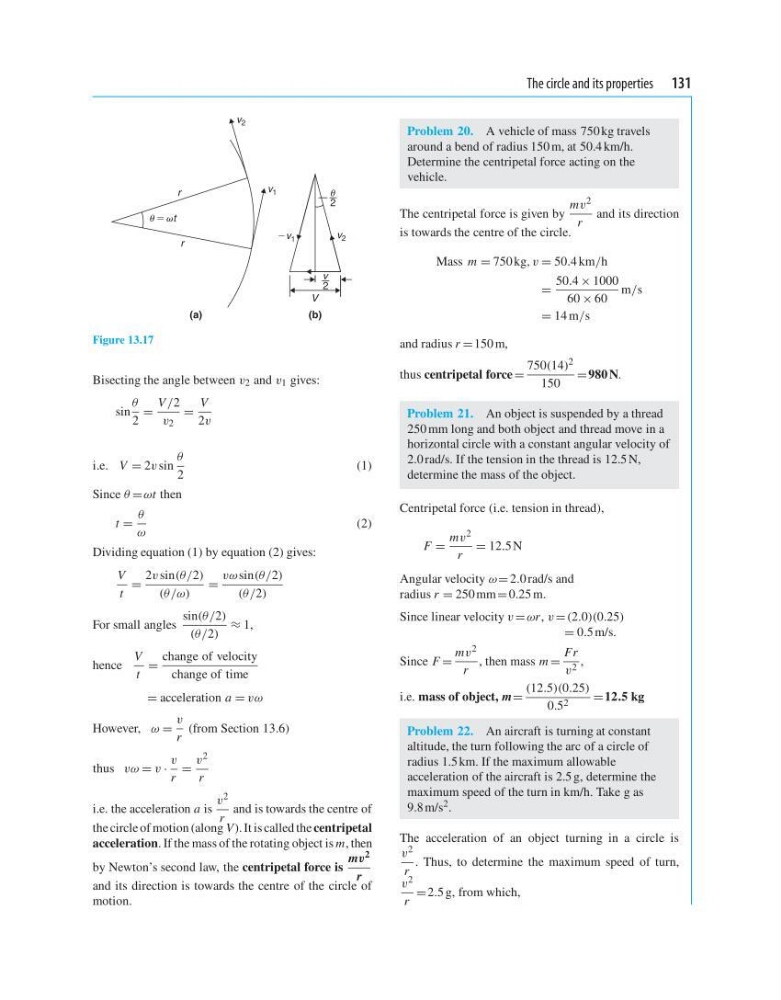
Figure 13.17
Bisecting the angle between v 2 and v 1 gives:
sin
θ
2
=
V /2
v 2
=
V
2v
i.e. V = 2v sin
θ
2
(1)
Since θ = ωt then
t =
θ
ω
(2)
Dividing equation (1) by equation (2) gives:
V
t
=
2v sin(θ/2)
(θ/ω)
=
vω sin(θ/2)
(θ/2)
For small angles
sin(θ/2)
(θ/2)
≈ 1,
hence
V
t
=
change of velocity
change of time
= acceleration a = vω
However, ω =
v
r
(from Section 13.6)
thus vω = v ·
v
r
=
v 2
r
i.e. the acceleration a is
v 2
r
and is towards the centre of
the circle of motion (along V). It is called the centripetal
acceleration. If the mass of the rotating object is m, then
by Newton’s second law, the centripetal force is
mv 2
r
and its direction is towards the centre of the circle of
motion.
Problem 20. A vehicle of mass 750 kg travels
around a bend of radius 150 m, at 50.4 km/h.
Determine the centripetal force acting on the
vehicle.
The centripetal force is given by
mv 2
r
and its direction
is towards the centre of the circle.
Mass m = 750 kg, v = 50.4 km/h
=
50.4 × 1000
60 × 60
m/s
= 14 m/s
and radius r = 150 m,
thus centripetal force =
750(14) 2
150
= 980 N.
Problem 21. An object is suspended by a thread
250 mm long and both object and thread move in a
horizontal circle with a constant angular velocity of
2.0 rad/s. If the tension in the thread is 12.5 N,
determine the mass of the object.
Centripetal force (i.e. tension in thread),
F =
mv 2
r
= 12.5 N
Angular velocity ω = 2.0 rad/s and
radius r = 250 mm = 0.25 m.
Since linear velocity v = ωr, v = (2.0)(0.25)
= 0.5 m/s.
Since F =
mv 2
r
, then mass m =
Fr
v 2 ,
i.e. mass of object, m =
(12.5)(0.25)
0.5 2
= 12.5 kg
Problem 22. An aircraft is turning at constant
altitude, the turn following the arc of a circle of
radius 1.5 km. If the maximum allowable
acceleration of the aircraft is 2.5 g, determine the
maximum speed of the turn in km/h. Take g as
9.8 m/s 2 .
The acceleration of an object turning in a circle is
v 2
r
. Thus, to determine the maximum speed of turn,
v 2
r
= 2.5 g, from which,
r
r
(a)
5 t
v 2
v 1
(b)
V
2v 1
v 2
v
2
2
Figure 13.17
Bisecting the angle between v 2 and v 1 gives:
sin
θ
2
=
V /2
v 2
=
V
2v
i.e. V = 2v sin
θ
2
(1)
Since θ = ωt then
t =
θ
ω
(2)
Dividing equation (1) by equation (2) gives:
V
t
=
2v sin(θ/2)
(θ/ω)
=
vω sin(θ/2)
(θ/2)
For small angles
sin(θ/2)
(θ/2)
≈ 1,
hence
V
t
=
change of velocity
change of time
= acceleration a = vω
However, ω =
v
r
(from Section 13.6)
thus vω = v ·
v
r
=
v 2
r
i.e. the acceleration a is
v 2
r
and is towards the centre of
the circle of motion (along V). It is called the centripetal
acceleration. If the mass of the rotating object is m, then
by Newton’s second law, the centripetal force is
mv 2
r
and its direction is towards the centre of the circle of
motion.
Problem 20. A vehicle of mass 750 kg travels
around a bend of radius 150 m, at 50.4 km/h.
Determine the centripetal force acting on the
vehicle.
The centripetal force is given by
mv 2
r
and its direction
is towards the centre of the circle.
Mass m = 750 kg, v = 50.4 km/h
=
50.4 × 1000
60 × 60
m/s
= 14 m/s
and radius r = 150 m,
thus centripetal force =
750(14) 2
150
= 980 N.
Problem 21. An object is suspended by a thread
250 mm long and both object and thread move in a
horizontal circle with a constant angular velocity of
2.0 rad/s. If the tension in the thread is 12.5 N,
determine the mass of the object.
Centripetal force (i.e. tension in thread),
F =
mv 2
r
= 12.5 N
Angular velocity ω = 2.0 rad/s and
radius r = 250 mm = 0.25 m.
Since linear velocity v = ωr, v = (2.0)(0.25)
= 0.5 m/s.
Since F =
mv 2
r
, then mass m =
Fr
v 2 ,
i.e. mass of object, m =
(12.5)(0.25)
0.5 2
= 12.5 kg
Problem 22. An aircraft is turning at constant
altitude, the turn following the arc of a circle of
radius 1.5 km. If the maximum allowable
acceleration of the aircraft is 2.5 g, determine the
maximum speed of the turn in km/h. Take g as
9.8 m/s 2 .
The acceleration of an object turning in a circle is
v 2
r
. Thus, to determine the maximum speed of turn,
v 2
r
= 2.5 g, from which,