

The circle and its properties 129
24
22
2
4
y
24
28
23
22
2
4
6 x
0
r 5
4
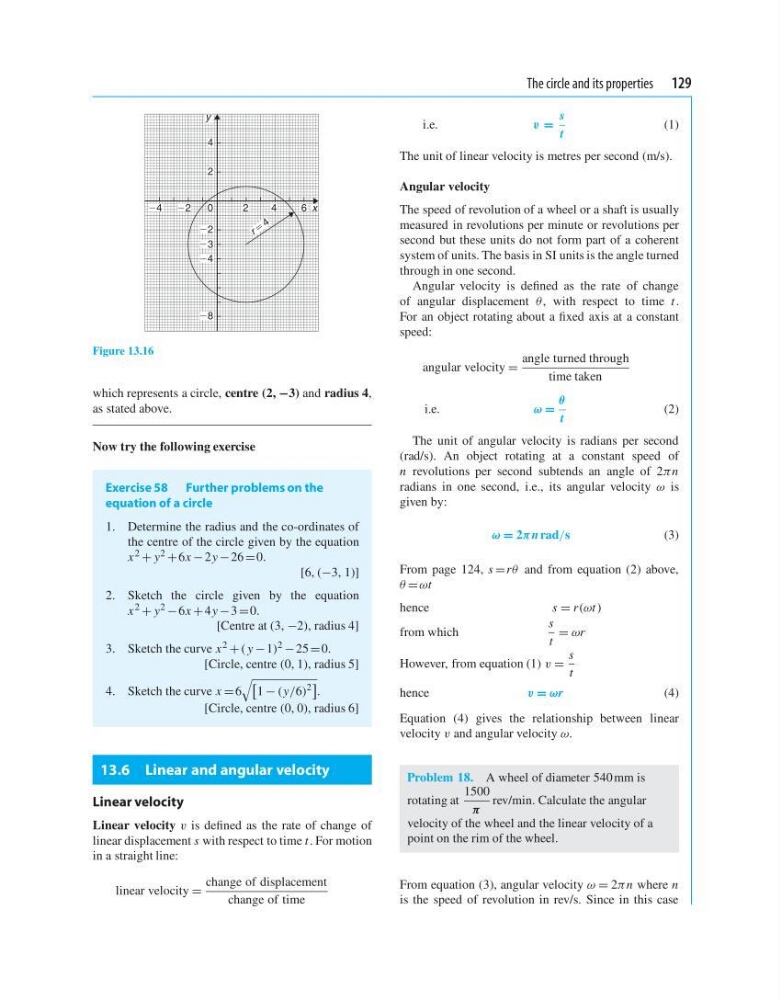
Figure 13.16
which represents a circle, centre (2, −3) and radius 4,
as stated above.
Now try the following exercise
Exercise 58 Further problems on the
equation of a circle
1. Determine the radius and the co-ordinates of
the centre of the circle given by the equation
x 2 + y 2 + 6x − 2y − 26 =0.
[6, (−3, 1)]
2. Sketch the circle given by the equation
x 2 + y 2 − 6x + 4y − 3 =0.
[Centre at (3, −2), radius 4]
3. Sketch the curve x 2 + ( y − 1) 2 − 25 =0.
[Circle, centre (0, 1), radius 5]
4. Sketch the curve x = 6
1 − (y/6)
2
.
[Circle, centre (0, 0), radius 6]
13.6 Linear and angular velocity
Linear velocity
Linear velocity v is defined as the rate of change of
linear displacement s with respect to time t . For motion
in a straight line:
linear velocity =
change of displacement
change of time
i.e.
v =
s
t
(1)
The unit of linear velocity is metres per second (m/s).
Angular velocity
The speed of revolution of a wheel or a shaft is usually
measured in revolutions per minute or revolutions per
second but these units do not form part of a coherent
system of units. The basis in SI units is the angle turned
through in one second.
Angular velocity is defined as the rate of change
of angular displacement θ, with respect to time t .
For an object rotating about a fixed axis at a constant
speed:
angular velocity =
angle turned through
time taken
i.e.
ω =
θ
t
(2)
The unit of angular velocity is radians per second
(rad/s). An object rotating at a constant speed of
n revolutions per second subtends an angle of 2πn
radians in one second, i.e., its angular velocity ω is
given by:
ω = 2πn rad/s
(3)
From page 124, s =rθ and from equation (2) above,
θ = ωt
hence
s = r(ωt )
from which
s
t
= ωr
However, from equation (1) v =
s
t
hence
v = ωr
(4)
Equation (4) gives the relationship between linear
velocity v and angular velocity ω.
Problem 18. A wheel of diameter 540 mm is
rotating at
1500
π
rev/min. Calculate the angular
velocity of the wheel and the linear velocity of a
point on the rim of the wheel.
From equation (3), angular velocity ω = 2πn where n
is the speed of revolution in rev/s. Since in this case
24
22
2
4
y
24
28
23
22
2
4
6 x
0
r 5
4
Figure 13.16
which represents a circle, centre (2, −3) and radius 4,
as stated above.
Now try the following exercise
Exercise 58 Further problems on the
equation of a circle
1. Determine the radius and the co-ordinates of
the centre of the circle given by the equation
x 2 + y 2 + 6x − 2y − 26 =0.
[6, (−3, 1)]
2. Sketch the circle given by the equation
x 2 + y 2 − 6x + 4y − 3 =0.
[Centre at (3, −2), radius 4]
3. Sketch the curve x 2 + ( y − 1) 2 − 25 =0.
[Circle, centre (0, 1), radius 5]
4. Sketch the curve x = 6
1 − (y/6)
2
.
[Circle, centre (0, 0), radius 6]
13.6 Linear and angular velocity
Linear velocity
Linear velocity v is defined as the rate of change of
linear displacement s with respect to time t . For motion
in a straight line:
linear velocity =
change of displacement
change of time
i.e.
v =
s
t
(1)
The unit of linear velocity is metres per second (m/s).
Angular velocity
The speed of revolution of a wheel or a shaft is usually
measured in revolutions per minute or revolutions per
second but these units do not form part of a coherent
system of units. The basis in SI units is the angle turned
through in one second.
Angular velocity is defined as the rate of change
of angular displacement θ, with respect to time t .
For an object rotating about a fixed axis at a constant
speed:
angular velocity =
angle turned through
time taken
i.e.
ω =
θ
t
(2)
The unit of angular velocity is radians per second
(rad/s). An object rotating at a constant speed of
n revolutions per second subtends an angle of 2πn
radians in one second, i.e., its angular velocity ω is
given by:
ω = 2πn rad/s
(3)
From page 124, s =rθ and from equation (2) above,
θ = ωt
hence
s = r(ωt )
from which
s
t
= ωr
However, from equation (1) v =
s
t
hence
v = ωr
(4)
Equation (4) gives the relationship between linear
velocity v and angular velocity ω.
Problem 18. A wheel of diameter 540 mm is
rotating at
1500
π
rev/min. Calculate the angular
velocity of the wheel and the linear velocity of a
point on the rim of the wheel.
From equation (3), angular velocity ω = 2πn where n
is the speed of revolution in rev/s. Since in this case