

The circle and its properties 127
11. Determine the length of the radius and circumference of a circle if an arc length of 32.6 cm
subtends an angle of 3.76 rad.
[8.67 cm, 54.48 cm]
12. Determine the angle of lap, in degrees and minutes, if 180 mm of a belt drive are in contact
with a pulley of diameter 250 mm.
[82 ◦ 30 ]
13. Determine the number of complete revolutions
a motorcycle wheel will make in travelling
2 km, if the wheel’s diameter is 85.1 cm.
[748]
14. The floodlights at a sports ground spread its
illumination over an angle of 40 ◦ to a distance
of 48 m. Determine (a) the angle in radians,
and (b) the maximum area that is floodlit.
[(a) 0.698 rad (b) 804.1 m 2 ]
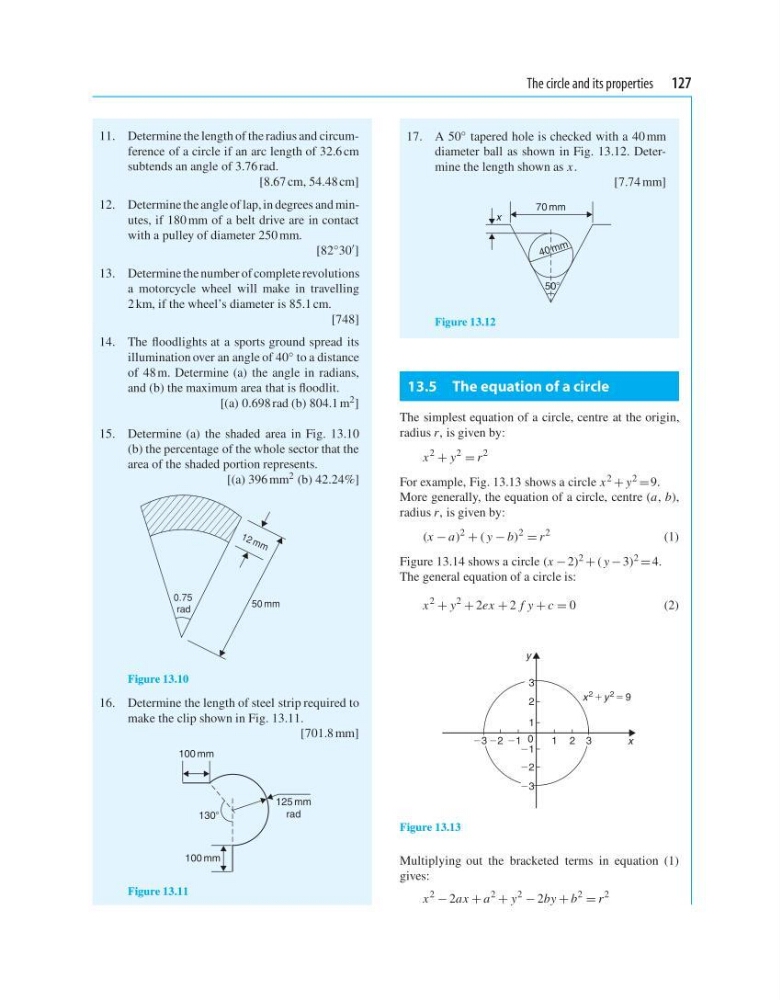
15. Determine (a) the shaded area in Fig. 13.10
(b) the percentage of the whole sector that the
area of the shaded portion represents.
[(a) 396 mm 2 (b) 42.24%]
50 mm
0.75
rad
1 2 m m
Figure 13.10
16. Determine the length of steel strip required to
make the clip shown in Fig. 13.11.
[701.8 mm]
100 mm
125 mm
rad
100 mm
1308
Figure 13.11
17. A 50 ◦ tapered hole is checked with a 40 mm
diameter ball as shown in Fig. 13.12. Determine the length shown as x.
[7.74 mm]
70 mm
x
508
4 0 m m
Figure 13.12
13.5 The equation of a circle
The simplest equation of a circle, centre at the origin,
radius r, is given by:
x
2
+ y
2
= r
2
For example, Fig. 13.13 shows a circle x 2 + y 2 = 9.
More generally, the equation of a circle, centre (a, b),
radius r, is given by:
(x − a)
2
+ ( y − b)
2
= r
2
(1)
Figure 13.14 shows a circle (x − 2) 2 + ( y − 3) 2 = 4.
The general equation of a circle is:
x
2
+ y
2
+ 2ex + 2 f y + c = 0
( 2 )
3
3
2
x
2 1 y
2 5 9
x
y
2
1
1
0
21
21
22
22
23
23
Figure 13.13
Multiplying out the bracketed terms in equation (1)
gives:
x
2
− 2ax + a
2
+ y
2
− 2by + b
2
= r
2
11. Determine the length of the radius and circumference of a circle if an arc length of 32.6 cm
subtends an angle of 3.76 rad.
[8.67 cm, 54.48 cm]
12. Determine the angle of lap, in degrees and minutes, if 180 mm of a belt drive are in contact
with a pulley of diameter 250 mm.
[82 ◦ 30 ]
13. Determine the number of complete revolutions
a motorcycle wheel will make in travelling
2 km, if the wheel’s diameter is 85.1 cm.
[748]
14. The floodlights at a sports ground spread its
illumination over an angle of 40 ◦ to a distance
of 48 m. Determine (a) the angle in radians,
and (b) the maximum area that is floodlit.
[(a) 0.698 rad (b) 804.1 m 2 ]
15. Determine (a) the shaded area in Fig. 13.10
(b) the percentage of the whole sector that the
area of the shaded portion represents.
[(a) 396 mm 2 (b) 42.24%]
50 mm
0.75
rad
1 2 m m
Figure 13.10
16. Determine the length of steel strip required to
make the clip shown in Fig. 13.11.
[701.8 mm]
100 mm
125 mm
rad
100 mm
1308
Figure 13.11
17. A 50 ◦ tapered hole is checked with a 40 mm
diameter ball as shown in Fig. 13.12. Determine the length shown as x.
[7.74 mm]
70 mm
x
508
4 0 m m
Figure 13.12
13.5 The equation of a circle
The simplest equation of a circle, centre at the origin,
radius r, is given by:
x
2
+ y
2
= r
2
For example, Fig. 13.13 shows a circle x 2 + y 2 = 9.
More generally, the equation of a circle, centre (a, b),
radius r, is given by:
(x − a)
2
+ ( y − b)
2
= r
2
(1)
Figure 13.14 shows a circle (x − 2) 2 + ( y − 3) 2 = 4.
The general equation of a circle is:
x
2
+ y
2
+ 2ex + 2 f y + c = 0
( 2 )
3
3
2
x
2 1 y
2 5 9
x
y
2
1
1
0
21
21
22
22
23
23
Figure 13.13
Multiplying out the bracketed terms in equation (1)
gives:
x
2
− 2ax + a
2
+ y
2
− 2by + b
2
= r
2