

Chapter 13
The circle and its properties
13.1 Introduction
A circle is a plain figure enclosed by a curved line, every
point on which is equidistant from a point within, called
the centre.
13.2 Properties of circles
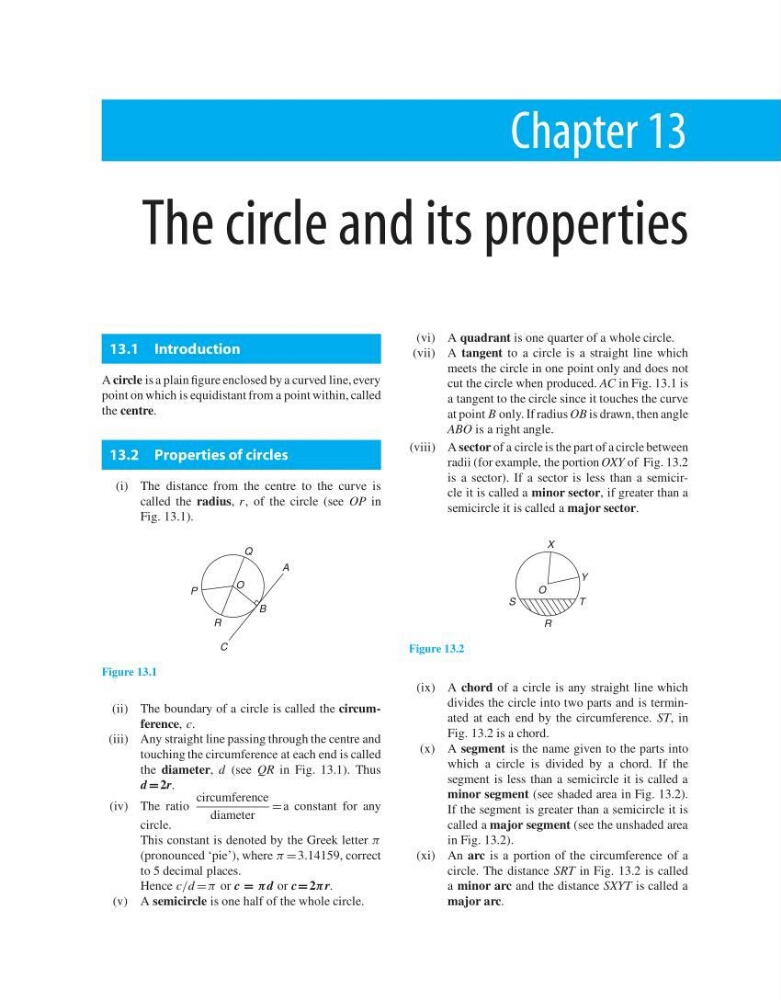
(i) The distance from the centre to the curve is
called the radius, r, of the circle (see OP in
Fig. 13.1).
C
B
Q
O
P
R
A
Figure 13.1
(ii) The boundary of a circle is called the circumference, c.
(iii) Any straight line passing through the centre and
touching the circumference at each end is called
the diameter, d (see QR in Fig. 13.1). Thus
d = 2r.
(iv) The ratio
circumference
diameter
= a constant for any
circle.
This constant is denoted by the Greek letter π
(pronounced ‘pie’), where π = 3.14159, correct
to 5 decimal places.
Hence c/d = π or c = πd or c = 2πr.
(v) A semicircle is one half of the whole circle.
(vi) A quadrant is one quarter of a whole circle.
(vii) A tangent to a circle is a straight line which
meets the circle in one point only and does not
cut the circle when produced. AC in Fig. 13.1 is
a tangent to the circle since it touches the curve
at point B only. If radius OB is drawn, then angle
ABO is a right angle.
(viii) A sector of a circle is the part of a circle between
radii (for example, the portion OXY of Fig. 13.2
is a sector). If a sector is less than a semicircle it is called a minor sector, if greater than a
semicircle it is called a major sector.
X
Y
T
S
R
O
Figure 13.2
(ix) A chord of a circle is any straight line which
divides the circle into two parts and is terminated at each end by the circumference. ST, in
Fig. 13.2 is a chord.
(x) A segment is the name given to the parts into
which a circle is divided by a chord. If the
segment is less than a semicircle it is called a
minor segment (see shaded area in Fig. 13.2).
If the segment is greater than a semicircle it is
called a major segment (see the unshaded area
in Fig. 13.2).
(xi) An arc is a portion of the circumference of a
circle. The distance SRT in Fig. 13.2 is called
a minor arc and the distance SXYT is called a
major arc.
The circle and its properties
13.1 Introduction
A circle is a plain figure enclosed by a curved line, every
point on which is equidistant from a point within, called
the centre.
13.2 Properties of circles
(i) The distance from the centre to the curve is
called the radius, r, of the circle (see OP in
Fig. 13.1).
C
B
Q
O
P
R
A
Figure 13.1
(ii) The boundary of a circle is called the circumference, c.
(iii) Any straight line passing through the centre and
touching the circumference at each end is called
the diameter, d (see QR in Fig. 13.1). Thus
d = 2r.
(iv) The ratio
circumference
diameter
= a constant for any
circle.
This constant is denoted by the Greek letter π
(pronounced ‘pie’), where π = 3.14159, correct
to 5 decimal places.
Hence c/d = π or c = πd or c = 2πr.
(v) A semicircle is one half of the whole circle.
(vi) A quadrant is one quarter of a whole circle.
(vii) A tangent to a circle is a straight line which
meets the circle in one point only and does not
cut the circle when produced. AC in Fig. 13.1 is
a tangent to the circle since it touches the curve
at point B only. If radius OB is drawn, then angle
ABO is a right angle.
(viii) A sector of a circle is the part of a circle between
radii (for example, the portion OXY of Fig. 13.2
is a sector). If a sector is less than a semicircle it is called a minor sector, if greater than a
semicircle it is called a major sector.
X
Y
T
S
R
O
Figure 13.2
(ix) A chord of a circle is any straight line which
divides the circle into two parts and is terminated at each end by the circumference. ST, in
Fig. 13.2 is a chord.
(x) A segment is the name given to the parts into
which a circle is divided by a chord. If the
segment is less than a semicircle it is called a
minor segment (see shaded area in Fig. 13.2).
If the segment is greater than a semicircle it is
called a major segment (see the unshaded area
in Fig. 13.2).
(xi) An arc is a portion of the circumference of a
circle. The distance SRT in Fig. 13.2 is called
a minor arc and the distance SXYT is called a
major arc.