

114 Higher Engineering Mathematics
448
488
30.0 m
D
C
B
A
Figure 11.36
For triangle ABC, using Pythagoras’ theorem:
BC
2
= AB
2
+ AC
2
DC
tan 44 ◦
2
= (30.0)
2
+
DC
tan 48 ◦
2
DC
2
1
tan 2 44 ◦ −
1
tan 2 48 ◦
= 30.0
2
DC
2
(1.072323 − 0.810727) = 30.0
2
DC
2
=
30.0 2
0.261596
= 3440.4
Hence, height of aerial,
DC =
√
3440.4 = 58.65 m
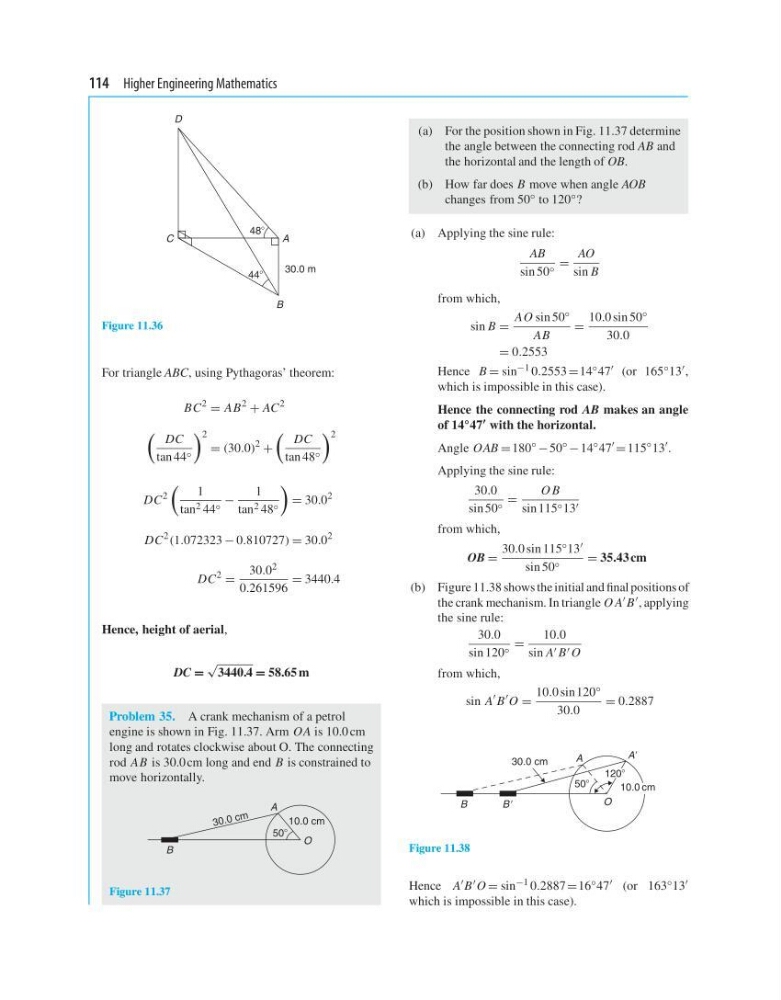
Problem 35. A crank mechanism of a petrol
engine is shown in Fig. 11.37. Arm OA is 10.0 cm
long and rotates clockwise about O. The connecting
rod AB is 30.0 cm long and end B is constrained to
move horizontally.
30 .0 cm
A
B
O
10.0 cm
508
Figure 11.37
(a) For the position shown in Fig. 11.37 determine
the angle between the connecting rod AB and
the horizontal and the length of OB.
(b) How far does B move when angle AOB
changes from 50 ◦ to 120 ◦ ?
(a) Applying the sine rule:
AB
sin 50 ◦ =
AO
sin B
from which,
sin B =
AO sin 50 ◦
AB
=
10.0 sin 50 ◦
30.0
= 0.2553
Hence B = sin −1 0.2553 =14 ◦ 47 (or 165 ◦ 13 ,
which is impossible in this case).
Hence the connecting rod AB makes an angle
of 14 ◦ 47 with the horizontal.
Angle OAB = 180
◦
− 50
◦
− 14
◦ 47
= 115
◦ 13
.
Applying the sine rule:
30.0
sin 50 ◦ =
O B
sin 115 ◦ 13
from which,
OB =
30.0 sin 115 ◦ 13
sin 50 ◦
= 35.43 cm
(b) Figure 11.38 shows the initial and final positions of
the crank mechanism. In triangle O A B , applying
the sine rule:
30.0
sin 120 ◦ =
10.0
sin A B O
from which,
sin A
B
O =
10.0 sin 120 ◦
30.0
= 0.2887
A
AЈ
B
B Ј
O
50Њ
30.0 cm
10.0 cm
120Њ
Figure 11.38
Hence A B O = sin −1 0.2887 =16 ◦ 47 (or 163 ◦ 13
which is impossible in this case).
448
488
30.0 m
D
C
B
A
Figure 11.36
For triangle ABC, using Pythagoras’ theorem:
BC
2
= AB
2
+ AC
2
DC
tan 44 ◦
2
= (30.0)
2
+
DC
tan 48 ◦
2
DC
2
1
tan 2 44 ◦ −
1
tan 2 48 ◦
= 30.0
2
DC
2
(1.072323 − 0.810727) = 30.0
2
DC
2
=
30.0 2
0.261596
= 3440.4
Hence, height of aerial,
DC =
√
3440.4 = 58.65 m
Problem 35. A crank mechanism of a petrol
engine is shown in Fig. 11.37. Arm OA is 10.0 cm
long and rotates clockwise about O. The connecting
rod AB is 30.0 cm long and end B is constrained to
move horizontally.
30 .0 cm
A
B
O
10.0 cm
508
Figure 11.37
(a) For the position shown in Fig. 11.37 determine
the angle between the connecting rod AB and
the horizontal and the length of OB.
(b) How far does B move when angle AOB
changes from 50 ◦ to 120 ◦ ?
(a) Applying the sine rule:
AB
sin 50 ◦ =
AO
sin B
from which,
sin B =
AO sin 50 ◦
AB
=
10.0 sin 50 ◦
30.0
= 0.2553
Hence B = sin −1 0.2553 =14 ◦ 47 (or 165 ◦ 13 ,
which is impossible in this case).
Hence the connecting rod AB makes an angle
of 14 ◦ 47 with the horizontal.
Angle OAB = 180
◦
− 50
◦
− 14
◦ 47
= 115
◦ 13
.
Applying the sine rule:
30.0
sin 50 ◦ =
O B
sin 115 ◦ 13
from which,
OB =
30.0 sin 115 ◦ 13
sin 50 ◦
= 35.43 cm
(b) Figure 11.38 shows the initial and final positions of
the crank mechanism. In triangle O A B , applying
the sine rule:
30.0
sin 120 ◦ =
10.0
sin A B O
from which,
sin A
B
O =
10.0 sin 120 ◦
30.0
= 0.2887
A
AЈ
B
B Ј
O
50Њ
30.0 cm
10.0 cm
120Њ
Figure 11.38
Hence A B O = sin −1 0.2887 =16 ◦ 47 (or 163 ◦ 13
which is impossible in this case).