

108 Higher Engineering Mathematics
Now try the following exercise
Exercise 48 Further problems on angles of
elevation and depression
1. If the angle of elevation of the top of a vertical
30 m high aerial is 32 ◦ , how far is it to the
aerial?
[48 m]
2. From the top of a vertical cliff 80.0 m high
the angles of depression of two buoys lying
due west of the cliff are 23 ◦ and 15 ◦ , respectively. How far are the buoys apart? [110.1 m]
3. From a point on horizontal ground a surveyor
measures the angle of elevation of the top of
a flagpole as 18 ◦ 40 . He moves 50 m nearer
to the flagpole and measures the angle of elevation as 26 ◦ 22 . Determine the height of the
flagpole.
[53.0 m]
4. A flagpole stands on the edge of the top of a
building. At a point 200 m from the building
the angles of elevation of the top and bottom of the pole are 32 ◦ and 30 ◦ respectively.
Calculate the height of the flagpole. [9.50 m]
5. From a ship at sea, the angles of elevation of
the top and bottom of a vertical lighthouse
standing on the edge of a vertical cliff are
31 ◦ and 26 ◦ , respectively. If the lighthouse is
25.0 m high, calculate the height of the cliff.
[107.8 m]
6. From a window 4.2 m above horizontal ground
the angle of depression of the foot of a building
across the road is 24 ◦ and the angle of elevation
of the top of the building is 34 ◦ . Determine,
correct to the nearest centimetre, the width of
the road and the height of the building.
[9.43 m, 10.56 m]
7. The elevation of a tower from two points, one
due east of the tower and the other due west
of it are 20 ◦ and 24 ◦ , respectively, and the two
points of observation are 300 m apart. Find the
height of the tower to the nearest metre.
[60 m]
11.7 Sine and cosine rules
To ‘solve a triangle’ means ‘to find the values of
unknown sides and angles’. If a triangle is right angled,
trigonometric ratios and the theorem of Pythagoras may
be used for its solution, as shown in Section 11.5. However, for a non-right-angled triangle, trigonometric
ratios and Pythagoras’ theorem cannot be used. Instead,
two rules, called the sine rule and the cosine rule,
are used.
Sine rule
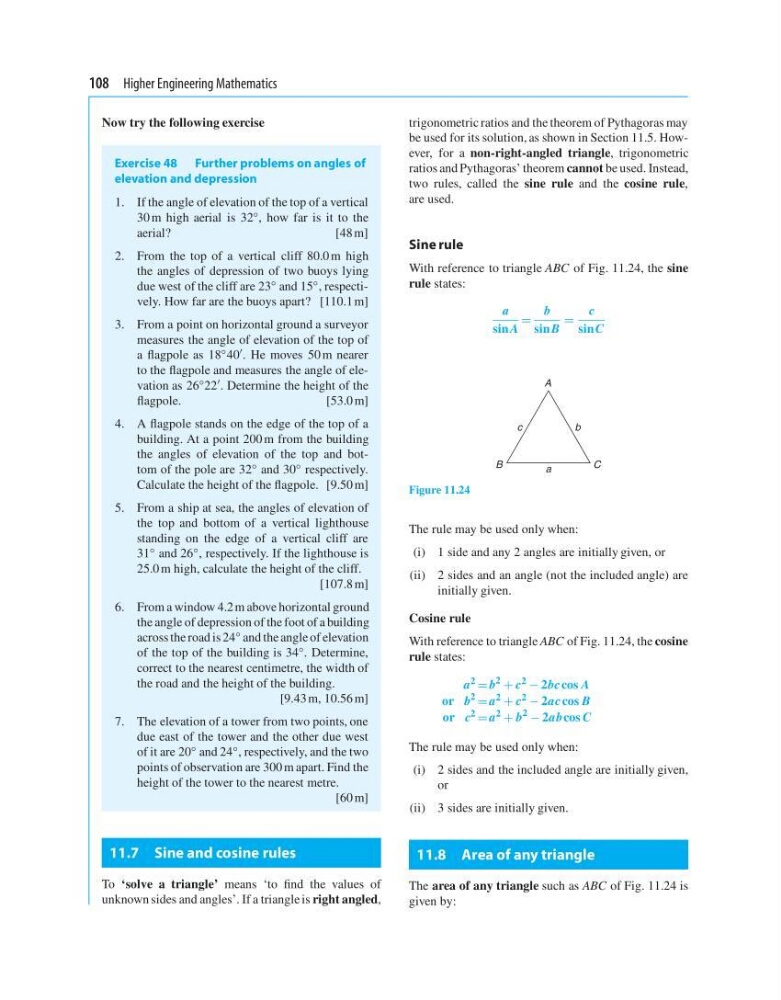
With reference to triangle ABC of Fig. 11.24, the sine
rule states:
a
sin A
=
b
sin B
=
c
sin C
c
b
a
B
A
C
Figure 11.24
The rule may be used only when:
(i) 1 side and any 2 angles are initially given, or
(ii) 2 sides and an angle (not the included angle) are
initially given.
Cosine rule
With reference to triangle ABC of Fig. 11.24, the cosine
rule states:
a 2 = b
2
+ c 2 − 2bc cos A
or b
2
= a 2 + c 2 − 2ac cos B
or c 2 = a 2 + b
2
− 2ab cos C
The rule may be used only when:
(i) 2 sides and the included angle are initially given,
or
(ii) 3 sides are initially given.
11.8 Area of any triangle
The area of any triangle such as ABC of Fig. 11.24 is
given by:
Now try the following exercise
Exercise 48 Further problems on angles of
elevation and depression
1. If the angle of elevation of the top of a vertical
30 m high aerial is 32 ◦ , how far is it to the
aerial?
[48 m]
2. From the top of a vertical cliff 80.0 m high
the angles of depression of two buoys lying
due west of the cliff are 23 ◦ and 15 ◦ , respectively. How far are the buoys apart? [110.1 m]
3. From a point on horizontal ground a surveyor
measures the angle of elevation of the top of
a flagpole as 18 ◦ 40 . He moves 50 m nearer
to the flagpole and measures the angle of elevation as 26 ◦ 22 . Determine the height of the
flagpole.
[53.0 m]
4. A flagpole stands on the edge of the top of a
building. At a point 200 m from the building
the angles of elevation of the top and bottom of the pole are 32 ◦ and 30 ◦ respectively.
Calculate the height of the flagpole. [9.50 m]
5. From a ship at sea, the angles of elevation of
the top and bottom of a vertical lighthouse
standing on the edge of a vertical cliff are
31 ◦ and 26 ◦ , respectively. If the lighthouse is
25.0 m high, calculate the height of the cliff.
[107.8 m]
6. From a window 4.2 m above horizontal ground
the angle of depression of the foot of a building
across the road is 24 ◦ and the angle of elevation
of the top of the building is 34 ◦ . Determine,
correct to the nearest centimetre, the width of
the road and the height of the building.
[9.43 m, 10.56 m]
7. The elevation of a tower from two points, one
due east of the tower and the other due west
of it are 20 ◦ and 24 ◦ , respectively, and the two
points of observation are 300 m apart. Find the
height of the tower to the nearest metre.
[60 m]
11.7 Sine and cosine rules
To ‘solve a triangle’ means ‘to find the values of
unknown sides and angles’. If a triangle is right angled,
trigonometric ratios and the theorem of Pythagoras may
be used for its solution, as shown in Section 11.5. However, for a non-right-angled triangle, trigonometric
ratios and Pythagoras’ theorem cannot be used. Instead,
two rules, called the sine rule and the cosine rule,
are used.
Sine rule
With reference to triangle ABC of Fig. 11.24, the sine
rule states:
a
sin A
=
b
sin B
=
c
sin C
c
b
a
B
A
C
Figure 11.24
The rule may be used only when:
(i) 1 side and any 2 angles are initially given, or
(ii) 2 sides and an angle (not the included angle) are
initially given.
Cosine rule
With reference to triangle ABC of Fig. 11.24, the cosine
rule states:
a 2 = b
2
+ c 2 − 2bc cos A
or b
2
= a 2 + c 2 − 2ac cos B
or c 2 = a 2 + b
2
− 2ab cos C
The rule may be used only when:
(i) 2 sides and the included angle are initially given,
or
(ii) 3 sides are initially given.
11.8 Area of any triangle
The area of any triangle such as ABC of Fig. 11.24 is
given by: