

Chapter 11
Introduction to trigonometry
11.1 Trigonometry
Trigonometry is the branch of mathematics which deals
with the measurement of sides and angles of triangles, and their relationship with each other. There are
many applications in engineering where a knowledge
of trigonometry is needed.
11.2 The theorem of Pythagoras
With reference to Fig. 11.1, the side opposite the right
angle (i.e. side b) is called the hypotenuse. The theorem
of Pythagoras states:
‘In any right-angled triangle, the square on the
hypotenuse is equal to the sum of the squares on the
other two sides.’
Hence b
2
= a 2 + c 2
B
A
C
a
b
c
Figure 11.1
Problem 1. In Fig. 11.2, find the length of EF.
E
d
F
D
f 5 5 cm
e 513 cm
Figure 11.2
By Pythagoras’ theorem:
e
2
= d
2
+ f
2
Hence
13
2
= d
2
+ 5
2
169 = d
2
+ 25
d
2
= 169 − 25 = 144
Thus
d =
√
144 = 12 cm
i.e.
EF = 12 cm
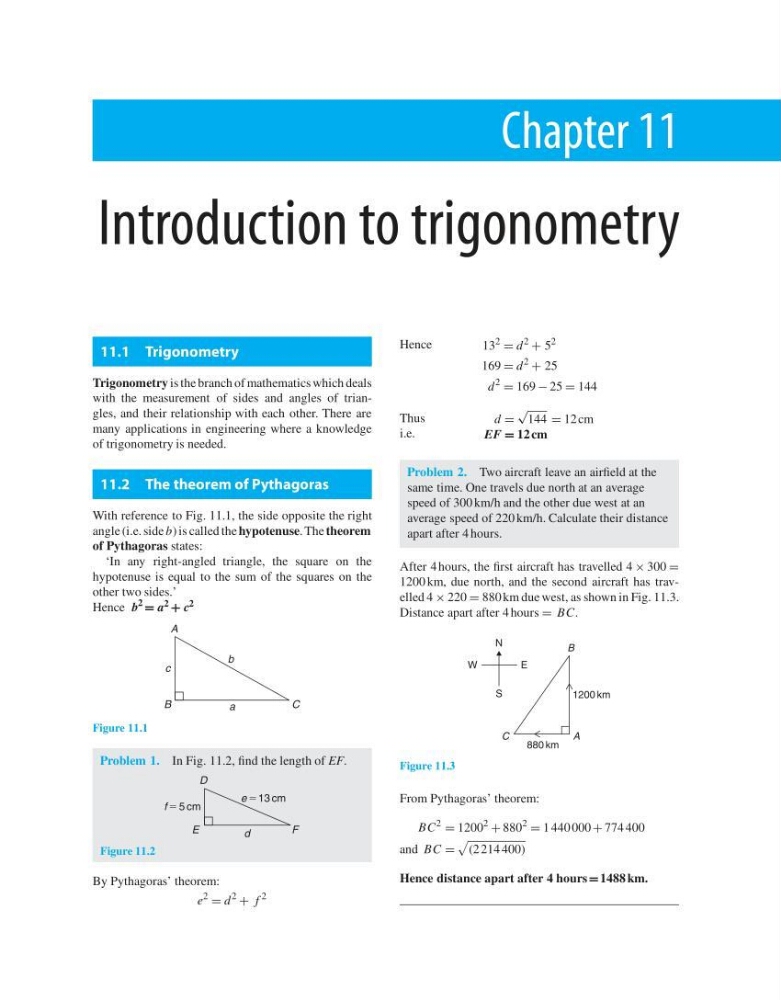
Problem 2. Two aircraft leave an airfield at the
same time. One travels due north at an average
speed of 300 km/h and the other due west at an
average speed of 220 km/h. Calculate their distance
apart after 4 hours.
After 4 hours, the first aircraft has travelled 4 × 300 =
1200 km, due north, and the second aircraft has travelled 4 × 220 = 880 km due west, as shown in Fig. 11.3.
Distance apart after 4 hours = BC.
A
B
N
E
W
S
C
1200 km
880 km
Figure 11.3
From Pythagoras’ theorem:
BC
2
= 1200
2
+ 880
2
= 1 440 000 + 774 400
and BC =
(2 214 400)
Hence distance apart after 4 hours = 1488 km.
Introduction to trigonometry
11.1 Trigonometry
Trigonometry is the branch of mathematics which deals
with the measurement of sides and angles of triangles, and their relationship with each other. There are
many applications in engineering where a knowledge
of trigonometry is needed.
11.2 The theorem of Pythagoras
With reference to Fig. 11.1, the side opposite the right
angle (i.e. side b) is called the hypotenuse. The theorem
of Pythagoras states:
‘In any right-angled triangle, the square on the
hypotenuse is equal to the sum of the squares on the
other two sides.’
Hence b
2
= a 2 + c 2
B
A
C
a
b
c
Figure 11.1
Problem 1. In Fig. 11.2, find the length of EF.
E
d
F
D
f 5 5 cm
e 513 cm
Figure 11.2
By Pythagoras’ theorem:
e
2
= d
2
+ f
2
Hence
13
2
= d
2
+ 5
2
169 = d
2
+ 25
d
2
= 169 − 25 = 144
Thus
d =
√
144 = 12 cm
i.e.
EF = 12 cm
Problem 2. Two aircraft leave an airfield at the
same time. One travels due north at an average
speed of 300 km/h and the other due west at an
average speed of 220 km/h. Calculate their distance
apart after 4 hours.
After 4 hours, the first aircraft has travelled 4 × 300 =
1200 km, due north, and the second aircraft has travelled 4 × 220 = 880 km due west, as shown in Fig. 11.3.
Distance apart after 4 hours = BC.
A
B
N
E
W
S
C
1200 km
880 km
Figure 11.3
From Pythagoras’ theorem:
BC
2
= 1200
2
+ 880
2
= 1 440 000 + 774 400
and BC =
(2 214 400)
Hence distance apart after 4 hours = 1488 km.