

90 Higher Engineering Mathematics
Problem 8. Perform the binary addition:
11111 + 10101
11111
+10101
sum 110100
carry 11111
Problem 9. Perform the binary addition:
1101001 + 1110101
1101001
+1110101
sum 11011110
carry 11
1
Problem 10. Perform the binary addition:
1011101 + 1100001 + 110101
1011101
1100001
+ 110101
sum 11110011
carry 11111 1
Now try the following exercise
Exercise 40 Further problems on binary
addition
Perform the following binary additions:
1. 10 + 11
[101]
2. 101 + 110
[1011]
3. 1101 + 111
[10100]
4. 1111 + 11101
[101100]
5. 110111 + 10001
[1001000]
6. 10000101 + 10000101
[100001010]
7. 11101100 + 111001011
[1010110111]
8. 110011010 + 11100011
[1001111101]
9. 10110 + 1011 + 11011
[111100]
10. 111 + 10101 + 11011
[110111]
11. 1101 + 1001 + 11101
[110011]
12. 100011 + 11101 + 101110
[1101110]
10.3 Octal numbers
For decimal integers containing several digits, repeatedly dividing by 2 can be a lengthy process. In this case,
it is usually easier to convert a decimal number to a
binary number via the octal system of numbers. This
system has a radix of 8, using the digits 0, 1, 2, 3, 4,
5, 6 and 7. The decimal number equivalent to the octal
number 4317 8 is:
4 × 8
3
+ 3 × 8
2
+ 1 × 8
1
+ 7 × 8
0
i.e. 4 × 512 + 3 × 64 + 1 × 8 + 7 × 1 or 2255 10
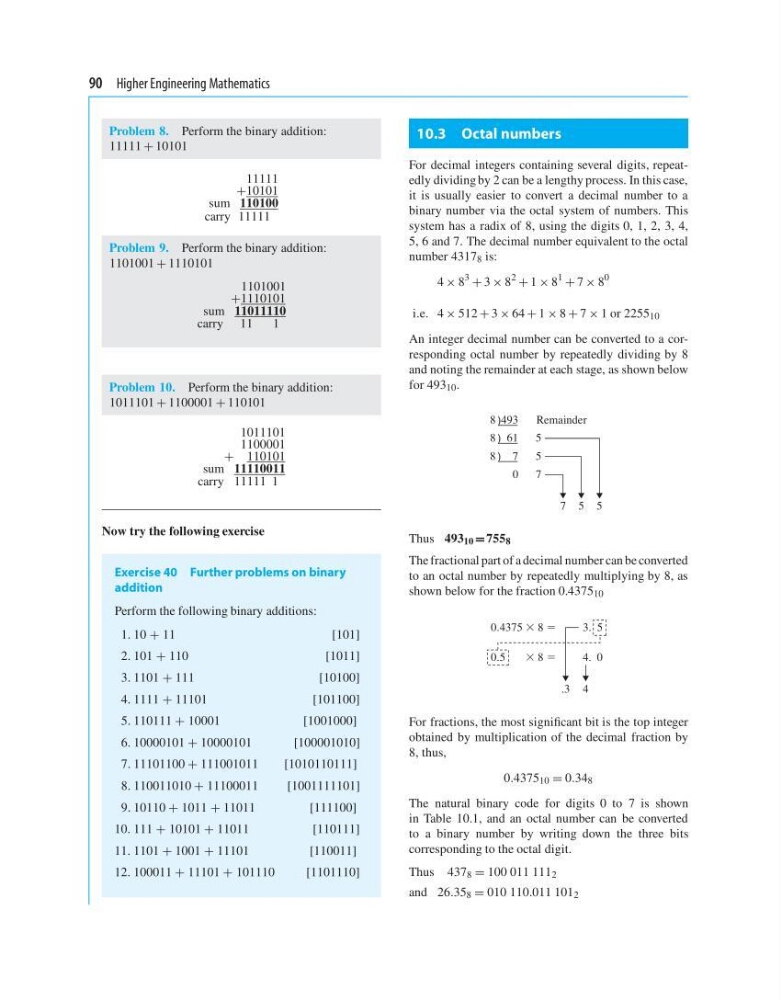
An integer decimal number can be converted to a corresponding octal number by repeatedly dividing by 8
and noting the remainder at each stage, as shown below
for 493 10 .
Remainder
7 5 5
8 493
8 61
8 7
5
5
7
0
Thus 493 10 = 755 8
The fractional part of a decimal number can be converted
to an octal number by repeatedly multiplying by 8, as
shown below for the fraction 0.4375 10
4
.3
3. 5
4. 0
0.4375 3 8 5
0.5
3 8 5
For fractions, the most significant bit is the top integer
obtained by multiplication of the decimal fraction by
8, thus,
0.4375 10 = 0.34 8
The natural binary code for digits 0 to 7 is shown
in Table 10.1, and an octal number can be converted
to a binary number by writing down the three bits
corresponding to the octal digit.
Thus 437 8 = 100 011 111 2
and 26.35 8 = 010 110.011 101 2
Problem 8. Perform the binary addition:
11111 + 10101
11111
+10101
sum 110100
carry 11111
Problem 9. Perform the binary addition:
1101001 + 1110101
1101001
+1110101
sum 11011110
carry 11
1
Problem 10. Perform the binary addition:
1011101 + 1100001 + 110101
1011101
1100001
+ 110101
sum 11110011
carry 11111 1
Now try the following exercise
Exercise 40 Further problems on binary
addition
Perform the following binary additions:
1. 10 + 11
[101]
2. 101 + 110
[1011]
3. 1101 + 111
[10100]
4. 1111 + 11101
[101100]
5. 110111 + 10001
[1001000]
6. 10000101 + 10000101
[100001010]
7. 11101100 + 111001011
[1010110111]
8. 110011010 + 11100011
[1001111101]
9. 10110 + 1011 + 11011
[111100]
10. 111 + 10101 + 11011
[110111]
11. 1101 + 1001 + 11101
[110011]
12. 100011 + 11101 + 101110
[1101110]
10.3 Octal numbers
For decimal integers containing several digits, repeatedly dividing by 2 can be a lengthy process. In this case,
it is usually easier to convert a decimal number to a
binary number via the octal system of numbers. This
system has a radix of 8, using the digits 0, 1, 2, 3, 4,
5, 6 and 7. The decimal number equivalent to the octal
number 4317 8 is:
4 × 8
3
+ 3 × 8
2
+ 1 × 8
1
+ 7 × 8
0
i.e. 4 × 512 + 3 × 64 + 1 × 8 + 7 × 1 or 2255 10
An integer decimal number can be converted to a corresponding octal number by repeatedly dividing by 8
and noting the remainder at each stage, as shown below
for 493 10 .
Remainder
7 5 5
8 493
8 61
8 7
5
5
7
0
Thus 493 10 = 755 8
The fractional part of a decimal number can be converted
to an octal number by repeatedly multiplying by 8, as
shown below for the fraction 0.4375 10
4
.3
3. 5
4. 0
0.4375 3 8 5
0.5
3 8 5
For fractions, the most significant bit is the top integer
obtained by multiplication of the decimal fraction by
8, thus,
0.4375 10 = 0.34 8
The natural binary code for digits 0 to 7 is shown
in Table 10.1, and an octal number can be converted
to a binary number by writing down the three bits
corresponding to the octal digit.
Thus 437 8 = 100 011 111 2
and 26.35 8 = 010 110.011 101 2