

Greek ecos (“house”) and logos (“the science of”). The “historical” part of historical
ecology is simply the passage of time in a linear sense on a human scale. Historical
ecology involves the study of human intervention in the landscape, and thus differs
from other ecological approaches that have nonhuman driving forces, tipping points,
and inorganic agents. Human-mediated disturbance (Myers and Bazely 2003) is
where the study begins, and it leads to landscape transformation. This is different
from the successional scheme of vegetation cover that derives from classical ecology
(e.g., Clements 1916).
Primary landscape transformation is human-mediated disturbance resulting in a
complete or nearly complete turnover of species (Balée 2006, 2013, 2018). Secondary landscape transformation is a much more nuanced change in the environment,
one that is also human-mediated, but in this case, turnover is partial.
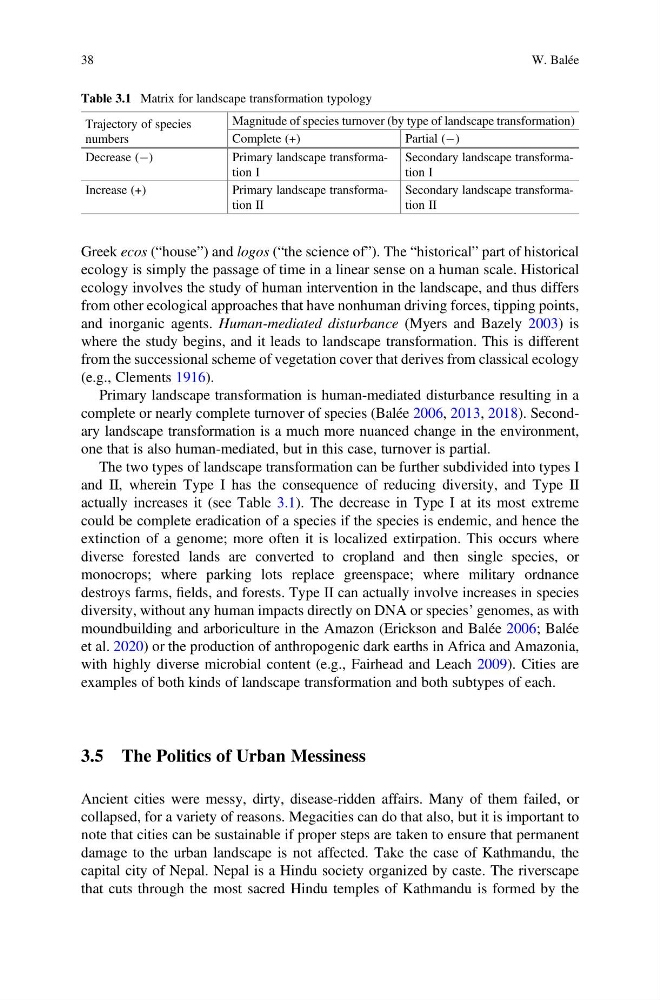
The two types of landscape transformation can be further subdivided into types I
and II, wherein Type I has the consequence of reducing diversity, and Type II
actually increases it (see Table 3.1). The decrease in Type I at its most extreme
could be complete eradication of a species if the species is endemic, and hence the
extinction of a genome; more often it is localized extirpation. This occurs where
diverse forested lands are converted to cropland and then single species, or
monocrops; where parking lots replace greenspace; where military ordnance
destroys farms, fields, and forests. Type II can actually involve increases in species
diversity, without any human impacts directly on DNA or species’ genomes, as with
moundbuilding and arboriculture in the Amazon (Erickson and Balée 2006; Balée
et al. 2020) or the production of anthropogenic dark earths in Africa and Amazonia,
with highly diverse microbial content (e.g., Fairhead and Leach 2009). Cities are
examples of both kinds of landscape transformation and both subtypes of each.
3.5 The Politics of Urban Messiness
Ancient cities were messy, dirty, disease-ridden affairs. Many of them failed, or
collapsed, for a variety of reasons. Megacities can do that also, but it is important to
note that cities can be sustainable if proper steps are taken to ensure that permanent
damage to the urban landscape is not affected. Take the case of Kathmandu, the
capital city of Nepal. Nepal is a Hindu society organized by caste. The riverscape
that cuts through the most sacred Hindu temples of Kathmandu is formed by the
Table 3.1 Matrix for landscape transformation typology
Trajectory of species
numbers
Magnitude of species turnover (by type of landscape transformation)
Complete (+)
Partial (À)
Decrease (À)
Primary landscape transformation I
Secondary landscape transformation I
Increase (+)
Primary landscape transformation II
Secondary landscape transformation II
38
W. Balée
ecology is simply the passage of time in a linear sense on a human scale. Historical
ecology involves the study of human intervention in the landscape, and thus differs
from other ecological approaches that have nonhuman driving forces, tipping points,
and inorganic agents. Human-mediated disturbance (Myers and Bazely 2003) is
where the study begins, and it leads to landscape transformation. This is different
from the successional scheme of vegetation cover that derives from classical ecology
(e.g., Clements 1916).
Primary landscape transformation is human-mediated disturbance resulting in a
complete or nearly complete turnover of species (Balée 2006, 2013, 2018). Secondary landscape transformation is a much more nuanced change in the environment,
one that is also human-mediated, but in this case, turnover is partial.
The two types of landscape transformation can be further subdivided into types I
and II, wherein Type I has the consequence of reducing diversity, and Type II
actually increases it (see Table 3.1). The decrease in Type I at its most extreme
could be complete eradication of a species if the species is endemic, and hence the
extinction of a genome; more often it is localized extirpation. This occurs where
diverse forested lands are converted to cropland and then single species, or
monocrops; where parking lots replace greenspace; where military ordnance
destroys farms, fields, and forests. Type II can actually involve increases in species
diversity, without any human impacts directly on DNA or species’ genomes, as with
moundbuilding and arboriculture in the Amazon (Erickson and Balée 2006; Balée
et al. 2020) or the production of anthropogenic dark earths in Africa and Amazonia,
with highly diverse microbial content (e.g., Fairhead and Leach 2009). Cities are
examples of both kinds of landscape transformation and both subtypes of each.
3.5 The Politics of Urban Messiness
Ancient cities were messy, dirty, disease-ridden affairs. Many of them failed, or
collapsed, for a variety of reasons. Megacities can do that also, but it is important to
note that cities can be sustainable if proper steps are taken to ensure that permanent
damage to the urban landscape is not affected. Take the case of Kathmandu, the
capital city of Nepal. Nepal is a Hindu society organized by caste. The riverscape
that cuts through the most sacred Hindu temples of Kathmandu is formed by the
Table 3.1 Matrix for landscape transformation typology
Trajectory of species
numbers
Magnitude of species turnover (by type of landscape transformation)
Complete (+)
Partial (À)
Decrease (À)
Primary landscape transformation I
Secondary landscape transformation I
Increase (+)
Primary landscape transformation II
Secondary landscape transformation II
38
W. Balée