

Other civic sacred spaces occurred more intimately as residents engaged in the
creation of community-managed special places that were self-organizing and democratically formed and that developed independent of memorial initiatives sanctioned by local government. Memory and meaning are dynamic social dimensions
and are a part of life in addition to historical artifact. An interpretive labor goes into
making sacred places and helps to determine the symbolic order and design of a
sacred space. Interpretive acts (such as ceremonies, pilgrimages, and ritual acts of
consecration) create webs of meaning that continually redefine and intertwine the
sacred and the profane within community.
Expressions of meaning making can vary quite a bit. Participatory planning and
design enable important public discussions about the intent and function of sacred
space. Some spaces are created explicitly for staging events with the intention of
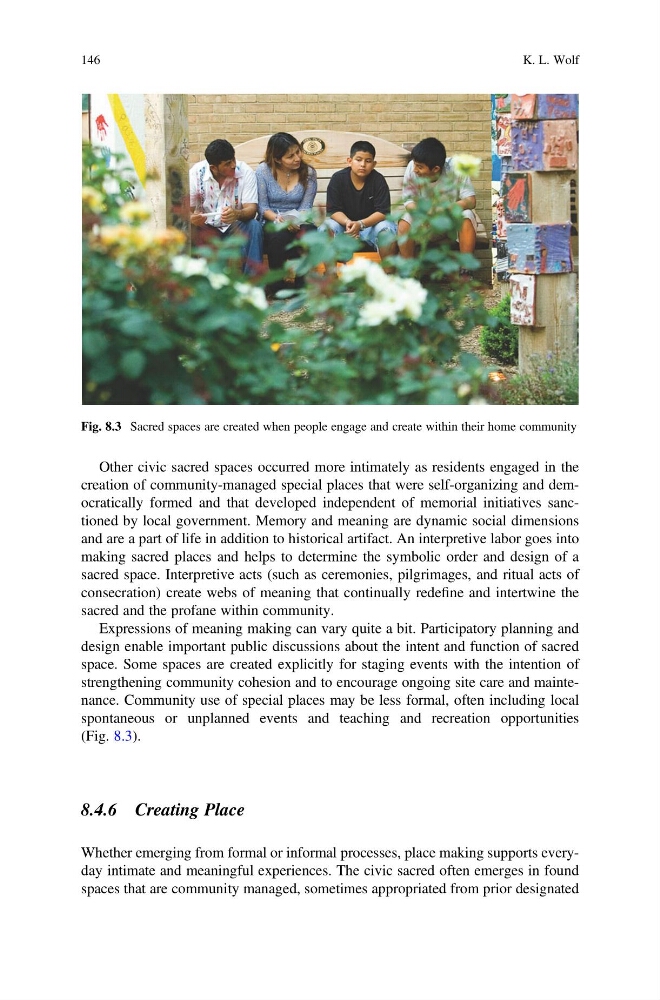
strengthening community cohesion and to encourage ongoing site care and maintenance. Community use of special places may be less formal, often including local
spontaneous or unplanned events and teaching and recreation opportunities
(Fig. 8.3).
8.4.6 Creating Place
Whether emerging from formal or informal processes, place making supports everyday intimate and meaningful experiences. The civic sacred often emerges in found
spaces that are community managed, sometimes appropriated from prior designated
Fig. 8.3 Sacred spaces are created when people engage and create within their home community
146
K. L. Wolf
creation of community-managed special places that were self-organizing and democratically formed and that developed independent of memorial initiatives sanctioned by local government. Memory and meaning are dynamic social dimensions
and are a part of life in addition to historical artifact. An interpretive labor goes into
making sacred places and helps to determine the symbolic order and design of a
sacred space. Interpretive acts (such as ceremonies, pilgrimages, and ritual acts of
consecration) create webs of meaning that continually redefine and intertwine the
sacred and the profane within community.
Expressions of meaning making can vary quite a bit. Participatory planning and
design enable important public discussions about the intent and function of sacred
space. Some spaces are created explicitly for staging events with the intention of
strengthening community cohesion and to encourage ongoing site care and maintenance. Community use of special places may be less formal, often including local
spontaneous or unplanned events and teaching and recreation opportunities
(Fig. 8.3).
8.4.6 Creating Place
Whether emerging from formal or informal processes, place making supports everyday intimate and meaningful experiences. The civic sacred often emerges in found
spaces that are community managed, sometimes appropriated from prior designated
Fig. 8.3 Sacred spaces are created when people engage and create within their home community
146
K. L. Wolf