

8.4 The Sacred City
The next opportunity in the evolving relationship of nature and society is recognition
of the sacred city. While the word “sacred” may evoke spiritual or even religious
implications, it is used here to capture a more expansive set of human experiences,
which may or may not be anchored in faith-based traditions.
The sacred city is one in which encounters with metro nature provide meaning,
restorative experiences, and healing of mind, body, and spirit. As human populations
become more urban and resource stressed, practical expressions of the sacred in
everyday life are increasingly necessary. The sacred city is a place where once takenfor-granted nature may perform ecological or infrastructure functions and also
become a pervasive backdrop that supports human vitality and quality of life. In
addition, residents may engage with nearby nature as a health promotion and disease
prevention strategy and, in recognition of such benefits, commit to stewardship
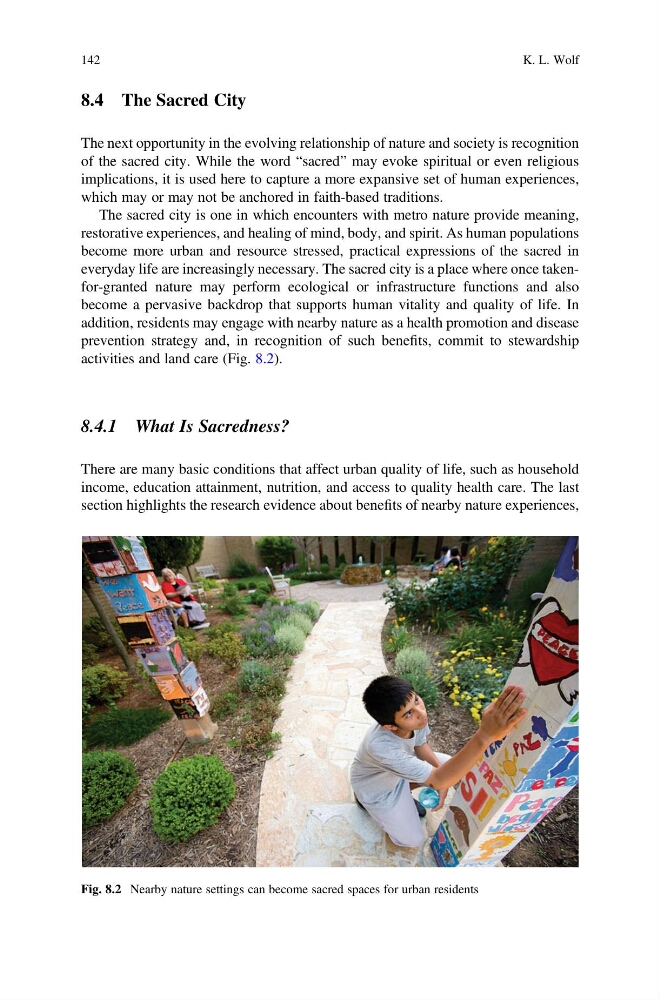
activities and land care (Fig. 8.2).
8.4.1 What Is Sacredness?
There are many basic conditions that affect urban quality of life, such as household
income, education attainment, nutrition, and access to quality health care. The last
section highlights the research evidence about benefits of nearby nature experiences,
Fig. 8.2 Nearby nature settings can become sacred spaces for urban residents
142
K. L. Wolf
The next opportunity in the evolving relationship of nature and society is recognition
of the sacred city. While the word “sacred” may evoke spiritual or even religious
implications, it is used here to capture a more expansive set of human experiences,
which may or may not be anchored in faith-based traditions.
The sacred city is one in which encounters with metro nature provide meaning,
restorative experiences, and healing of mind, body, and spirit. As human populations
become more urban and resource stressed, practical expressions of the sacred in
everyday life are increasingly necessary. The sacred city is a place where once takenfor-granted nature may perform ecological or infrastructure functions and also
become a pervasive backdrop that supports human vitality and quality of life. In
addition, residents may engage with nearby nature as a health promotion and disease
prevention strategy and, in recognition of such benefits, commit to stewardship
activities and land care (Fig. 8.2).
8.4.1 What Is Sacredness?
There are many basic conditions that affect urban quality of life, such as household
income, education attainment, nutrition, and access to quality health care. The last
section highlights the research evidence about benefits of nearby nature experiences,
Fig. 8.2 Nearby nature settings can become sacred spaces for urban residents
142
K. L. Wolf